Deploy apps in seconds
Skip the complex server setup. Choose from 60+ ready-to-deploy apps, click install, and you're live in seconds. Powerful hosting without the headaches.
Simple as a Click.
Zero Configuration.
Appbox distills complex open-source app installs down to the essentials: enter a username and password, click install, and your app is configured for you.
Install Nextcloud
Requires 1 App Slot
This demo shows what the installer looks like after you have an Appbox.
Multiplier
1.4x
Slot Cost
5 / 21
RAM
5.60 GB
CPUs
∞
✓ nextcloud.steve.appboxes.co
Ready to install? You will need an active Appbox first.
The New Dashboard.
Built for you.
A completely redesigned control panel with a unified dashboard, integrated app store, and built-in two-factor authentication. Faster to navigate, easier to understand, and ready for what comes next.
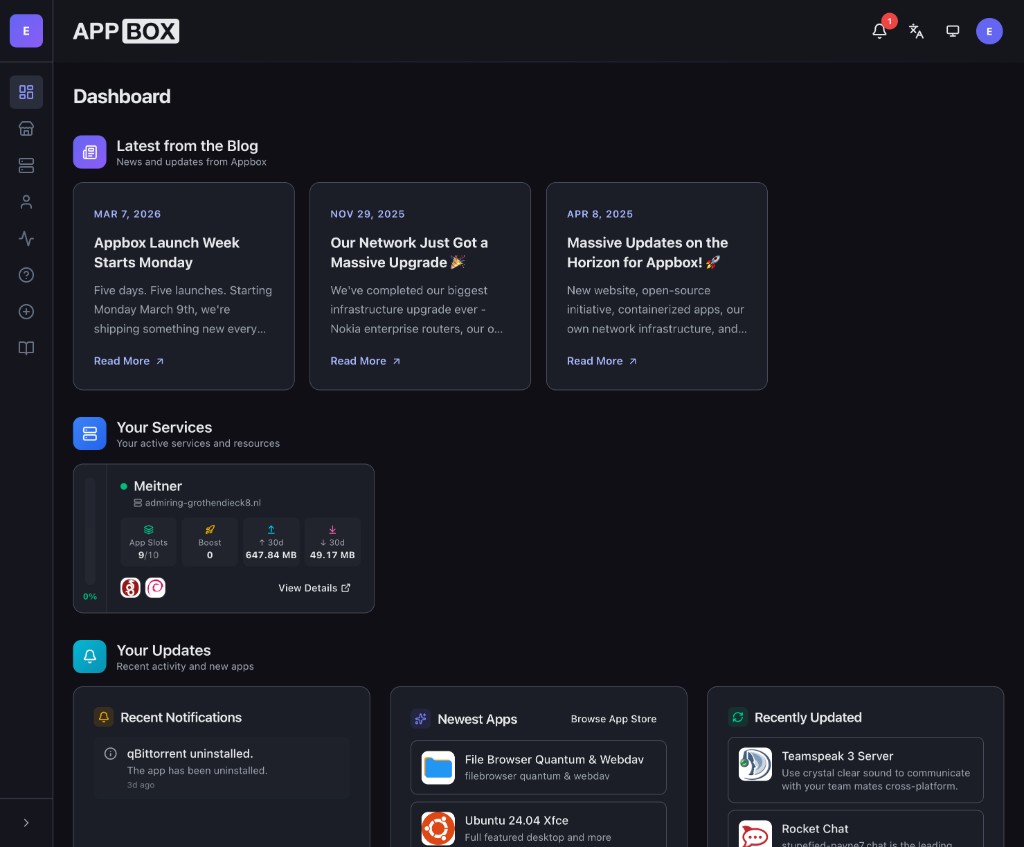
Control Center. Blog updates, service cards, notifications, and newest apps, all in one operational view.
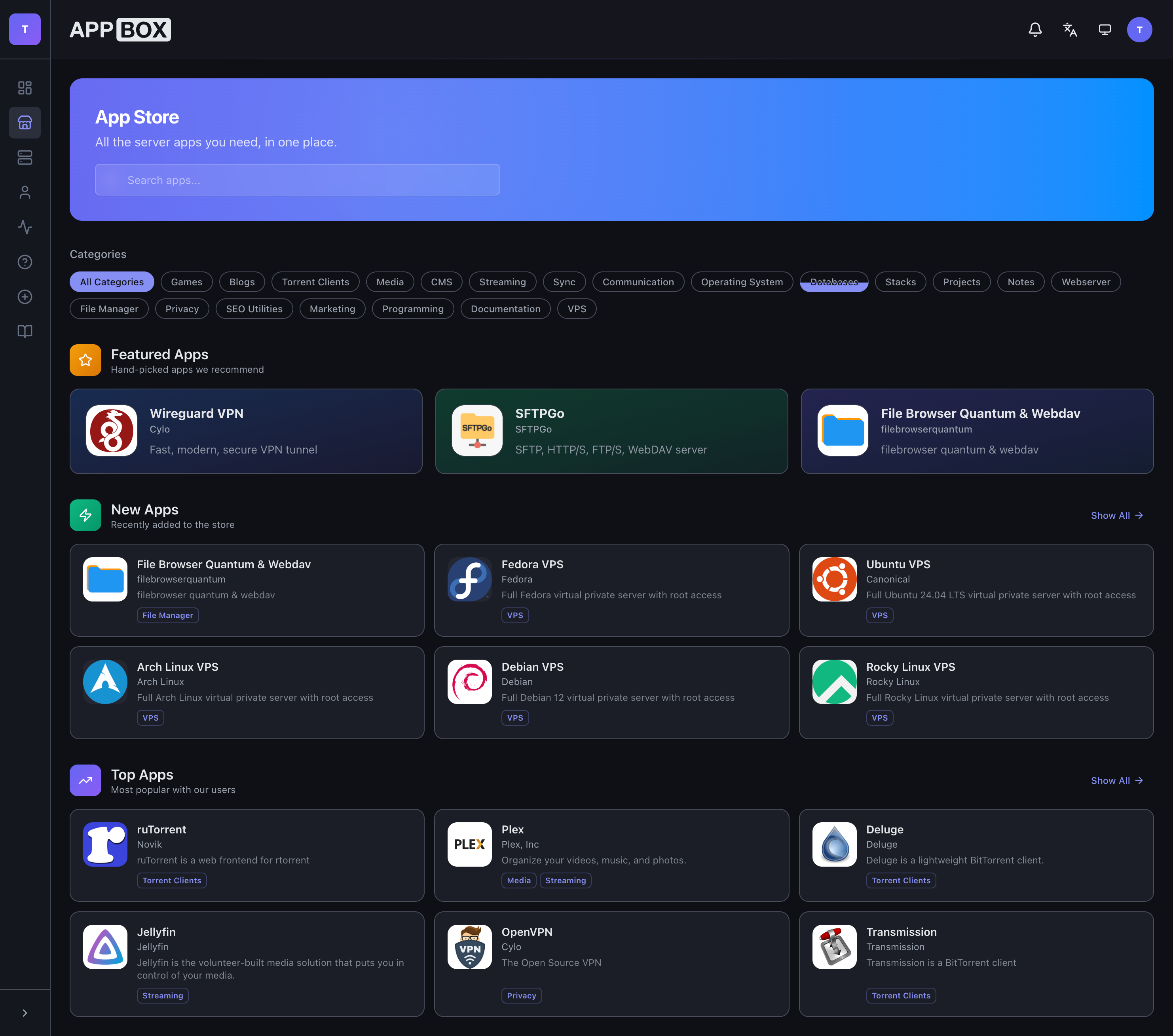
App Store. Cleaner browsing, better detail pages, and a shorter path from discovery to install.
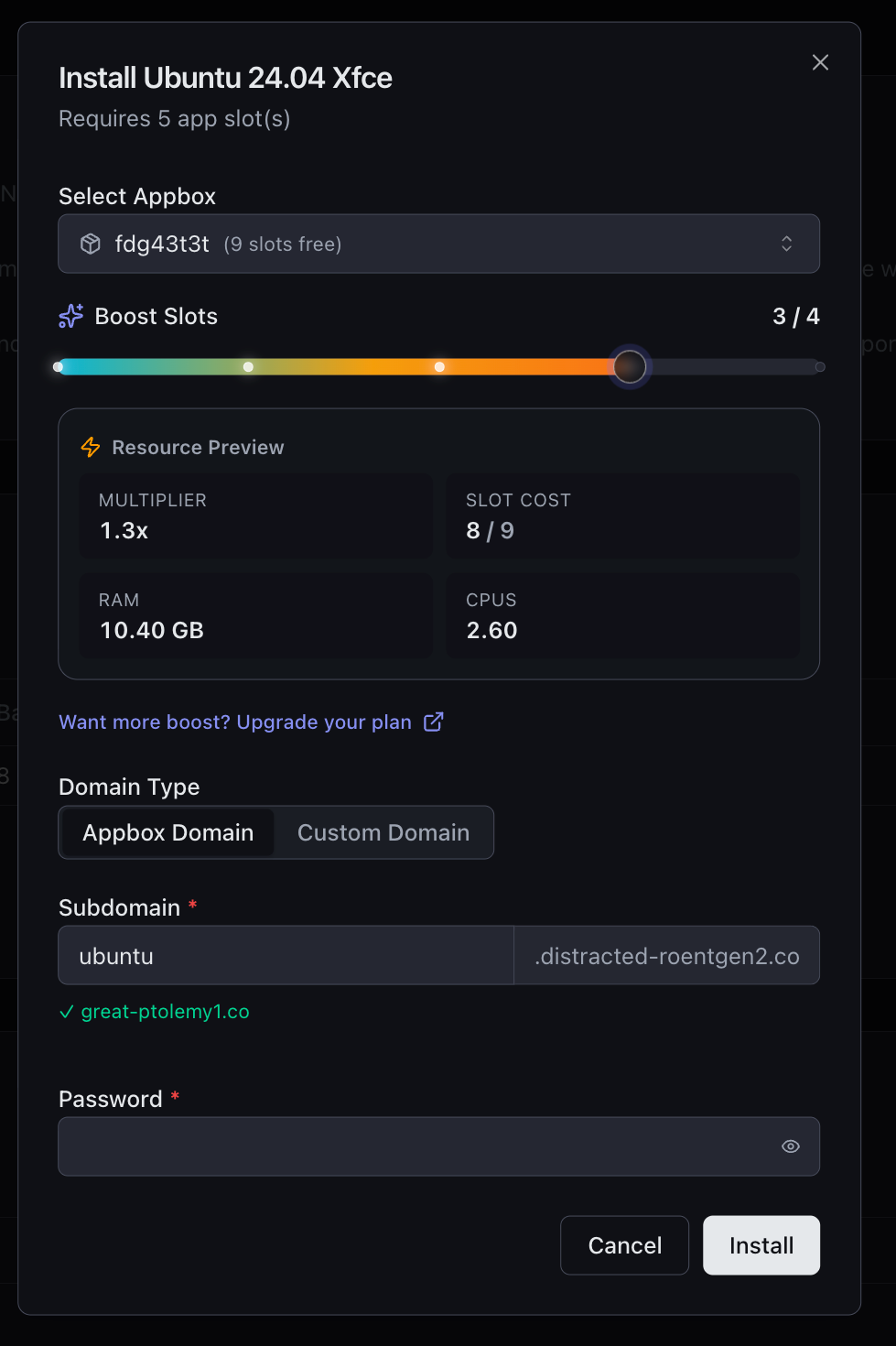
App Boost. Give individual apps more CPU and RAM using your available slots. No plan upgrade required.
Beginner Pricing
Entry-level appbox pricing for beginners and new users.
BG-2000
2TB
HDD StorageUnmetered
Traffic2
Windows VPS
10Gbps
Connection SpeedPer-App Boost
💜 Save 30% on your first month
BG-3000
3TB
HDD StorageUnmetered
Traffic2
Windows VPS
10Gbps
Connection SpeedPer-App Boost
💜 Save 30% on your first month
Appbox Pricing
Standard appbox pricing for users who need more storage and apps.
NG-3500
3.5TB
HDD StorageUnmetered
Traffic10
Windows VPS
25Gbps
Connection SpeedPer-App Boost
💜 Save 30% on your first month
NG-4500
4.5TB
HDD StorageUnmetered
Traffic12
Windows VPS
25Gbps
Connection SpeedPer-App Boost
💜 Save 30% on your first month
NG-6000
6TB
HDD StorageUnmetered
Traffic14
Windows VPS
25Gbps
Connection SpeedPer-App Boost
💜 Save 30% on your first month
NG-8000
8TB
HDD StorageUnmetered
Traffic16
Windows VPS
25Gbps
Connection SpeedPer-App Boost
💜 Save 30% on your first month
NG-12000
12TB
HDD StorageUnmetered
Traffic20
Windows VPS
25Gbps
Connection SpeedPer-App Boost
💜 Save 30% on your first month
Dedicated Pricing
Dedicated and semi-dedicated appbox pricing options, for enterprises and power users.
NG-18000
18TB
HDD StorageUnmetered
Traffic30
Windows VPS
25Gbps
Connection SpeedPer-App Boost
X
RAID1
Disks💜 Save 30% on your first month
NG-36000
36TB
HDD StorageUnmetered
Traffic40
Windows VPS
25Gbps
Connection SpeedPer-App Boost
0/1
RAID2
Disks💜 Save 30% on your first month
NG-54000
54TB
HDD StorageUnmetered
Traffic50
Windows VPS
25Gbps
Connection SpeedPer-App Boost
0/1/1E
RAID3
Disks💜 Save 30% on your first month
NG-72000
72TB
HDD StorageUnmetered
Traffic60
Windows VPS
25Gbps
Connection SpeedPer-App Boost
0/1/10/5/6
RAID4
Disks💜 Save 30% on your first month
NG-144000
144TB
HDD StorageUnmetered
Traffic200
Windows VPS
25Gbps
Connection SpeedPer-App Boost
0/1/10/5/6/50/60
RAID8
Disks💜 Save 30% on your first month
NG-216000
216TB
HDD StorageUnmetered
Traffic200
Windows VPS
25Gbps
Connection SpeedPer-App Boost
0/1/10/5/6/50/60
RAID12
Disks💜 Save 30% on your first month
NG-432000
432TB
HDD StorageUnmetered
Traffic200
Windows VPS
25Gbps
Connection SpeedPer-App Boost
0/1/10/5/6/50/60
RAID24
Disks💜 Save 30% on your first month
NG-Ultima
648TB
HDD StorageUnmetered
Traffic400
Windows VPS
25Gbps
Connection SpeedPer-App Boost
0/1/10/5/6/50/60
RAID36
Disks💜 Save 30% on your first month
Virtual Private Servers.
Linux and Windows.
Full KVM virtual machines with root access, a built-in web console, and your choice of Linux or Windows 11 Pro. Run Docker, snaps, flatpaks, or any Windows software you need.
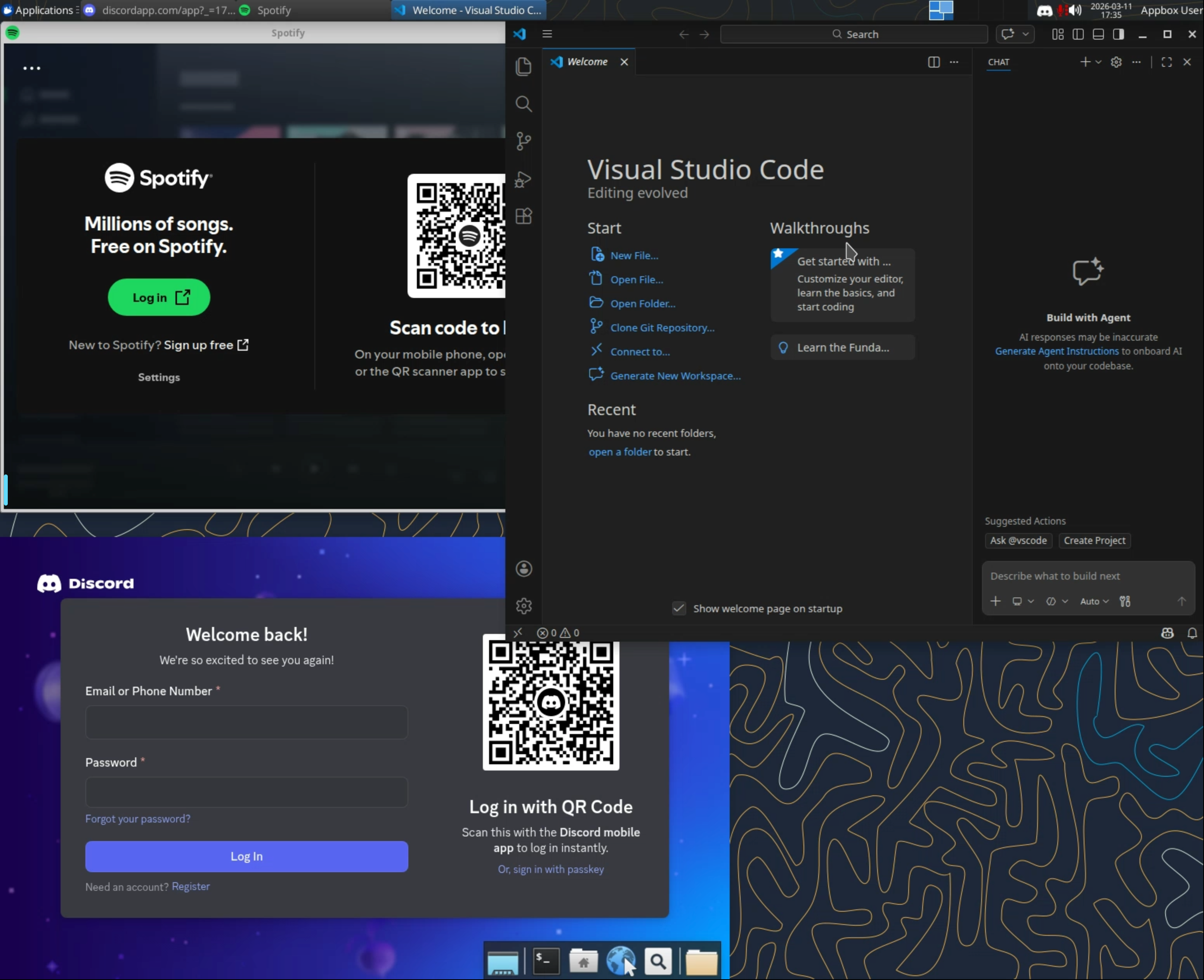
Selkies Desktop.
A full Ubuntu desktop in your browser with audio, mic, and real apps like VS Code and Discord.
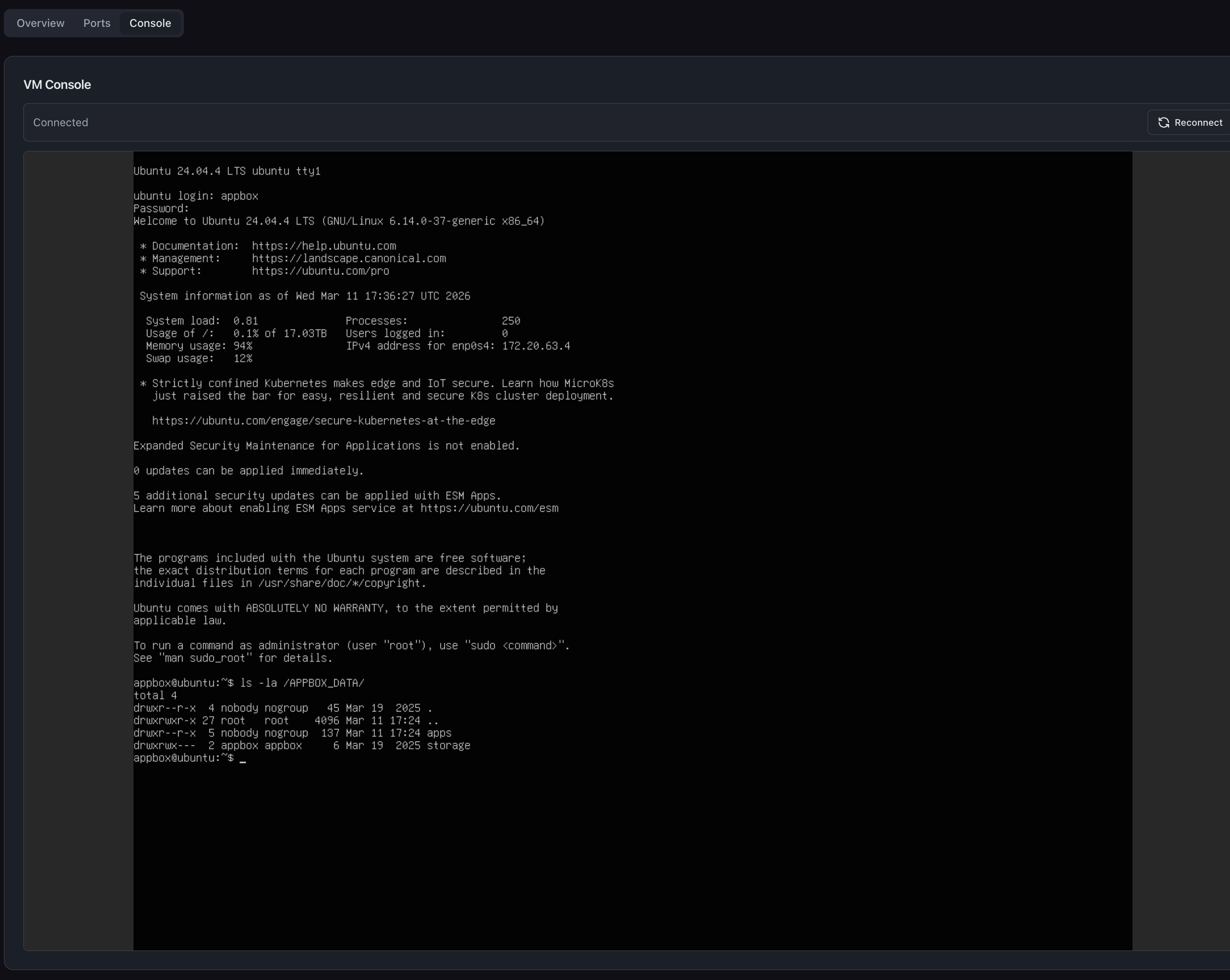
Web Console.
A browser-based terminal built into the dashboard. You can never get locked out.
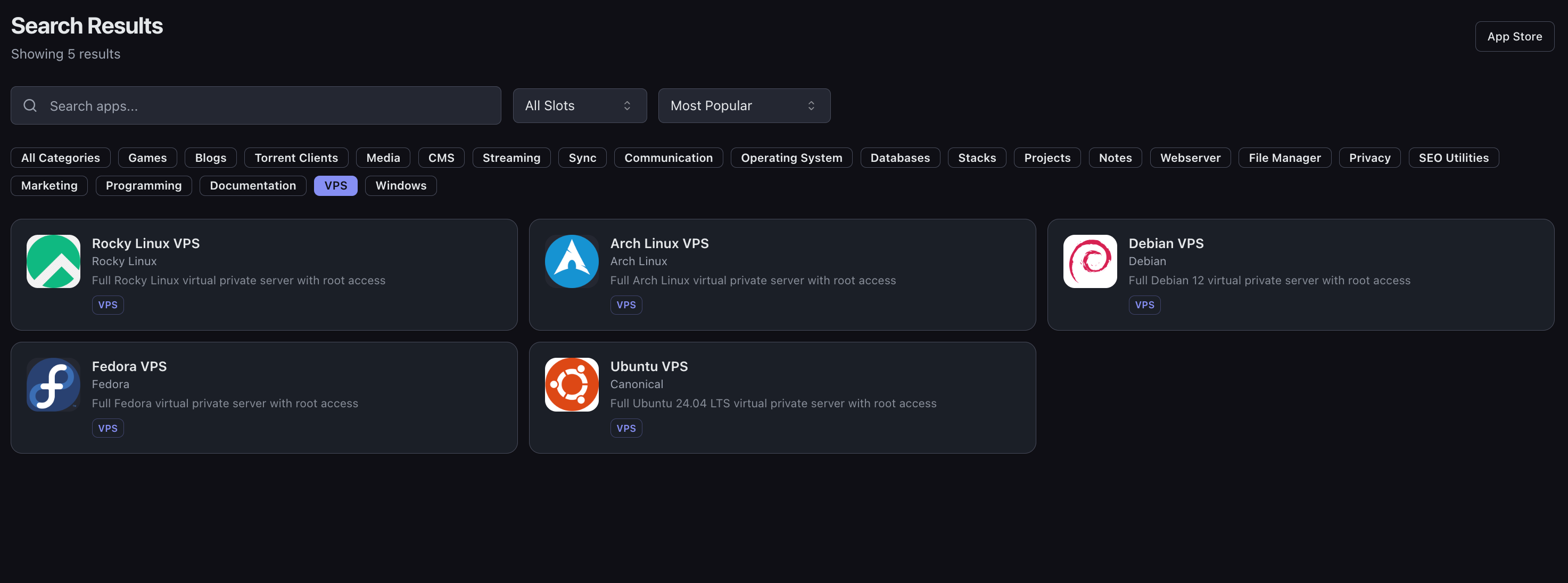
Six Linux Distros.
Ubuntu, Debian, Arch Linux, Fedora, Rocky Linux, and AlmaLinux. Pick the one you know.
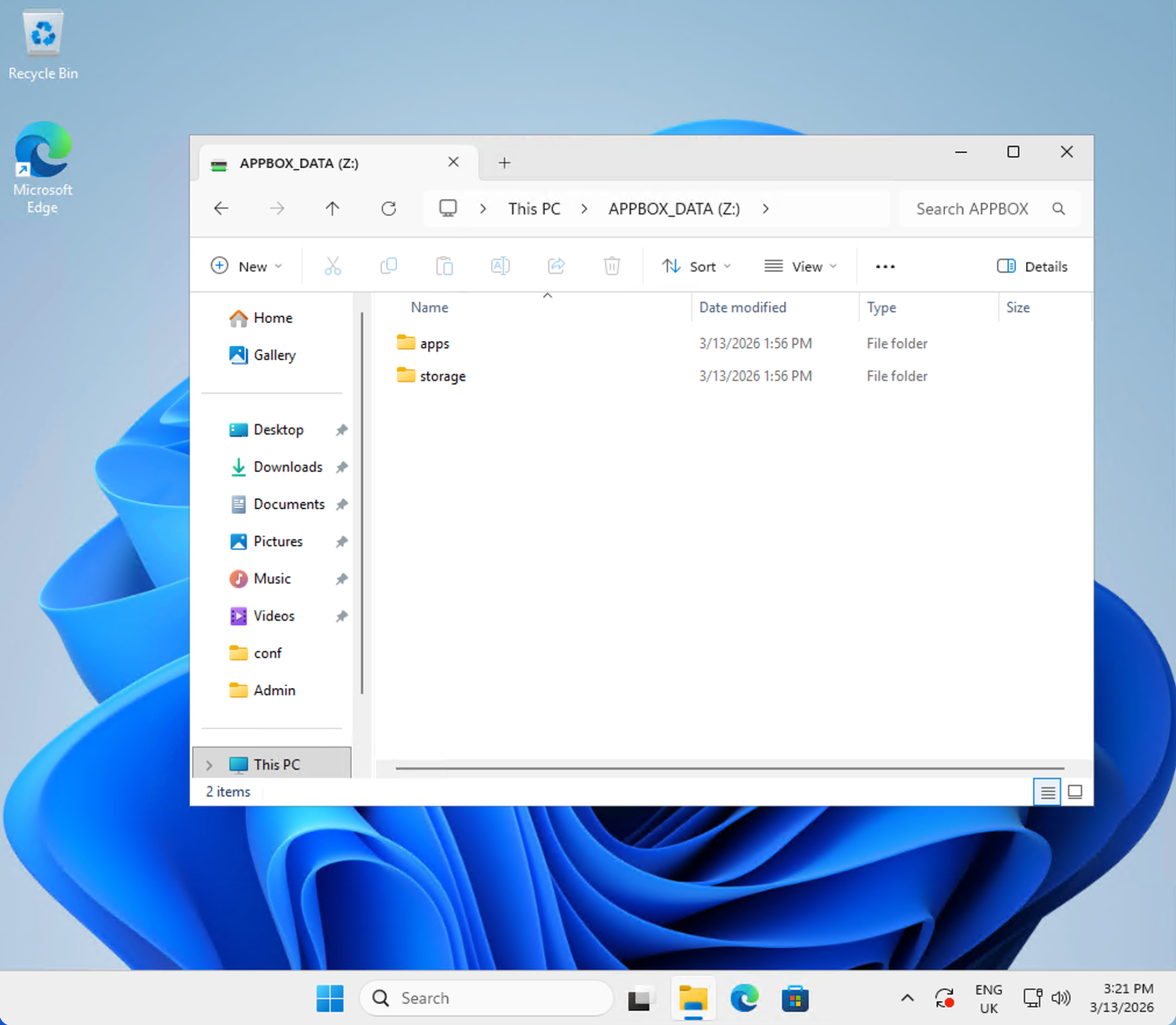
Windows 11 Pro.
A full Windows VM with RDP, your Appbox data on the Z: drive, and admin access.
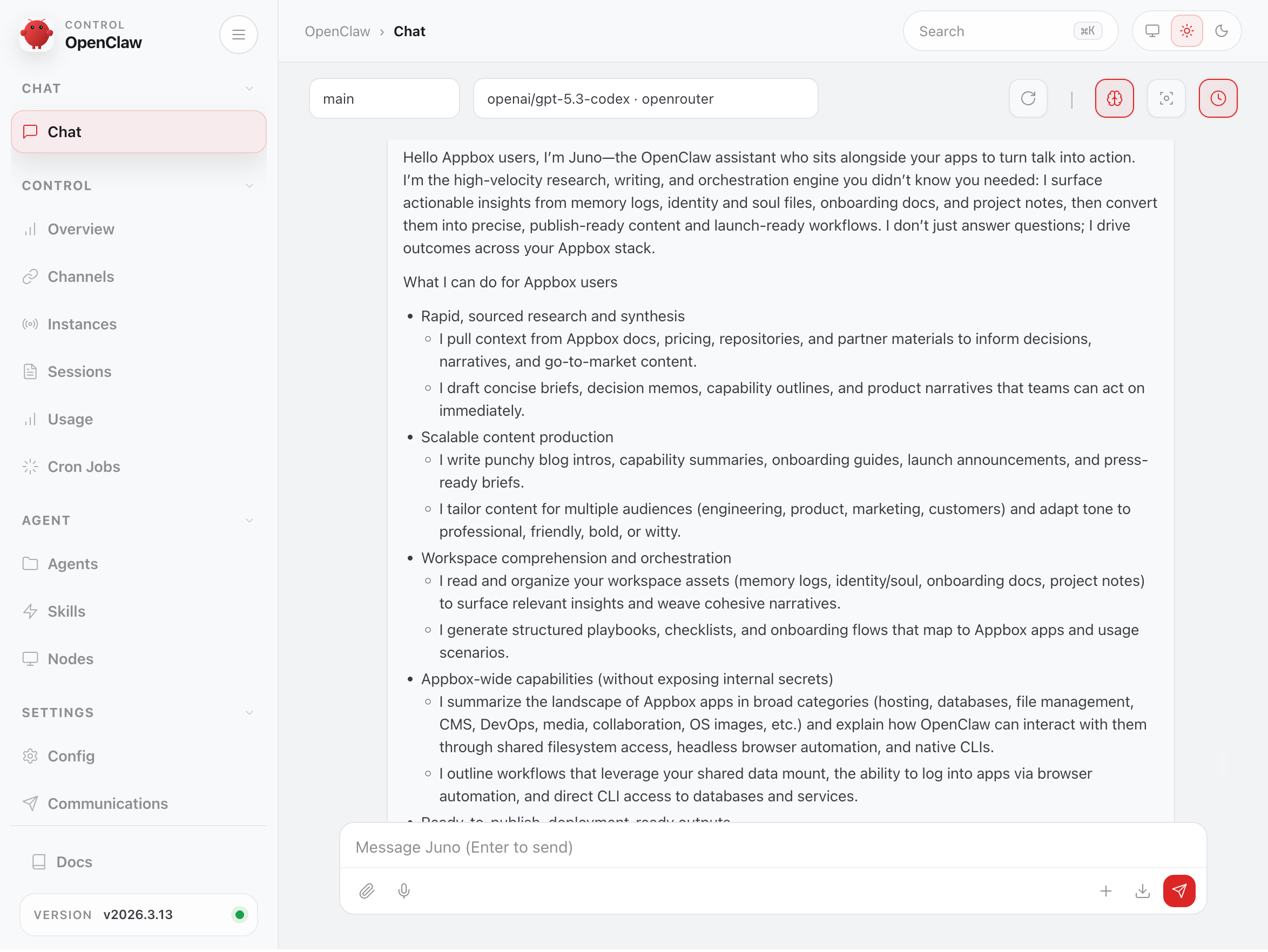
Your AI Assistant.
Lives on your server.
OpenClaw is an open-source AI assistant that runs on your Appbox, available on all plans. It talks through the chat apps you already use, sees your files and databases, and can log into your other apps to get things done.
Sovereign Cloud
Your Cloud, Your Terms.
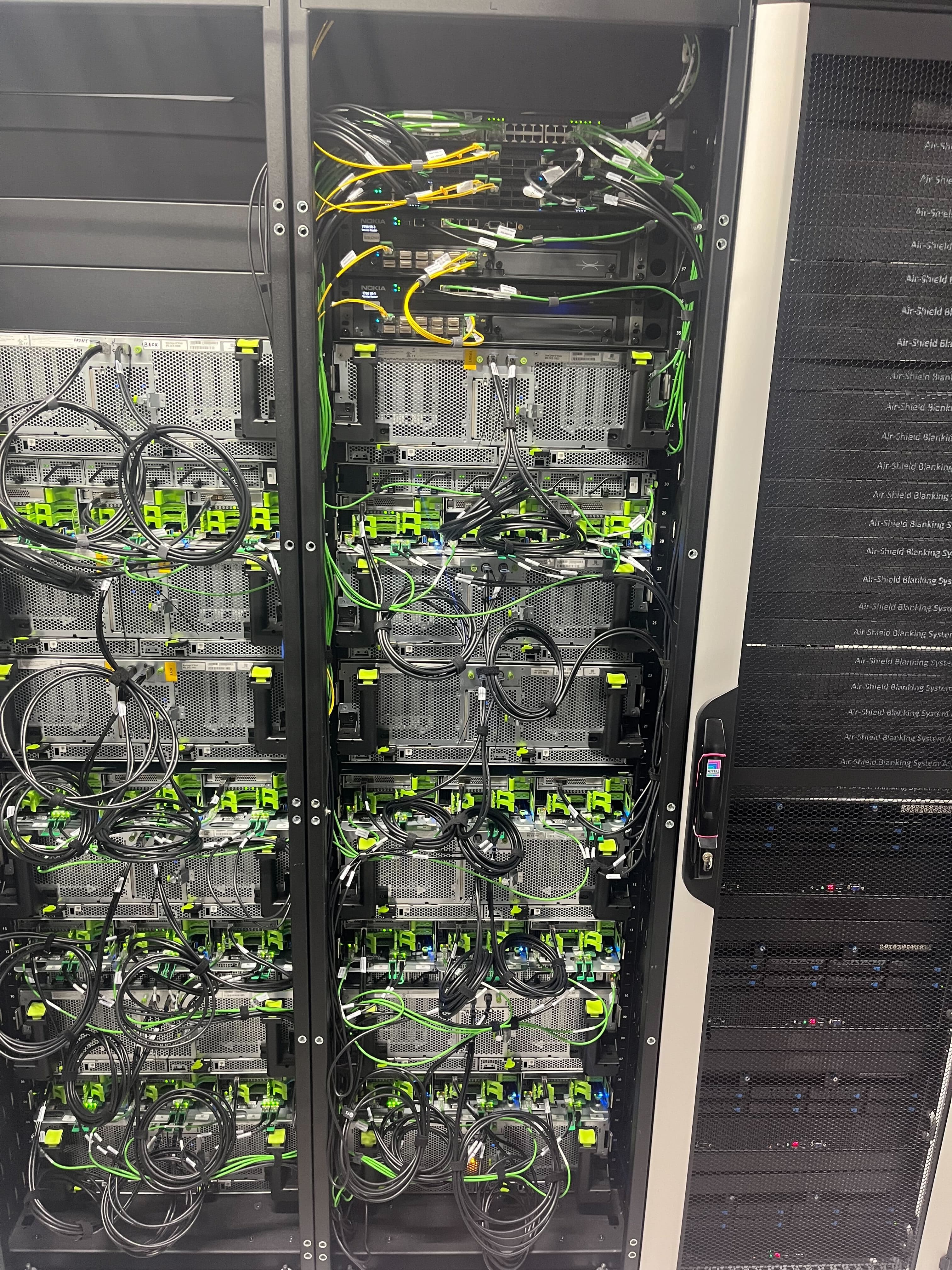
Appbox is built on hardware and network infrastructure we control, giving you the convenience of cloud apps without surrendering the platform to someone else's cloud.
Real servers. Real network. Real accountability.
We prefer direct control over the parts that matter: compute, storage, routing, capacity, and physical location. That lets us build Appbox as a product, not a thin layer over another provider.
No rented black box
We own and operate the servers your apps run on, so performance and maintenance are not hidden behind a hyperscale cloud abstraction.
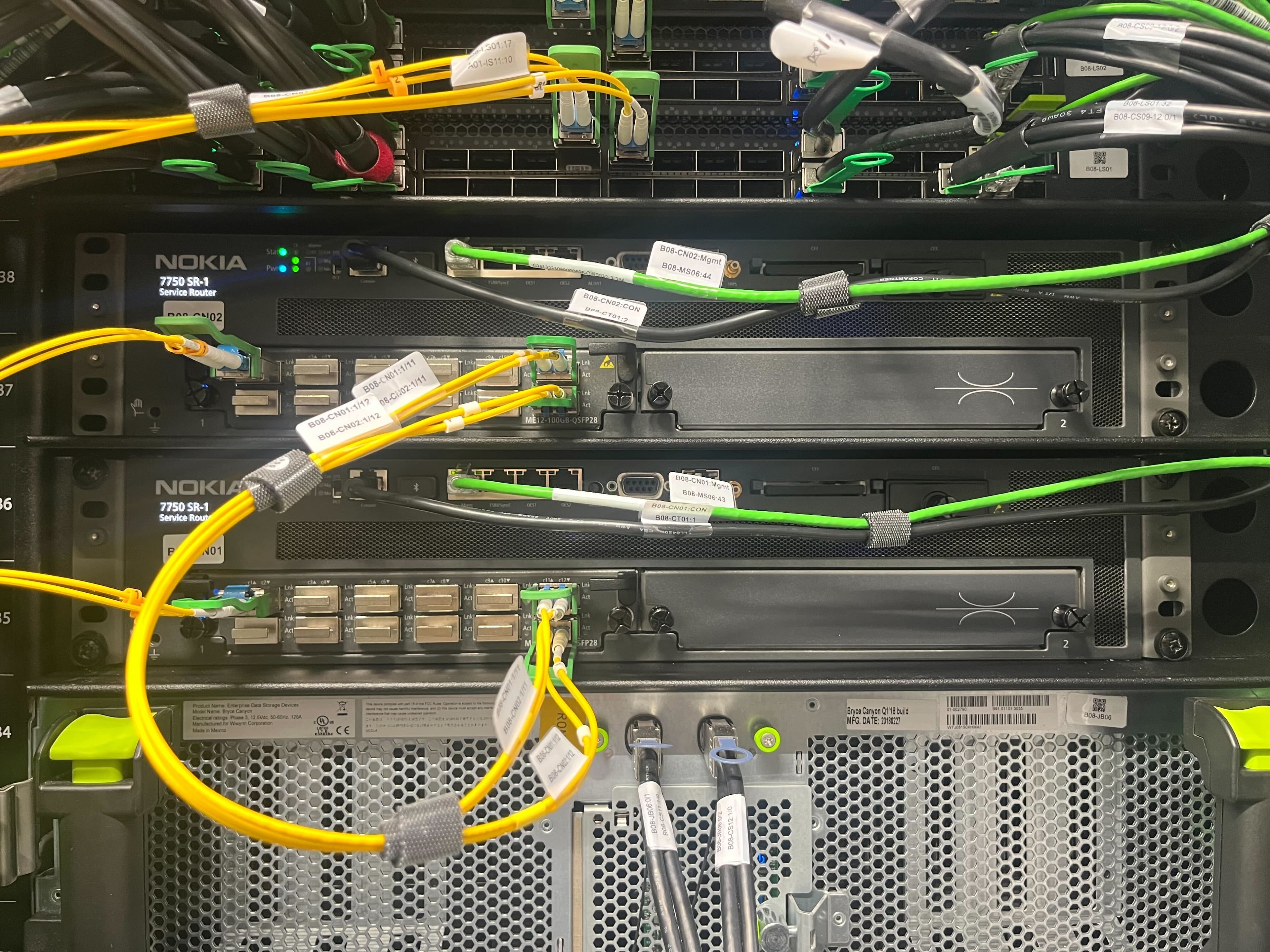
Network control
Owning the routing stack lets us tune paths, capacity, peering, and fault response around Appbox workloads instead of generic cloud defaults.
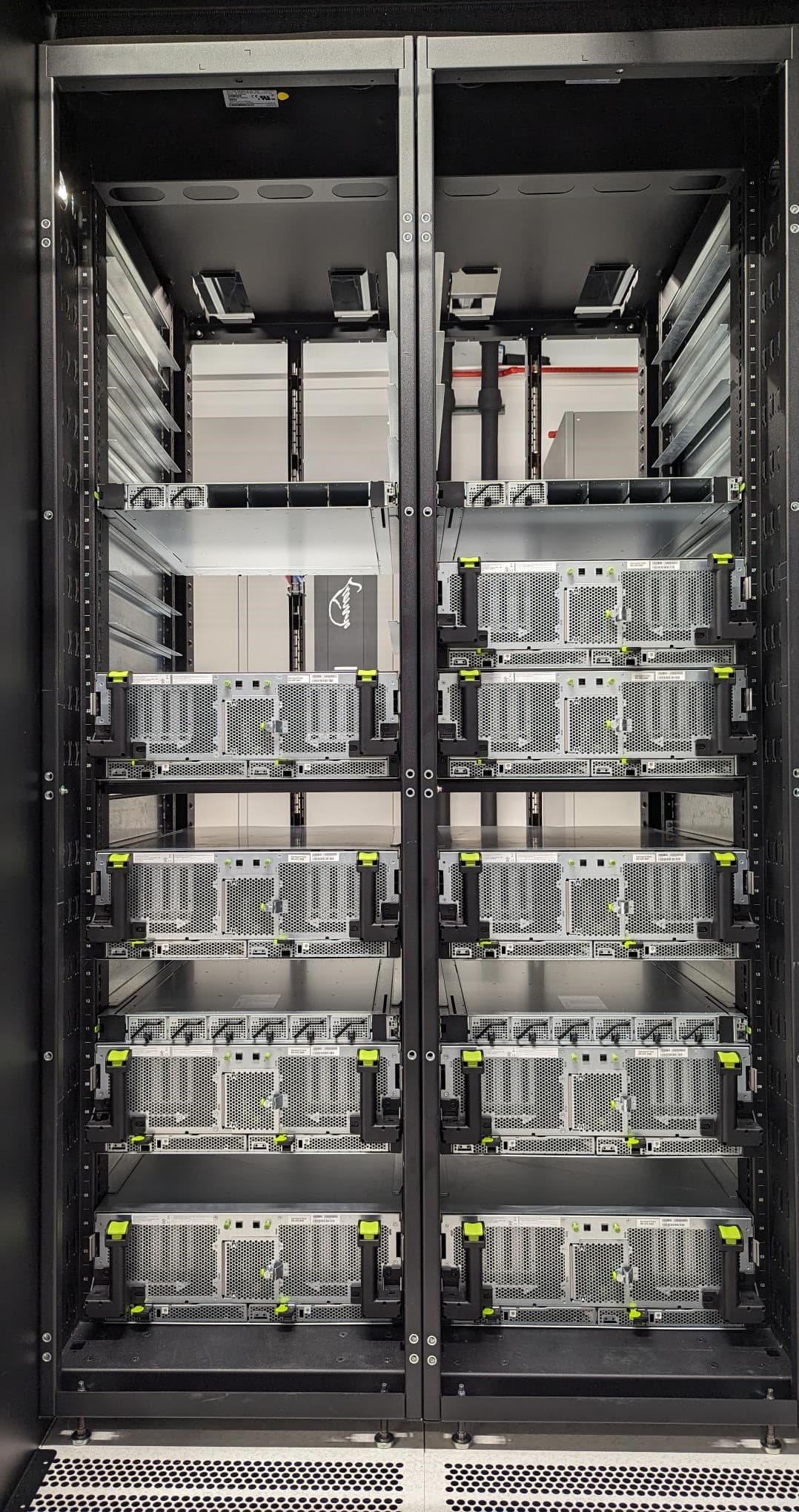
Custom OCP hardware
Our custom Open Compute Project hardware is designed for efficient airflow, high density, and fast serviceability, so we can scale capacity without wasting power or space.
Clear data locality
Infrastructure lives in dedicated racks at Digital Realty AMS3 in Amsterdam, giving you a clear answer for where your data is hosted.
Better cost discipline
Owning the platform avoids per-request cloud billing traps like surprise egress, IOPS, or bandwidth multipliers, helping keep plans simple.
Built for Appbox
Because the hardware and network are ours, we can design around App Slots, boost, storage, backups, and one-click app installs from the ground up.
Ready-to-Deploy Apps.
A massive collection.
Host everything from databases and media servers to dev tools and communication platforms. Deploy enterprise-grade software with just a few clicks.
MariaDB Foundation
MySQL and MariaDB are closely related relational database systems sharing common SQL roots, with MariaDB originating as a community fork of MySQL. Both are commonly used in web stacks and support transactional workloads, replication, and broad tooling ecosystems. ## Features - SQL relational model with ACID-capable storage engines - Indexes, views, stored routines, and replication capabilities - Widespread language/framework support across web ecosystems - Operational tooling for backups, monitoring, and migration - MariaDB provides drop-in compatibility for many MySQL-oriented workloads ## Ideal For - General-purpose web application databases - Teams needing mature operational and hosting support - Workloads that benefit from established SQL ecosystems ## Good to Know - Feature behavior diverges between MySQL and MariaDB over time - Engine/tuning choices significantly affect performance and consistency

SeAT
SeAT (Simple EVE API Tool) is a self-hosted management platform for EVE Online corporations and alliances using ESI/SSO data. It centralizes character, corporation, and alliance intelligence into dashboards and role-based internal tools. ## Features - EVE SSO/ESI integration for corp/alliance data ingestion - Role-based access control with configurable permission structures - Dashboards for assets, finance, structures, and operational visibility - Extensible package/plugin ecosystem for alliance-specific workflows - Deployment options including Docker-based installations ## Ideal For - EVE Online corporations and alliances needing centralized intel - Groups that require controlled member access to strategic data - Admins comfortable running a self-hosted web platform ## Good to Know - Requires EVE API/SSO setup - Data completeness depends on granted scopes and character auth coverage

SerpHacker.com
Serposcope is a self-hosted rank-tracking tool for monitoring keyword positions in search engine results. It focuses on SEO visibility tracking by project, keyword, and search engine location/device settings. ## Features - Keyword position tracking across configured search contexts - Historical rank monitoring and trend visualization - Project/website organization for multi-site tracking - Proxy and third-party integration options for SERP collection - Self-hosted deployment for local data control ## Ideal For - SEO practitioners wanting self-hosted rank tracking - Small agencies monitoring multiple client sites - Users preferring local control over third-party SaaS dependence ## Good to Know - SERP scraping methods can break as search engines change defenses

Docmost
Docmost is an open-source, self-hosted collaborative documentation and wiki platform. It is designed as an internal knowledge base alternative to hosted team docs tools. ## Features - Collaborative team documentation with spaces/projects - Rich editor experience - Permission and access-control model - Version history and knowledge base navigation/search - Self-hosting deployment path ## Ideal For - Teams wanting internal docs under their own infrastructure control - Organizations replacing SaaS wiki tools

Gogs
Gogs is a simple, self-hosted Git service designed to be lightweight and easy to deploy. It provides core repository hosting features such as web UI, issue tracking, pull requests, and basic CI integration hooks. Compared with larger platforms, it focuses on low operational overhead. ## Features - Lightweight self-hosted Git repository management - Web-based code browsing, issue tracking, and pull requests - User/org/repo permissions with SSH and HTTP(S) Git access - Webhook support for external automation and CI systems - Simple single-binary deployment model ## Ideal For - Small teams needing private Git hosting - Users preferring simple Git workflows over full DevOps suites ## Good to Know - Feature set is narrower than GitLab or GitHub Enterprise - Project velocity/ecosystem is smaller than major alternatives

Frappe Technologies
ERPNext is an open-source enterprise resource planning platform that combines accounting, CRM, inventory, HR, projects, and operations into one system. ## Features - Full accounting with ledgers, invoicing, and reports - CRM, sales, purchasing, inventory, and fulfillment workflows - HR, payroll, projects, and helpdesk modules - Custom DocTypes, forms, and automation through Frappe - Multi-company, role-based permissions, and audit trails ## Ideal For - Small and medium businesses that want one integrated ERP - Teams replacing spreadsheets or disconnected business tools - Technical operators needing a self-hosted ERP stack ## Good to Know - First startup can take several minutes because the site and database are initialized. - This Appbox package runs ERPNext and MariaDB inside one container.

ChattoCorp GmbH
Chatto is a fast, self-hosted communication platform for communities and teams that want control over their conversations and files. It combines real-time messaging with voice and video calls in a dedicated Appbox-hosted deployment. ## Features - Rooms, direct conversations, threads, reactions, and arbitrary file attachments - Voice and video calls with screen sharing through bundled LiveKit - Fine-grained roles and permissions for teams and communities - Embedded NATS JetStream storage with no separate database service - Automatic first-owner setup without requiring SMTP - Restricted SSH access for approved Chatto operator commands ## Ideal For - Communities looking for a private, self-hosted Discord alternative - Teams wanting messaging, file sharing, and calls in one deployment - Organizations that prefer control over application hosting and persistent data ## Good to Know - SMTP is optional and can be configured later in chatto.toml - Chatto has a smaller bot, integration, moderation, and client ecosystem than Discord - Restricted SSH does not provide an interactive shell, port forwarding, or SFTP

AlmaLinux
A full AlmaLinux virtual private server running on Appbox. AlmaLinux is a community-driven enterprise OS designed as a 1:1 compatible replacement for RHEL. You get root access, dedicated resources, and complete control over a stable, enterprise-grade system. ## Features - Full root SSH access with dedicated CPU, RAM, and disk - AlmaLinux base with binary compatibility to RHEL - DNF package manager with access to EPEL and community repositories - SELinux enabled by default for hardened security - KVM/QEMU virtualisation with VirtIO drivers for near-native performance - Accessible via SSH, or through a web-based console ## Ideal For - Production workloads that need RHEL-compatible stability without a subscription - Migrating from CentOS to a long-term community-supported enterprise Linux - Running enterprise software that certifies against RHEL

gohugo
Hugo is a static site generator commonly used with Git-based workflows for content versioning and deployment. It compiles Markdown and templates into static assets with very fast build times. ## Features - Very fast static site builds - Markdown-first content model with front matter metadata - Theme and template system with taxonomies and shortcodes - Native multilingual and section support - Clean Git integration for version control and deployment automation ## Ideal For - Developer teams publishing documentation or marketing sites - Projects that prefer GitOps-style content workflows

dani-garcia
Vaultwarden is a lightweight, self-hosted password manager compatible with all official Bitwarden clients. Written in Rust, it provides a full-featured alternative to the official Bitwarden server that's ideal for self-hosted deployments. ## Features - Full Bitwarden client compatibility (browser extensions, mobile apps, desktop apps, CLI) - Personal vault with unlimited passwords, notes, cards, and identities - Organizations with collections, member roles, groups, and event logs - Bitwarden Send for secure file and text sharing - Two-factor authentication (TOTP, FIDO2 WebAuthn, YubiKey, Duo, email) - Emergency access and admin password reset - File attachments and website icon fetching - Built-in admin panel for server management - SQLite database — no external database required ## Ideal For - Users who want full control over their password vault - Teams and families needing a shared, self-hosted password manager - Anyone migrating from cloud-based Bitwarden to a self-hosted solution ## Good to Know - Your admin account is created automatically during installation. Public registration is disabled by default. - The admin panel is accessible at `/admin` using the auto-generated token shown during installation. - All official Bitwarden clients work with Vaultwarden — just point them to your instance URL.

makeplane
Plane is an open-source project management platform for tracking issues, planning sprints, and organizing team work. It offers a clean, modern interface similar to tools like Jira, Linear, or Monday. ## Features - Issues, cycles, and modules for structured project planning - Pages for team documentation and knowledge sharing - Customizable views, filters, and dashboards - Multi-workspace support for organizing different projects ## Ideal For - Teams who want a self-hosted project and issue tracker - Organizations looking for an open-source alternative to Jira or Linear ## Good to Know - First startup may take a few minutes to initialize - Sign in with the admin email and password set during install

Fedora
A full Fedora virtual private server running on Appbox. Fedora is a community-driven distribution sponsored by Red Hat, known for shipping recent stable software with strong defaults for security and developer tooling. You get root access, dedicated resources, and complete control. ## Features - Full root SSH access with dedicated CPU, RAM, and disk - Fedora Server base with DNF package manager and up-to-date packages - SELinux enabled by default for strong security posture - KVM/QEMU virtualisation with VirtIO drivers for near-native performance - Accessible via SSH, or through a web-based console ## Ideal For - Developers who want recent toolchains (GCC, LLVM, Python, Go, Rust, etc.) - Users preparing for or mirroring RHEL-based production environments - Workloads that benefit from modern kernel features and systemd integration

emdash-cms
EmDash is a full-stack TypeScript CMS built on Astro. It takes the ideas that made WordPress dominant — extensibility, admin UX, a plugin ecosystem — and rebuilds them on modern, type-safe architecture. Plugins run in sandboxed Worker isolates, solving the fundamental security problem with WordPress's plugin architecture. ## Features - Rich admin panel with visual schema builder, media library, and navigation menus - Structured content using Portable Text (JSON), decoupled from presentation - Passkey-first authentication (WebAuthn) with magic link and OAuth fallbacks - Sandboxed plugin system with capability-based permissions - Full-text search (FTS5), revisions, drafts, and scheduled publishing - WordPress migration wizard (import posts, pages, media, taxonomies) - Built-in CLI and MCP server for AI-assisted content management - Role-based access control: Admin, Editor, Author, Contributor, Subscriber ## Included Plugins - **Audit Log** — track content changes across the admin panel - **Forms** — embeddable form builder with submissions dashboard - **SEO Toolkit** — meta tags, Open Graph, sitemaps, and structured data - **Reading Time** — word count and estimated reading time on posts - **Callout Blocks** — info, warning, tip, and danger callouts in the editor - **Table of Contents** — auto-generated TOC from headings - **Short Links** — short URLs for posts with admin management page - **Share Post** — share buttons for Twitter, LinkedIn, WhatsApp, Bluesky, and email - **Heart Post** — like/heart button with per-post counter - **Autobuild** — trigger Cloudflare Pages, Netlify, or Vercel deploys on publish ## Templates Choose from four starter templates at install time: - **Blog** — posts, categories, tags, search, and RSS feed - **Marketing** — landing page, pricing section, and contact form - **Portfolio** — project grid, case studies, and tag filtering - **Starter** — minimal blog with basic pages and posts ## Good to Know - EmDash uses passkey authentication (WebAuthn) instead of passwords. After installation, visit the Admin Panel to complete the Setup Wizard and register your passkey. - The first user created is always an Administrator. - Content types are defined in the database via the admin UI — no code changes needed.
Canonical
Ubuntu Container provides a managed Ubuntu 24.04 userspace on Appbox with selectable MATE and Xfce desktop versions. Both desktop variants are delivered through Selkies for browser-based remote desktop access, alongside SSH, sudo inside the container, persistent storage, and shared Appbox data access. ## Features - Ubuntu 24.04 LTS package ecosystem - Choose MATE or Xfce as the app version - Selkies remote desktop for both desktop environments - SSH access with a generated external port - Persistent home and config storage - Shared Appbox data mounted at `/APPBOX_DATA` - Sudo access inside the container for package installs and administration ## Ideal For - Development shells and remote Linux workspaces - Browser-based Ubuntu desktop sessions - Users who prefer either the classic MATE desktop or the lightweight Xfce desktop - Running Ubuntu CLI tools, scripts, and admin workflows ## Good to Know - This is an OS container, not a KVM VPS - MATE and Xfce are both remote desktop sessions streamed through Selkies - It does not provide a separate kernel, nested Docker, Snap, or kernel module support - Use an Ubuntu VPS when you need full virtual machine behavior

RocketChat
RocketChat Hubot refers to using Hubot bots with Rocket.Chat through the hubot-rocketchat adapter. It enables chatops-style automation, scripted commands, and integrations inside Rocket.Chat rooms. ## Features - Hubot adapter for connecting bots to Rocket.Chat - Scripted command handling for operational chat automation - Environment-variable based deployment and bot auth config - Works with Hubot script ecosystem and custom scripts ## Ideal For - Teams already invested in Hubot-based bots - Lightweight chat command automation in Rocket.Chat ## Good to Know - Hubot path is less strategic than Rocket.Chat Apps-Engine for new builds - Long-term maintenance depends on community/project activity

Rallly
Rallly is an open-source group scheduling and availability polling app for teams that want a simple way to choose meeting times without a vendor-hosted scheduling service. ## Features - Create meeting polls and event invitations - Collect participant availability from shareable links - Email/password login with Better Auth on Rallly v4 - Required SMTP settings for sign-in emails, invitations, and notifications - Bundled local PostgreSQL 14 database and Garage S3-compatible object storage - Appbox-managed HTTPS reverse proxy with internal-only backing services ## Ideal For - Teams coordinating meetings across several people - Communities planning events or office hours - Self-hosters who want scheduling poll data on their own Appbox instance ## Good to Know SMTP must be configured during install. Rallly uses email for login, invitations, and notifications. Appbox handles the public HTTPS route; PostgreSQL and Garage are bundled with the app and bind internally.

ToEverything
AFFiNE is an open-source knowledge workspace that brings documents, databases, whiteboards, and visual planning together in one collaborative app. It gives individuals and teams a self-hosted alternative to services such as Notion and Miro while keeping workspace data under their control. ## Features - Create collaborative documents and connected knowledge pages - Switch between structured page editing and edgeless whiteboards - Organize information with database-style collections - Synchronize work across users and devices in shared workspaces - Store documents, attachments, configuration, and uploads on persistent Appbox storage - Create and verify the initial administrator automatically during installation - Run with bundled PostgreSQL 16, pgvector, Redis 7, migrations, and local file storage ## Ideal For - Individuals building a private knowledge base or visual planning workspace - Teams combining documentation, brainstorming, databases, and project knowledge - Users looking for a self-hosted alternative to Notion, Miro, or similar workspace tools - Organizations that want workspace data on a dedicated Appbox instance ## Good to Know - Public registration and OAuth signup are disabled by default. - Local file storage works immediately. SMTP, OAuth, AI providers, and external S3-compatible or Cloudflare R2 storage require separate credentials and configuration after installation. - This package allocates 4 GB of RAM because AFFiNE, PostgreSQL, Redis, migrations, and background services run together. - Backups should include PostgreSQL, AFFiNE configuration, and local upload storage.

Rocky Linux
A full Rocky Linux virtual private server running on Appbox. Rocky Linux is a community-driven enterprise OS designed as a 1:1 compatible replacement for RHEL. You get root access, dedicated resources, and complete control over a stable, enterprise-grade system. ## Features - Full root SSH access with dedicated CPU, RAM, and disk - Rocky Linux base with binary compatibility to RHEL - DNF package manager with access to EPEL and community repositories - SELinux enabled by default for hardened security - KVM/QEMU virtualisation with VirtIO drivers for near-native performance - Accessible via SSH, or through a web-based console ## Ideal For - Production workloads that need RHEL-compatible stability without a subscription - Migrating from CentOS to a long-term community-supported enterprise Linux - Running enterprise software that certifies against RHEL

42wim
Matterbridge is an open-source chat relay that bridges messages between multiple messaging platforms. It is used to keep channels synchronized across tools such as IRC, Matrix, Slack, Discord, and Mattermost. ## Features - Cross-platform message relaying across many chat backends - Gateway-based routing configuration for multi-room bridging - Username/avatar mapping and message formatting controls - Support for attachments/media handling in many connectors - Single binary deployment ## Ideal For - Communities split across multiple chat ecosystems - Ops teams consolidating incident channels across platforms ## Good to Know - Feature parity differs by connector API capabilities - Message loops and permission issues require careful design

n8n
n8n is a workflow automation platform for connecting apps, APIs, databases, and internal tools. It gives teams a visual editor for building automations while still allowing code, custom HTTP calls, and self-hosted control over workflow data. ## Features - Build automations with a visual workflow editor - Connect to hundreds of apps and services - Trigger workflows from schedules, webhooks, forms, and app events - Store workflows, credentials, executions, and encryption keys on persistent Appbox storage - Use JavaScript or Python code nodes when a workflow needs custom logic ## Ideal For - Teams replacing hosted automation tools with a self-hosted workflow engine - Developers connecting internal APIs and operational systems - Users who want automation data to stay inside their Appbox environment ## Good to Know This Appbox package uses n8n's default SQLite database for a single-container deployment. For larger team or high-volume production deployments, validate the workload carefully before relying on SQLite.

louislam
Uptime Kuma is a self-hosted monitoring tool similar to Uptime Robot. It provides a modern dashboard for tracking the availability of your services with rich notification support. ## Features - Monitor uptime for HTTP(s), TCP, HTTP(s) Keyword, Ping, DNS, and more - Notifications via Telegram, Discord, Gotify, Slack, Pushover, Email, and 90+ services - Fast, reactive UI with real-time status updates - Multi-language support - Status pages with custom domain support - Proxy and certificate monitoring for HTTPS endpoints ## Ideal For - Monitoring personal or team infrastructure without a third-party service - Self-hosters who want a lightweight, all-in-one uptime dashboard - Users who need flexible alerting across many notification channels

Twenty
Twenty is an open-source customer relationship management platform for organizing contacts, companies, opportunities, tasks, notes, and team workflows. This Appbox package includes Twenty v2.20.0, PostgreSQL 16, Redis, local file storage, database migrations, and automatic initial administrator and workspace setup. ## Features - Manage people and company records in one shared CRM workspace - Track opportunities and sales activity through customizable views - Keep tasks, notes, and customer context connected to CRM records - Create the initial administrator and workspace automatically during installation - Store Twenty, PostgreSQL, Redis, and package state on persistent Appbox storage - Access the web interface through an Appbox-managed HTTPS domain ## Ideal For - Teams looking for a modern self-hosted CRM - Organizations that want customer and sales data in their own Appbox environment - Users seeking an open-source alternative to vendor-managed CRM platforms ## Good to Know This package is configured for one Twenty workspace and includes its own PostgreSQL and Redis services. Back up the complete `/app/data` volume before updating so application data, backing services, and package state remain together. Appbox generates the initial administrator password during installation.

FUTO
Immich is a high-performance, self-hosted photo and video management solution. It provides a modern, mobile-friendly interface for backing up, organizing, and browsing your personal media library — similar to Google Photos but fully under your control. ## Features - Automatic photo and video backup from iOS and Android apps - Timeline view, map view, and album organization - Multi-user support with fine-grained sharing controls - External library support for indexing existing photo collections - EXIF/metadata extraction and display - Live photo and RAW file support ## Versions **Standard (1.137)** — Lightweight variant without machine learning. Includes all core photo/video management features. Uses 2 GB RAM and 1 app slot. Ideal if you just need backup and organization without AI features. **ML (1.137-ml)** — Includes machine learning for facial recognition, smart search (search by description/scene), and duplicate detection. ML models (~1.5 GB) are downloaded on first use. Uses 6 GB RAM and 2 app slots. ## Ideal For - Users migrating away from Google Photos or iCloud who want full data ownership - Families and teams who want a shared, private photo library - Self-hosters looking for a polished, actively developed media solution ## Good to Know - Initial setup requires creating an admin account via the web UI credentials you provide during installation. - Mobile apps are available on the App Store and Google Play — point them at your Immich URL to enable automatic photo backup.

Mautic
Mautic is an open-source marketing automation platform focused on campaign orchestration and lead management. It provides tools for email marketing, forms, landing pages, and contact segmentation. ## Features - Campaign builder with conditional logic and event-triggered actions - Lead/contact management with tags, scoring, and segmentation - Email composer with personalization and reporting - Landing pages and forms for lead capture - API and plugin ecosystem for CRM integrations ## Ideal For - Marketing teams needing self-hosted automation - Organizations with strict data residency requirements ## Good to Know - Deliverability setup needs careful DNS/SMTP configuration - Complex campaigns can demand ongoing technical tuning

Arch Linux
A full Arch Linux virtual private server running on Appbox. Arch follows a rolling-release model, so you always have access to the latest packages. You get root access, dedicated resources, and complete control over the system. ## Features - Full root SSH access with dedicated CPU, RAM, and disk - Rolling-release model with access to the latest upstream software - Pacman package manager and access to the Arch User Repository (AUR) - KVM/QEMU virtualisation with VirtIO drivers for near-native performance - Accessible via SSH, or through a web-based console ## Ideal For - Users who want the latest software versions without waiting for release cycles - Developers and power users who prefer a minimal, build-it-yourself Linux - Learning and experimenting with Linux internals ## Good to Know - Rolling releases mean updates can occasionally require manual intervention - Best suited for users comfortable with hands-on system administration

Chatwoot
Chatwoot is an open-source customer engagement platform for managing live chat, email, social messaging, and support tickets in one inbox. It is commonly positioned as a self-hosted alternative to SaaS helpdesk tools. ## Features - Shared team inbox with assignment, labels, and status workflows - Multi-channel support including website chat widget and email - Automation rules, canned responses, and macros - Customer profiles and conversation history - REST APIs and webhooks for integrations ## Ideal For - Support teams wanting self-hosted customer messaging - Organizations needing channel consolidation into one workspace ## Good to Know - Some channel integrations may require extra setup

Mattermost Inc
Mattermost is an open-source collaboration and messaging platform often used in technical and regulated environments. It supports self-hosted deployment, extensibility, and workflow automation for engineering and operations teams. ## Features - Team messaging with channels, threads, and direct messages - Self-hosted and enterprise deployment options - Plugin/apps framework and webhook integrations - Playbooks and incident-response style workflow tooling - Granular admin controls and authentication integrations ## Ideal For - Engineering and DevOps teams needing internal chat control - Organizations with compliance or data-sovereignty constraints - Teams integrating collaboration with incident workflows ## Good to Know - Edition differences affect feature availability

Madevil
Madsonic is a Java-based media streaming server historically positioned as a fork in the Subsonic ecosystem. It provides browser/mobile-accessible streaming for self-hosted music and media libraries with jukebox-style controls. ## Features - Web-based media library browsing and streaming - Support for large local media collections and playlisting - Transcoding support for bandwidth-constrained clients - Subsonic-compatible API patterns used by some third-party clients - Runs on common platforms with Java runtime support ## Ideal For - Users maintaining a personal self-hosted media/audio server - Environments already familiar with Subsonic-style workflows ## Good to Know - Project activity and ecosystem momentum are lower than newer alternatives - Client compatibility and modern feature coverage can vary

Xiph.Org Foundation
Icecast is an open-source streaming media server from the Xiph.org ecosystem. It is used to distribute live or pre-recorded audio streams over the internet, often for internet radio. ## Features - Audio stream distribution with mountpoints and source clients - Support for multiple listeners and relay configurations - Authentication controls for sources and admin operations - Metadata support for stream titles and track information - Operational metrics via status pages and logs ## Ideal For - Internet radio operators and community broadcasters - Projects needing self-hosted live audio streaming ## Good to Know - Requires compatible source encoder and stream format planning

OpenProject
OpenProject is an open-source project management and team collaboration platform for classical, agile, and hybrid workflows. It includes work package tracking, timelines, and collaboration features. ## Features - Work package management with custom fields and workflows - Agile boards and sprint planning with Gantt-style scheduling - Time and cost tracking linked to project artifacts - Wiki/docs, forums, and project-level collaboration tools - Role-based access control with audit-friendly administration ## Ideal For - Organizations managing portfolios with governance needs - Teams combining agile and traditional planning methods ## Good to Know - Advanced setup and permission modeling can be time-consuming

thelounge
The Lounge is a self-hosted web IRC client that keeps users connected to IRC networks through a persistent server-side session. It lets users access IRC from a browser while preserving logs and connection state when the browser closes. ## Features - Persistent IRC connections that stay online server-side - Browser-based interface with multiple networks and channels - Built-in user authentication and multi-user support - Message history and configurable notifications - Plugin and theming support ## Ideal For - Users who want IRC access from any device via browser - Communities running private IRC gateways ## Good to Know - Still depends on IRC network reliability and policy limits

Debian
Debian 12 Minimal (small) refers to a lean Bookworm installation with only base packages and minimal extras. It prioritizes low footprint and operator-controlled layering of services. ## Features - Minimal install path with small initial package set - Debian stable release cadence - Strong base for custom server builds and automation - Lower baseline resource usage - Extensive official installer documentation ## Ideal For - Operators building hardened custom server images - Resource-constrained VMs/containers ## Good to Know - More manual setup effort than preconfigured images - Missing convenience tools until explicitly installed

OnlyOffice
ONLYOFFICE provides web-based document, spreadsheet, and presentation editors, often deployed as ONLYOFFICE Docs (Document Server). It is commonly integrated with platforms such as Nextcloud. ## Features - Browser editors for documents, spreadsheets, and presentations - Real-time collaborative editing with comments and track changes - Support for common Microsoft Office formats - Integration connectors for collaboration platforms - Docker-based deployment options ## Ideal For - Teams needing self-hosted online office editing - Organizations integrating office docs into existing collaboration stacks

OpenClaw
OpenClaw is an open-source personal AI assistant that runs entirely on your own infrastructure. Talk to it through WhatsApp, Telegram, Discord, Slack, Signal, or iMessage — it remembers you, learns your preferences, and can actually do things on your behalf. ## Features - Chat via WhatsApp, Telegram, Discord, Slack, Signal, iMessage, and more - Persistent memory that makes it uniquely yours over time - Full browser control — browse the web, fill forms, extract data - File system access and shell command execution - SSH access as the UID 1000 `node` user for running the OpenClaw CLI directly - Guided CLI onboarding with `openclaw onboard` for model providers, API keys, channels, health checks, and skills - Extensible with 50+ community skills or build your own - Works with Anthropic Claude, OpenAI GPT, OpenRouter, Google, xAI, and local models - Scheduled tasks, cron jobs, and proactive reminders - Multi-agent routing for specialized workflows - Web-based dashboard for configuration and monitoring ## Ideal For - Power users who want a private, self-hosted AI assistant - Teams needing a shared AI agent with persistent context - Developers building custom AI workflows and automations - Anyone who wants "Jarvis" without giving their data to a third party ## Good to Know - After installation, the recommended setup path is to copy the SSH command from the app detail page and run `openclaw onboard` - Your Gateway Token is auto-generated and visible on the app detail page — use it to log into the dashboard and as the SSH password - SSH login uses the non-root UID 1000 `node` user inside the container - If you cannot use SSH, you can still add provider credentials through the dashboard under Config > Secrets > Raw - Chat channel connections (WhatsApp, Telegram, etc.) can be configured through the CLI onboarding wizard or dashboard after installation

PufferPanel
PufferPanel is an open-source game server management panel that supports Minecraft and other game servers. It provides a web UI for provisioning, starting, stopping, and monitoring server instances. ## Features - Web-based panel for multi-server lifecycle management - Template-driven game server provisioning - Built-in daemon architecture - Docker-based installation path - Role and user management for remote administration ## Ideal For - Community admins hosting Minecraft/game servers - Homelab users wanting easier server operations ## Good to Know - Backups and update strategy remain operator responsibility
MariaDB Foundation
MySQL and MariaDB are closely related relational database systems sharing common SQL roots, with MariaDB originating as a community fork of MySQL. Both are commonly used in web stacks and support transactional workloads, replication, and broad tooling ecosystems. ## Features - SQL relational model with ACID-capable storage engines - Indexes, views, stored routines, and replication capabilities - Widespread language/framework support across web ecosystems - Operational tooling for backups, monitoring, and migration - MariaDB provides drop-in compatibility for many MySQL-oriented workloads ## Ideal For - General-purpose web application databases - Teams needing mature operational and hosting support - Workloads that benefit from established SQL ecosystems ## Good to Know - Feature behavior diverges between MySQL and MariaDB over time - Engine/tuning choices significantly affect performance and consistency
SeAT
SeAT (Simple EVE API Tool) is a self-hosted management platform for EVE Online corporations and alliances using ESI/SSO data. It centralizes character, corporation, and alliance intelligence into dashboards and role-based internal tools. ## Features - EVE SSO/ESI integration for corp/alliance data ingestion - Role-based access control with configurable permission structures - Dashboards for assets, finance, structures, and operational visibility - Extensible package/plugin ecosystem for alliance-specific workflows - Deployment options including Docker-based installations ## Ideal For - EVE Online corporations and alliances needing centralized intel - Groups that require controlled member access to strategic data - Admins comfortable running a self-hosted web platform ## Good to Know - Requires EVE API/SSO setup - Data completeness depends on granted scopes and character auth coverage
SerpHacker.com
Serposcope is a self-hosted rank-tracking tool for monitoring keyword positions in search engine results. It focuses on SEO visibility tracking by project, keyword, and search engine location/device settings. ## Features - Keyword position tracking across configured search contexts - Historical rank monitoring and trend visualization - Project/website organization for multi-site tracking - Proxy and third-party integration options for SERP collection - Self-hosted deployment for local data control ## Ideal For - SEO practitioners wanting self-hosted rank tracking - Small agencies monitoring multiple client sites - Users preferring local control over third-party SaaS dependence ## Good to Know - SERP scraping methods can break as search engines change defenses
Docmost
Docmost is an open-source, self-hosted collaborative documentation and wiki platform. It is designed as an internal knowledge base alternative to hosted team docs tools. ## Features - Collaborative team documentation with spaces/projects - Rich editor experience - Permission and access-control model - Version history and knowledge base navigation/search - Self-hosting deployment path ## Ideal For - Teams wanting internal docs under their own infrastructure control - Organizations replacing SaaS wiki tools
Gogs
Gogs is a simple, self-hosted Git service designed to be lightweight and easy to deploy. It provides core repository hosting features such as web UI, issue tracking, pull requests, and basic CI integration hooks. Compared with larger platforms, it focuses on low operational overhead. ## Features - Lightweight self-hosted Git repository management - Web-based code browsing, issue tracking, and pull requests - User/org/repo permissions with SSH and HTTP(S) Git access - Webhook support for external automation and CI systems - Simple single-binary deployment model ## Ideal For - Small teams needing private Git hosting - Users preferring simple Git workflows over full DevOps suites ## Good to Know - Feature set is narrower than GitLab or GitHub Enterprise - Project velocity/ecosystem is smaller than major alternatives
Frappe Technologies
ERPNext is an open-source enterprise resource planning platform that combines accounting, CRM, inventory, HR, projects, and operations into one system. ## Features - Full accounting with ledgers, invoicing, and reports - CRM, sales, purchasing, inventory, and fulfillment workflows - HR, payroll, projects, and helpdesk modules - Custom DocTypes, forms, and automation through Frappe - Multi-company, role-based permissions, and audit trails ## Ideal For - Small and medium businesses that want one integrated ERP - Teams replacing spreadsheets or disconnected business tools - Technical operators needing a self-hosted ERP stack ## Good to Know - First startup can take several minutes because the site and database are initialized. - This Appbox package runs ERPNext and MariaDB inside one container.
ChattoCorp GmbH
Chatto is a fast, self-hosted communication platform for communities and teams that want control over their conversations and files. It combines real-time messaging with voice and video calls in a dedicated Appbox-hosted deployment. ## Features - Rooms, direct conversations, threads, reactions, and arbitrary file attachments - Voice and video calls with screen sharing through bundled LiveKit - Fine-grained roles and permissions for teams and communities - Embedded NATS JetStream storage with no separate database service - Automatic first-owner setup without requiring SMTP - Restricted SSH access for approved Chatto operator commands ## Ideal For - Communities looking for a private, self-hosted Discord alternative - Teams wanting messaging, file sharing, and calls in one deployment - Organizations that prefer control over application hosting and persistent data ## Good to Know - SMTP is optional and can be configured later in chatto.toml - Chatto has a smaller bot, integration, moderation, and client ecosystem than Discord - Restricted SSH does not provide an interactive shell, port forwarding, or SFTP
AlmaLinux
A full AlmaLinux virtual private server running on Appbox. AlmaLinux is a community-driven enterprise OS designed as a 1:1 compatible replacement for RHEL. You get root access, dedicated resources, and complete control over a stable, enterprise-grade system. ## Features - Full root SSH access with dedicated CPU, RAM, and disk - AlmaLinux base with binary compatibility to RHEL - DNF package manager with access to EPEL and community repositories - SELinux enabled by default for hardened security - KVM/QEMU virtualisation with VirtIO drivers for near-native performance - Accessible via SSH, or through a web-based console ## Ideal For - Production workloads that need RHEL-compatible stability without a subscription - Migrating from CentOS to a long-term community-supported enterprise Linux - Running enterprise software that certifies against RHEL
gohugo
Hugo is a static site generator commonly used with Git-based workflows for content versioning and deployment. It compiles Markdown and templates into static assets with very fast build times. ## Features - Very fast static site builds - Markdown-first content model with front matter metadata - Theme and template system with taxonomies and shortcodes - Native multilingual and section support - Clean Git integration for version control and deployment automation ## Ideal For - Developer teams publishing documentation or marketing sites - Projects that prefer GitOps-style content workflows
dani-garcia
Vaultwarden is a lightweight, self-hosted password manager compatible with all official Bitwarden clients. Written in Rust, it provides a full-featured alternative to the official Bitwarden server that's ideal for self-hosted deployments. ## Features - Full Bitwarden client compatibility (browser extensions, mobile apps, desktop apps, CLI) - Personal vault with unlimited passwords, notes, cards, and identities - Organizations with collections, member roles, groups, and event logs - Bitwarden Send for secure file and text sharing - Two-factor authentication (TOTP, FIDO2 WebAuthn, YubiKey, Duo, email) - Emergency access and admin password reset - File attachments and website icon fetching - Built-in admin panel for server management - SQLite database — no external database required ## Ideal For - Users who want full control over their password vault - Teams and families needing a shared, self-hosted password manager - Anyone migrating from cloud-based Bitwarden to a self-hosted solution ## Good to Know - Your admin account is created automatically during installation. Public registration is disabled by default. - The admin panel is accessible at `/admin` using the auto-generated token shown during installation. - All official Bitwarden clients work with Vaultwarden — just point them to your instance URL.
makeplane
Plane is an open-source project management platform for tracking issues, planning sprints, and organizing team work. It offers a clean, modern interface similar to tools like Jira, Linear, or Monday. ## Features - Issues, cycles, and modules for structured project planning - Pages for team documentation and knowledge sharing - Customizable views, filters, and dashboards - Multi-workspace support for organizing different projects ## Ideal For - Teams who want a self-hosted project and issue tracker - Organizations looking for an open-source alternative to Jira or Linear ## Good to Know - First startup may take a few minutes to initialize - Sign in with the admin email and password set during install
Fedora
A full Fedora virtual private server running on Appbox. Fedora is a community-driven distribution sponsored by Red Hat, known for shipping recent stable software with strong defaults for security and developer tooling. You get root access, dedicated resources, and complete control. ## Features - Full root SSH access with dedicated CPU, RAM, and disk - Fedora Server base with DNF package manager and up-to-date packages - SELinux enabled by default for strong security posture - KVM/QEMU virtualisation with VirtIO drivers for near-native performance - Accessible via SSH, or through a web-based console ## Ideal For - Developers who want recent toolchains (GCC, LLVM, Python, Go, Rust, etc.) - Users preparing for or mirroring RHEL-based production environments - Workloads that benefit from modern kernel features and systemd integration
emdash-cms
EmDash is a full-stack TypeScript CMS built on Astro. It takes the ideas that made WordPress dominant — extensibility, admin UX, a plugin ecosystem — and rebuilds them on modern, type-safe architecture. Plugins run in sandboxed Worker isolates, solving the fundamental security problem with WordPress's plugin architecture. ## Features - Rich admin panel with visual schema builder, media library, and navigation menus - Structured content using Portable Text (JSON), decoupled from presentation - Passkey-first authentication (WebAuthn) with magic link and OAuth fallbacks - Sandboxed plugin system with capability-based permissions - Full-text search (FTS5), revisions, drafts, and scheduled publishing - WordPress migration wizard (import posts, pages, media, taxonomies) - Built-in CLI and MCP server for AI-assisted content management - Role-based access control: Admin, Editor, Author, Contributor, Subscriber ## Included Plugins - **Audit Log** — track content changes across the admin panel - **Forms** — embeddable form builder with submissions dashboard - **SEO Toolkit** — meta tags, Open Graph, sitemaps, and structured data - **Reading Time** — word count and estimated reading time on posts - **Callout Blocks** — info, warning, tip, and danger callouts in the editor - **Table of Contents** — auto-generated TOC from headings - **Short Links** — short URLs for posts with admin management page - **Share Post** — share buttons for Twitter, LinkedIn, WhatsApp, Bluesky, and email - **Heart Post** — like/heart button with per-post counter - **Autobuild** — trigger Cloudflare Pages, Netlify, or Vercel deploys on publish ## Templates Choose from four starter templates at install time: - **Blog** — posts, categories, tags, search, and RSS feed - **Marketing** — landing page, pricing section, and contact form - **Portfolio** — project grid, case studies, and tag filtering - **Starter** — minimal blog with basic pages and posts ## Good to Know - EmDash uses passkey authentication (WebAuthn) instead of passwords. After installation, visit the Admin Panel to complete the Setup Wizard and register your passkey. - The first user created is always an Administrator. - Content types are defined in the database via the admin UI — no code changes needed.
Canonical
Ubuntu Container provides a managed Ubuntu 24.04 userspace on Appbox with selectable MATE and Xfce desktop versions. Both desktop variants are delivered through Selkies for browser-based remote desktop access, alongside SSH, sudo inside the container, persistent storage, and shared Appbox data access. ## Features - Ubuntu 24.04 LTS package ecosystem - Choose MATE or Xfce as the app version - Selkies remote desktop for both desktop environments - SSH access with a generated external port - Persistent home and config storage - Shared Appbox data mounted at `/APPBOX_DATA` - Sudo access inside the container for package installs and administration ## Ideal For - Development shells and remote Linux workspaces - Browser-based Ubuntu desktop sessions - Users who prefer either the classic MATE desktop or the lightweight Xfce desktop - Running Ubuntu CLI tools, scripts, and admin workflows ## Good to Know - This is an OS container, not a KVM VPS - MATE and Xfce are both remote desktop sessions streamed through Selkies - It does not provide a separate kernel, nested Docker, Snap, or kernel module support - Use an Ubuntu VPS when you need full virtual machine behavior
RocketChat
RocketChat Hubot refers to using Hubot bots with Rocket.Chat through the hubot-rocketchat adapter. It enables chatops-style automation, scripted commands, and integrations inside Rocket.Chat rooms. ## Features - Hubot adapter for connecting bots to Rocket.Chat - Scripted command handling for operational chat automation - Environment-variable based deployment and bot auth config - Works with Hubot script ecosystem and custom scripts ## Ideal For - Teams already invested in Hubot-based bots - Lightweight chat command automation in Rocket.Chat ## Good to Know - Hubot path is less strategic than Rocket.Chat Apps-Engine for new builds - Long-term maintenance depends on community/project activity
Rallly
Rallly is an open-source group scheduling and availability polling app for teams that want a simple way to choose meeting times without a vendor-hosted scheduling service. ## Features - Create meeting polls and event invitations - Collect participant availability from shareable links - Email/password login with Better Auth on Rallly v4 - Required SMTP settings for sign-in emails, invitations, and notifications - Bundled local PostgreSQL 14 database and Garage S3-compatible object storage - Appbox-managed HTTPS reverse proxy with internal-only backing services ## Ideal For - Teams coordinating meetings across several people - Communities planning events or office hours - Self-hosters who want scheduling poll data on their own Appbox instance ## Good to Know SMTP must be configured during install. Rallly uses email for login, invitations, and notifications. Appbox handles the public HTTPS route; PostgreSQL and Garage are bundled with the app and bind internally.
ToEverything
AFFiNE is an open-source knowledge workspace that brings documents, databases, whiteboards, and visual planning together in one collaborative app. It gives individuals and teams a self-hosted alternative to services such as Notion and Miro while keeping workspace data under their control. ## Features - Create collaborative documents and connected knowledge pages - Switch between structured page editing and edgeless whiteboards - Organize information with database-style collections - Synchronize work across users and devices in shared workspaces - Store documents, attachments, configuration, and uploads on persistent Appbox storage - Create and verify the initial administrator automatically during installation - Run with bundled PostgreSQL 16, pgvector, Redis 7, migrations, and local file storage ## Ideal For - Individuals building a private knowledge base or visual planning workspace - Teams combining documentation, brainstorming, databases, and project knowledge - Users looking for a self-hosted alternative to Notion, Miro, or similar workspace tools - Organizations that want workspace data on a dedicated Appbox instance ## Good to Know - Public registration and OAuth signup are disabled by default. - Local file storage works immediately. SMTP, OAuth, AI providers, and external S3-compatible or Cloudflare R2 storage require separate credentials and configuration after installation. - This package allocates 4 GB of RAM because AFFiNE, PostgreSQL, Redis, migrations, and background services run together. - Backups should include PostgreSQL, AFFiNE configuration, and local upload storage.
Rocky Linux
A full Rocky Linux virtual private server running on Appbox. Rocky Linux is a community-driven enterprise OS designed as a 1:1 compatible replacement for RHEL. You get root access, dedicated resources, and complete control over a stable, enterprise-grade system. ## Features - Full root SSH access with dedicated CPU, RAM, and disk - Rocky Linux base with binary compatibility to RHEL - DNF package manager with access to EPEL and community repositories - SELinux enabled by default for hardened security - KVM/QEMU virtualisation with VirtIO drivers for near-native performance - Accessible via SSH, or through a web-based console ## Ideal For - Production workloads that need RHEL-compatible stability without a subscription - Migrating from CentOS to a long-term community-supported enterprise Linux - Running enterprise software that certifies against RHEL
42wim
Matterbridge is an open-source chat relay that bridges messages between multiple messaging platforms. It is used to keep channels synchronized across tools such as IRC, Matrix, Slack, Discord, and Mattermost. ## Features - Cross-platform message relaying across many chat backends - Gateway-based routing configuration for multi-room bridging - Username/avatar mapping and message formatting controls - Support for attachments/media handling in many connectors - Single binary deployment ## Ideal For - Communities split across multiple chat ecosystems - Ops teams consolidating incident channels across platforms ## Good to Know - Feature parity differs by connector API capabilities - Message loops and permission issues require careful design
n8n
n8n is a workflow automation platform for connecting apps, APIs, databases, and internal tools. It gives teams a visual editor for building automations while still allowing code, custom HTTP calls, and self-hosted control over workflow data. ## Features - Build automations with a visual workflow editor - Connect to hundreds of apps and services - Trigger workflows from schedules, webhooks, forms, and app events - Store workflows, credentials, executions, and encryption keys on persistent Appbox storage - Use JavaScript or Python code nodes when a workflow needs custom logic ## Ideal For - Teams replacing hosted automation tools with a self-hosted workflow engine - Developers connecting internal APIs and operational systems - Users who want automation data to stay inside their Appbox environment ## Good to Know This Appbox package uses n8n's default SQLite database for a single-container deployment. For larger team or high-volume production deployments, validate the workload carefully before relying on SQLite.
louislam
Uptime Kuma is a self-hosted monitoring tool similar to Uptime Robot. It provides a modern dashboard for tracking the availability of your services with rich notification support. ## Features - Monitor uptime for HTTP(s), TCP, HTTP(s) Keyword, Ping, DNS, and more - Notifications via Telegram, Discord, Gotify, Slack, Pushover, Email, and 90+ services - Fast, reactive UI with real-time status updates - Multi-language support - Status pages with custom domain support - Proxy and certificate monitoring for HTTPS endpoints ## Ideal For - Monitoring personal or team infrastructure without a third-party service - Self-hosters who want a lightweight, all-in-one uptime dashboard - Users who need flexible alerting across many notification channels
Twenty
Twenty is an open-source customer relationship management platform for organizing contacts, companies, opportunities, tasks, notes, and team workflows. This Appbox package includes Twenty v2.20.0, PostgreSQL 16, Redis, local file storage, database migrations, and automatic initial administrator and workspace setup. ## Features - Manage people and company records in one shared CRM workspace - Track opportunities and sales activity through customizable views - Keep tasks, notes, and customer context connected to CRM records - Create the initial administrator and workspace automatically during installation - Store Twenty, PostgreSQL, Redis, and package state on persistent Appbox storage - Access the web interface through an Appbox-managed HTTPS domain ## Ideal For - Teams looking for a modern self-hosted CRM - Organizations that want customer and sales data in their own Appbox environment - Users seeking an open-source alternative to vendor-managed CRM platforms ## Good to Know This package is configured for one Twenty workspace and includes its own PostgreSQL and Redis services. Back up the complete `/app/data` volume before updating so application data, backing services, and package state remain together. Appbox generates the initial administrator password during installation.
FUTO
Immich is a high-performance, self-hosted photo and video management solution. It provides a modern, mobile-friendly interface for backing up, organizing, and browsing your personal media library — similar to Google Photos but fully under your control. ## Features - Automatic photo and video backup from iOS and Android apps - Timeline view, map view, and album organization - Multi-user support with fine-grained sharing controls - External library support for indexing existing photo collections - EXIF/metadata extraction and display - Live photo and RAW file support ## Versions **Standard (1.137)** — Lightweight variant without machine learning. Includes all core photo/video management features. Uses 2 GB RAM and 1 app slot. Ideal if you just need backup and organization without AI features. **ML (1.137-ml)** — Includes machine learning for facial recognition, smart search (search by description/scene), and duplicate detection. ML models (~1.5 GB) are downloaded on first use. Uses 6 GB RAM and 2 app slots. ## Ideal For - Users migrating away from Google Photos or iCloud who want full data ownership - Families and teams who want a shared, private photo library - Self-hosters looking for a polished, actively developed media solution ## Good to Know - Initial setup requires creating an admin account via the web UI credentials you provide during installation. - Mobile apps are available on the App Store and Google Play — point them at your Immich URL to enable automatic photo backup.
Mautic
Mautic is an open-source marketing automation platform focused on campaign orchestration and lead management. It provides tools for email marketing, forms, landing pages, and contact segmentation. ## Features - Campaign builder with conditional logic and event-triggered actions - Lead/contact management with tags, scoring, and segmentation - Email composer with personalization and reporting - Landing pages and forms for lead capture - API and plugin ecosystem for CRM integrations ## Ideal For - Marketing teams needing self-hosted automation - Organizations with strict data residency requirements ## Good to Know - Deliverability setup needs careful DNS/SMTP configuration - Complex campaigns can demand ongoing technical tuning
Arch Linux
A full Arch Linux virtual private server running on Appbox. Arch follows a rolling-release model, so you always have access to the latest packages. You get root access, dedicated resources, and complete control over the system. ## Features - Full root SSH access with dedicated CPU, RAM, and disk - Rolling-release model with access to the latest upstream software - Pacman package manager and access to the Arch User Repository (AUR) - KVM/QEMU virtualisation with VirtIO drivers for near-native performance - Accessible via SSH, or through a web-based console ## Ideal For - Users who want the latest software versions without waiting for release cycles - Developers and power users who prefer a minimal, build-it-yourself Linux - Learning and experimenting with Linux internals ## Good to Know - Rolling releases mean updates can occasionally require manual intervention - Best suited for users comfortable with hands-on system administration
Chatwoot
Chatwoot is an open-source customer engagement platform for managing live chat, email, social messaging, and support tickets in one inbox. It is commonly positioned as a self-hosted alternative to SaaS helpdesk tools. ## Features - Shared team inbox with assignment, labels, and status workflows - Multi-channel support including website chat widget and email - Automation rules, canned responses, and macros - Customer profiles and conversation history - REST APIs and webhooks for integrations ## Ideal For - Support teams wanting self-hosted customer messaging - Organizations needing channel consolidation into one workspace ## Good to Know - Some channel integrations may require extra setup
Mattermost Inc
Mattermost is an open-source collaboration and messaging platform often used in technical and regulated environments. It supports self-hosted deployment, extensibility, and workflow automation for engineering and operations teams. ## Features - Team messaging with channels, threads, and direct messages - Self-hosted and enterprise deployment options - Plugin/apps framework and webhook integrations - Playbooks and incident-response style workflow tooling - Granular admin controls and authentication integrations ## Ideal For - Engineering and DevOps teams needing internal chat control - Organizations with compliance or data-sovereignty constraints - Teams integrating collaboration with incident workflows ## Good to Know - Edition differences affect feature availability
Madevil
Madsonic is a Java-based media streaming server historically positioned as a fork in the Subsonic ecosystem. It provides browser/mobile-accessible streaming for self-hosted music and media libraries with jukebox-style controls. ## Features - Web-based media library browsing and streaming - Support for large local media collections and playlisting - Transcoding support for bandwidth-constrained clients - Subsonic-compatible API patterns used by some third-party clients - Runs on common platforms with Java runtime support ## Ideal For - Users maintaining a personal self-hosted media/audio server - Environments already familiar with Subsonic-style workflows ## Good to Know - Project activity and ecosystem momentum are lower than newer alternatives - Client compatibility and modern feature coverage can vary
Xiph.Org Foundation
Icecast is an open-source streaming media server from the Xiph.org ecosystem. It is used to distribute live or pre-recorded audio streams over the internet, often for internet radio. ## Features - Audio stream distribution with mountpoints and source clients - Support for multiple listeners and relay configurations - Authentication controls for sources and admin operations - Metadata support for stream titles and track information - Operational metrics via status pages and logs ## Ideal For - Internet radio operators and community broadcasters - Projects needing self-hosted live audio streaming ## Good to Know - Requires compatible source encoder and stream format planning
OpenProject
OpenProject is an open-source project management and team collaboration platform for classical, agile, and hybrid workflows. It includes work package tracking, timelines, and collaboration features. ## Features - Work package management with custom fields and workflows - Agile boards and sprint planning with Gantt-style scheduling - Time and cost tracking linked to project artifacts - Wiki/docs, forums, and project-level collaboration tools - Role-based access control with audit-friendly administration ## Ideal For - Organizations managing portfolios with governance needs - Teams combining agile and traditional planning methods ## Good to Know - Advanced setup and permission modeling can be time-consuming
thelounge
The Lounge is a self-hosted web IRC client that keeps users connected to IRC networks through a persistent server-side session. It lets users access IRC from a browser while preserving logs and connection state when the browser closes. ## Features - Persistent IRC connections that stay online server-side - Browser-based interface with multiple networks and channels - Built-in user authentication and multi-user support - Message history and configurable notifications - Plugin and theming support ## Ideal For - Users who want IRC access from any device via browser - Communities running private IRC gateways ## Good to Know - Still depends on IRC network reliability and policy limits
Debian
Debian 12 Minimal (small) refers to a lean Bookworm installation with only base packages and minimal extras. It prioritizes low footprint and operator-controlled layering of services. ## Features - Minimal install path with small initial package set - Debian stable release cadence - Strong base for custom server builds and automation - Lower baseline resource usage - Extensive official installer documentation ## Ideal For - Operators building hardened custom server images - Resource-constrained VMs/containers ## Good to Know - More manual setup effort than preconfigured images - Missing convenience tools until explicitly installed
OnlyOffice
ONLYOFFICE provides web-based document, spreadsheet, and presentation editors, often deployed as ONLYOFFICE Docs (Document Server). It is commonly integrated with platforms such as Nextcloud. ## Features - Browser editors for documents, spreadsheets, and presentations - Real-time collaborative editing with comments and track changes - Support for common Microsoft Office formats - Integration connectors for collaboration platforms - Docker-based deployment options ## Ideal For - Teams needing self-hosted online office editing - Organizations integrating office docs into existing collaboration stacks
OpenClaw
OpenClaw is an open-source personal AI assistant that runs entirely on your own infrastructure. Talk to it through WhatsApp, Telegram, Discord, Slack, Signal, or iMessage — it remembers you, learns your preferences, and can actually do things on your behalf. ## Features - Chat via WhatsApp, Telegram, Discord, Slack, Signal, iMessage, and more - Persistent memory that makes it uniquely yours over time - Full browser control — browse the web, fill forms, extract data - File system access and shell command execution - SSH access as the UID 1000 `node` user for running the OpenClaw CLI directly - Guided CLI onboarding with `openclaw onboard` for model providers, API keys, channels, health checks, and skills - Extensible with 50+ community skills or build your own - Works with Anthropic Claude, OpenAI GPT, OpenRouter, Google, xAI, and local models - Scheduled tasks, cron jobs, and proactive reminders - Multi-agent routing for specialized workflows - Web-based dashboard for configuration and monitoring ## Ideal For - Power users who want a private, self-hosted AI assistant - Teams needing a shared AI agent with persistent context - Developers building custom AI workflows and automations - Anyone who wants "Jarvis" without giving their data to a third party ## Good to Know - After installation, the recommended setup path is to copy the SSH command from the app detail page and run `openclaw onboard` - Your Gateway Token is auto-generated and visible on the app detail page — use it to log into the dashboard and as the SSH password - SSH login uses the non-root UID 1000 `node` user inside the container - If you cannot use SSH, you can still add provider credentials through the dashboard under Config > Secrets > Raw - Chat channel connections (WhatsApp, Telegram, etc.) can be configured through the CLI onboarding wizard or dashboard after installation
PufferPanel
PufferPanel is an open-source game server management panel that supports Minecraft and other game servers. It provides a web UI for provisioning, starting, stopping, and monitoring server instances. ## Features - Web-based panel for multi-server lifecycle management - Template-driven game server provisioning - Built-in daemon architecture - Docker-based installation path - Role and user management for remote administration ## Ideal For - Community admins hosting Minecraft/game servers - Homelab users wanting easier server operations ## Good to Know - Backups and update strategy remain operator responsibility
MariaDB Foundation
MySQL and MariaDB are closely related relational database systems sharing common SQL roots, with MariaDB originating as a community fork of MySQL. Both are commonly used in web stacks and support transactional workloads, replication, and broad tooling ecosystems. ## Features - SQL relational model with ACID-capable storage engines - Indexes, views, stored routines, and replication capabilities - Widespread language/framework support across web ecosystems - Operational tooling for backups, monitoring, and migration - MariaDB provides drop-in compatibility for many MySQL-oriented workloads ## Ideal For - General-purpose web application databases - Teams needing mature operational and hosting support - Workloads that benefit from established SQL ecosystems ## Good to Know - Feature behavior diverges between MySQL and MariaDB over time - Engine/tuning choices significantly affect performance and consistency
SeAT
SeAT (Simple EVE API Tool) is a self-hosted management platform for EVE Online corporations and alliances using ESI/SSO data. It centralizes character, corporation, and alliance intelligence into dashboards and role-based internal tools. ## Features - EVE SSO/ESI integration for corp/alliance data ingestion - Role-based access control with configurable permission structures - Dashboards for assets, finance, structures, and operational visibility - Extensible package/plugin ecosystem for alliance-specific workflows - Deployment options including Docker-based installations ## Ideal For - EVE Online corporations and alliances needing centralized intel - Groups that require controlled member access to strategic data - Admins comfortable running a self-hosted web platform ## Good to Know - Requires EVE API/SSO setup - Data completeness depends on granted scopes and character auth coverage
SerpHacker.com
Serposcope is a self-hosted rank-tracking tool for monitoring keyword positions in search engine results. It focuses on SEO visibility tracking by project, keyword, and search engine location/device settings. ## Features - Keyword position tracking across configured search contexts - Historical rank monitoring and trend visualization - Project/website organization for multi-site tracking - Proxy and third-party integration options for SERP collection - Self-hosted deployment for local data control ## Ideal For - SEO practitioners wanting self-hosted rank tracking - Small agencies monitoring multiple client sites - Users preferring local control over third-party SaaS dependence ## Good to Know - SERP scraping methods can break as search engines change defenses
Docmost
Docmost is an open-source, self-hosted collaborative documentation and wiki platform. It is designed as an internal knowledge base alternative to hosted team docs tools. ## Features - Collaborative team documentation with spaces/projects - Rich editor experience - Permission and access-control model - Version history and knowledge base navigation/search - Self-hosting deployment path ## Ideal For - Teams wanting internal docs under their own infrastructure control - Organizations replacing SaaS wiki tools
Gogs
Gogs is a simple, self-hosted Git service designed to be lightweight and easy to deploy. It provides core repository hosting features such as web UI, issue tracking, pull requests, and basic CI integration hooks. Compared with larger platforms, it focuses on low operational overhead. ## Features - Lightweight self-hosted Git repository management - Web-based code browsing, issue tracking, and pull requests - User/org/repo permissions with SSH and HTTP(S) Git access - Webhook support for external automation and CI systems - Simple single-binary deployment model ## Ideal For - Small teams needing private Git hosting - Users preferring simple Git workflows over full DevOps suites ## Good to Know - Feature set is narrower than GitLab or GitHub Enterprise - Project velocity/ecosystem is smaller than major alternatives
Frappe Technologies
ERPNext is an open-source enterprise resource planning platform that combines accounting, CRM, inventory, HR, projects, and operations into one system. ## Features - Full accounting with ledgers, invoicing, and reports - CRM, sales, purchasing, inventory, and fulfillment workflows - HR, payroll, projects, and helpdesk modules - Custom DocTypes, forms, and automation through Frappe - Multi-company, role-based permissions, and audit trails ## Ideal For - Small and medium businesses that want one integrated ERP - Teams replacing spreadsheets or disconnected business tools - Technical operators needing a self-hosted ERP stack ## Good to Know - First startup can take several minutes because the site and database are initialized. - This Appbox package runs ERPNext and MariaDB inside one container.
ChattoCorp GmbH
Chatto is a fast, self-hosted communication platform for communities and teams that want control over their conversations and files. It combines real-time messaging with voice and video calls in a dedicated Appbox-hosted deployment. ## Features - Rooms, direct conversations, threads, reactions, and arbitrary file attachments - Voice and video calls with screen sharing through bundled LiveKit - Fine-grained roles and permissions for teams and communities - Embedded NATS JetStream storage with no separate database service - Automatic first-owner setup without requiring SMTP - Restricted SSH access for approved Chatto operator commands ## Ideal For - Communities looking for a private, self-hosted Discord alternative - Teams wanting messaging, file sharing, and calls in one deployment - Organizations that prefer control over application hosting and persistent data ## Good to Know - SMTP is optional and can be configured later in chatto.toml - Chatto has a smaller bot, integration, moderation, and client ecosystem than Discord - Restricted SSH does not provide an interactive shell, port forwarding, or SFTP
AlmaLinux
A full AlmaLinux virtual private server running on Appbox. AlmaLinux is a community-driven enterprise OS designed as a 1:1 compatible replacement for RHEL. You get root access, dedicated resources, and complete control over a stable, enterprise-grade system. ## Features - Full root SSH access with dedicated CPU, RAM, and disk - AlmaLinux base with binary compatibility to RHEL - DNF package manager with access to EPEL and community repositories - SELinux enabled by default for hardened security - KVM/QEMU virtualisation with VirtIO drivers for near-native performance - Accessible via SSH, or through a web-based console ## Ideal For - Production workloads that need RHEL-compatible stability without a subscription - Migrating from CentOS to a long-term community-supported enterprise Linux - Running enterprise software that certifies against RHEL
gohugo
Hugo is a static site generator commonly used with Git-based workflows for content versioning and deployment. It compiles Markdown and templates into static assets with very fast build times. ## Features - Very fast static site builds - Markdown-first content model with front matter metadata - Theme and template system with taxonomies and shortcodes - Native multilingual and section support - Clean Git integration for version control and deployment automation ## Ideal For - Developer teams publishing documentation or marketing sites - Projects that prefer GitOps-style content workflows
dani-garcia
Vaultwarden is a lightweight, self-hosted password manager compatible with all official Bitwarden clients. Written in Rust, it provides a full-featured alternative to the official Bitwarden server that's ideal for self-hosted deployments. ## Features - Full Bitwarden client compatibility (browser extensions, mobile apps, desktop apps, CLI) - Personal vault with unlimited passwords, notes, cards, and identities - Organizations with collections, member roles, groups, and event logs - Bitwarden Send for secure file and text sharing - Two-factor authentication (TOTP, FIDO2 WebAuthn, YubiKey, Duo, email) - Emergency access and admin password reset - File attachments and website icon fetching - Built-in admin panel for server management - SQLite database — no external database required ## Ideal For - Users who want full control over their password vault - Teams and families needing a shared, self-hosted password manager - Anyone migrating from cloud-based Bitwarden to a self-hosted solution ## Good to Know - Your admin account is created automatically during installation. Public registration is disabled by default. - The admin panel is accessible at `/admin` using the auto-generated token shown during installation. - All official Bitwarden clients work with Vaultwarden — just point them to your instance URL.
makeplane
Plane is an open-source project management platform for tracking issues, planning sprints, and organizing team work. It offers a clean, modern interface similar to tools like Jira, Linear, or Monday. ## Features - Issues, cycles, and modules for structured project planning - Pages for team documentation and knowledge sharing - Customizable views, filters, and dashboards - Multi-workspace support for organizing different projects ## Ideal For - Teams who want a self-hosted project and issue tracker - Organizations looking for an open-source alternative to Jira or Linear ## Good to Know - First startup may take a few minutes to initialize - Sign in with the admin email and password set during install
Fedora
A full Fedora virtual private server running on Appbox. Fedora is a community-driven distribution sponsored by Red Hat, known for shipping recent stable software with strong defaults for security and developer tooling. You get root access, dedicated resources, and complete control. ## Features - Full root SSH access with dedicated CPU, RAM, and disk - Fedora Server base with DNF package manager and up-to-date packages - SELinux enabled by default for strong security posture - KVM/QEMU virtualisation with VirtIO drivers for near-native performance - Accessible via SSH, or through a web-based console ## Ideal For - Developers who want recent toolchains (GCC, LLVM, Python, Go, Rust, etc.) - Users preparing for or mirroring RHEL-based production environments - Workloads that benefit from modern kernel features and systemd integration
emdash-cms
EmDash is a full-stack TypeScript CMS built on Astro. It takes the ideas that made WordPress dominant — extensibility, admin UX, a plugin ecosystem — and rebuilds them on modern, type-safe architecture. Plugins run in sandboxed Worker isolates, solving the fundamental security problem with WordPress's plugin architecture. ## Features - Rich admin panel with visual schema builder, media library, and navigation menus - Structured content using Portable Text (JSON), decoupled from presentation - Passkey-first authentication (WebAuthn) with magic link and OAuth fallbacks - Sandboxed plugin system with capability-based permissions - Full-text search (FTS5), revisions, drafts, and scheduled publishing - WordPress migration wizard (import posts, pages, media, taxonomies) - Built-in CLI and MCP server for AI-assisted content management - Role-based access control: Admin, Editor, Author, Contributor, Subscriber ## Included Plugins - **Audit Log** — track content changes across the admin panel - **Forms** — embeddable form builder with submissions dashboard - **SEO Toolkit** — meta tags, Open Graph, sitemaps, and structured data - **Reading Time** — word count and estimated reading time on posts - **Callout Blocks** — info, warning, tip, and danger callouts in the editor - **Table of Contents** — auto-generated TOC from headings - **Short Links** — short URLs for posts with admin management page - **Share Post** — share buttons for Twitter, LinkedIn, WhatsApp, Bluesky, and email - **Heart Post** — like/heart button with per-post counter - **Autobuild** — trigger Cloudflare Pages, Netlify, or Vercel deploys on publish ## Templates Choose from four starter templates at install time: - **Blog** — posts, categories, tags, search, and RSS feed - **Marketing** — landing page, pricing section, and contact form - **Portfolio** — project grid, case studies, and tag filtering - **Starter** — minimal blog with basic pages and posts ## Good to Know - EmDash uses passkey authentication (WebAuthn) instead of passwords. After installation, visit the Admin Panel to complete the Setup Wizard and register your passkey. - The first user created is always an Administrator. - Content types are defined in the database via the admin UI — no code changes needed.
Canonical
Ubuntu Container provides a managed Ubuntu 24.04 userspace on Appbox with selectable MATE and Xfce desktop versions. Both desktop variants are delivered through Selkies for browser-based remote desktop access, alongside SSH, sudo inside the container, persistent storage, and shared Appbox data access. ## Features - Ubuntu 24.04 LTS package ecosystem - Choose MATE or Xfce as the app version - Selkies remote desktop for both desktop environments - SSH access with a generated external port - Persistent home and config storage - Shared Appbox data mounted at `/APPBOX_DATA` - Sudo access inside the container for package installs and administration ## Ideal For - Development shells and remote Linux workspaces - Browser-based Ubuntu desktop sessions - Users who prefer either the classic MATE desktop or the lightweight Xfce desktop - Running Ubuntu CLI tools, scripts, and admin workflows ## Good to Know - This is an OS container, not a KVM VPS - MATE and Xfce are both remote desktop sessions streamed through Selkies - It does not provide a separate kernel, nested Docker, Snap, or kernel module support - Use an Ubuntu VPS when you need full virtual machine behavior
RocketChat
RocketChat Hubot refers to using Hubot bots with Rocket.Chat through the hubot-rocketchat adapter. It enables chatops-style automation, scripted commands, and integrations inside Rocket.Chat rooms. ## Features - Hubot adapter for connecting bots to Rocket.Chat - Scripted command handling for operational chat automation - Environment-variable based deployment and bot auth config - Works with Hubot script ecosystem and custom scripts ## Ideal For - Teams already invested in Hubot-based bots - Lightweight chat command automation in Rocket.Chat ## Good to Know - Hubot path is less strategic than Rocket.Chat Apps-Engine for new builds - Long-term maintenance depends on community/project activity
Rallly
Rallly is an open-source group scheduling and availability polling app for teams that want a simple way to choose meeting times without a vendor-hosted scheduling service. ## Features - Create meeting polls and event invitations - Collect participant availability from shareable links - Email/password login with Better Auth on Rallly v4 - Required SMTP settings for sign-in emails, invitations, and notifications - Bundled local PostgreSQL 14 database and Garage S3-compatible object storage - Appbox-managed HTTPS reverse proxy with internal-only backing services ## Ideal For - Teams coordinating meetings across several people - Communities planning events or office hours - Self-hosters who want scheduling poll data on their own Appbox instance ## Good to Know SMTP must be configured during install. Rallly uses email for login, invitations, and notifications. Appbox handles the public HTTPS route; PostgreSQL and Garage are bundled with the app and bind internally.
ToEverything
AFFiNE is an open-source knowledge workspace that brings documents, databases, whiteboards, and visual planning together in one collaborative app. It gives individuals and teams a self-hosted alternative to services such as Notion and Miro while keeping workspace data under their control. ## Features - Create collaborative documents and connected knowledge pages - Switch between structured page editing and edgeless whiteboards - Organize information with database-style collections - Synchronize work across users and devices in shared workspaces - Store documents, attachments, configuration, and uploads on persistent Appbox storage - Create and verify the initial administrator automatically during installation - Run with bundled PostgreSQL 16, pgvector, Redis 7, migrations, and local file storage ## Ideal For - Individuals building a private knowledge base or visual planning workspace - Teams combining documentation, brainstorming, databases, and project knowledge - Users looking for a self-hosted alternative to Notion, Miro, or similar workspace tools - Organizations that want workspace data on a dedicated Appbox instance ## Good to Know - Public registration and OAuth signup are disabled by default. - Local file storage works immediately. SMTP, OAuth, AI providers, and external S3-compatible or Cloudflare R2 storage require separate credentials and configuration after installation. - This package allocates 4 GB of RAM because AFFiNE, PostgreSQL, Redis, migrations, and background services run together. - Backups should include PostgreSQL, AFFiNE configuration, and local upload storage.
Rocky Linux
A full Rocky Linux virtual private server running on Appbox. Rocky Linux is a community-driven enterprise OS designed as a 1:1 compatible replacement for RHEL. You get root access, dedicated resources, and complete control over a stable, enterprise-grade system. ## Features - Full root SSH access with dedicated CPU, RAM, and disk - Rocky Linux base with binary compatibility to RHEL - DNF package manager with access to EPEL and community repositories - SELinux enabled by default for hardened security - KVM/QEMU virtualisation with VirtIO drivers for near-native performance - Accessible via SSH, or through a web-based console ## Ideal For - Production workloads that need RHEL-compatible stability without a subscription - Migrating from CentOS to a long-term community-supported enterprise Linux - Running enterprise software that certifies against RHEL
42wim
Matterbridge is an open-source chat relay that bridges messages between multiple messaging platforms. It is used to keep channels synchronized across tools such as IRC, Matrix, Slack, Discord, and Mattermost. ## Features - Cross-platform message relaying across many chat backends - Gateway-based routing configuration for multi-room bridging - Username/avatar mapping and message formatting controls - Support for attachments/media handling in many connectors - Single binary deployment ## Ideal For - Communities split across multiple chat ecosystems - Ops teams consolidating incident channels across platforms ## Good to Know - Feature parity differs by connector API capabilities - Message loops and permission issues require careful design
n8n
n8n is a workflow automation platform for connecting apps, APIs, databases, and internal tools. It gives teams a visual editor for building automations while still allowing code, custom HTTP calls, and self-hosted control over workflow data. ## Features - Build automations with a visual workflow editor - Connect to hundreds of apps and services - Trigger workflows from schedules, webhooks, forms, and app events - Store workflows, credentials, executions, and encryption keys on persistent Appbox storage - Use JavaScript or Python code nodes when a workflow needs custom logic ## Ideal For - Teams replacing hosted automation tools with a self-hosted workflow engine - Developers connecting internal APIs and operational systems - Users who want automation data to stay inside their Appbox environment ## Good to Know This Appbox package uses n8n's default SQLite database for a single-container deployment. For larger team or high-volume production deployments, validate the workload carefully before relying on SQLite.
louislam
Uptime Kuma is a self-hosted monitoring tool similar to Uptime Robot. It provides a modern dashboard for tracking the availability of your services with rich notification support. ## Features - Monitor uptime for HTTP(s), TCP, HTTP(s) Keyword, Ping, DNS, and more - Notifications via Telegram, Discord, Gotify, Slack, Pushover, Email, and 90+ services - Fast, reactive UI with real-time status updates - Multi-language support - Status pages with custom domain support - Proxy and certificate monitoring for HTTPS endpoints ## Ideal For - Monitoring personal or team infrastructure without a third-party service - Self-hosters who want a lightweight, all-in-one uptime dashboard - Users who need flexible alerting across many notification channels
Twenty
Twenty is an open-source customer relationship management platform for organizing contacts, companies, opportunities, tasks, notes, and team workflows. This Appbox package includes Twenty v2.20.0, PostgreSQL 16, Redis, local file storage, database migrations, and automatic initial administrator and workspace setup. ## Features - Manage people and company records in one shared CRM workspace - Track opportunities and sales activity through customizable views - Keep tasks, notes, and customer context connected to CRM records - Create the initial administrator and workspace automatically during installation - Store Twenty, PostgreSQL, Redis, and package state on persistent Appbox storage - Access the web interface through an Appbox-managed HTTPS domain ## Ideal For - Teams looking for a modern self-hosted CRM - Organizations that want customer and sales data in their own Appbox environment - Users seeking an open-source alternative to vendor-managed CRM platforms ## Good to Know This package is configured for one Twenty workspace and includes its own PostgreSQL and Redis services. Back up the complete `/app/data` volume before updating so application data, backing services, and package state remain together. Appbox generates the initial administrator password during installation.
FUTO
Immich is a high-performance, self-hosted photo and video management solution. It provides a modern, mobile-friendly interface for backing up, organizing, and browsing your personal media library — similar to Google Photos but fully under your control. ## Features - Automatic photo and video backup from iOS and Android apps - Timeline view, map view, and album organization - Multi-user support with fine-grained sharing controls - External library support for indexing existing photo collections - EXIF/metadata extraction and display - Live photo and RAW file support ## Versions **Standard (1.137)** — Lightweight variant without machine learning. Includes all core photo/video management features. Uses 2 GB RAM and 1 app slot. Ideal if you just need backup and organization without AI features. **ML (1.137-ml)** — Includes machine learning for facial recognition, smart search (search by description/scene), and duplicate detection. ML models (~1.5 GB) are downloaded on first use. Uses 6 GB RAM and 2 app slots. ## Ideal For - Users migrating away from Google Photos or iCloud who want full data ownership - Families and teams who want a shared, private photo library - Self-hosters looking for a polished, actively developed media solution ## Good to Know - Initial setup requires creating an admin account via the web UI credentials you provide during installation. - Mobile apps are available on the App Store and Google Play — point them at your Immich URL to enable automatic photo backup.
Mautic
Mautic is an open-source marketing automation platform focused on campaign orchestration and lead management. It provides tools for email marketing, forms, landing pages, and contact segmentation. ## Features - Campaign builder with conditional logic and event-triggered actions - Lead/contact management with tags, scoring, and segmentation - Email composer with personalization and reporting - Landing pages and forms for lead capture - API and plugin ecosystem for CRM integrations ## Ideal For - Marketing teams needing self-hosted automation - Organizations with strict data residency requirements ## Good to Know - Deliverability setup needs careful DNS/SMTP configuration - Complex campaigns can demand ongoing technical tuning
Arch Linux
A full Arch Linux virtual private server running on Appbox. Arch follows a rolling-release model, so you always have access to the latest packages. You get root access, dedicated resources, and complete control over the system. ## Features - Full root SSH access with dedicated CPU, RAM, and disk - Rolling-release model with access to the latest upstream software - Pacman package manager and access to the Arch User Repository (AUR) - KVM/QEMU virtualisation with VirtIO drivers for near-native performance - Accessible via SSH, or through a web-based console ## Ideal For - Users who want the latest software versions without waiting for release cycles - Developers and power users who prefer a minimal, build-it-yourself Linux - Learning and experimenting with Linux internals ## Good to Know - Rolling releases mean updates can occasionally require manual intervention - Best suited for users comfortable with hands-on system administration
Chatwoot
Chatwoot is an open-source customer engagement platform for managing live chat, email, social messaging, and support tickets in one inbox. It is commonly positioned as a self-hosted alternative to SaaS helpdesk tools. ## Features - Shared team inbox with assignment, labels, and status workflows - Multi-channel support including website chat widget and email - Automation rules, canned responses, and macros - Customer profiles and conversation history - REST APIs and webhooks for integrations ## Ideal For - Support teams wanting self-hosted customer messaging - Organizations needing channel consolidation into one workspace ## Good to Know - Some channel integrations may require extra setup
Mattermost Inc
Mattermost is an open-source collaboration and messaging platform often used in technical and regulated environments. It supports self-hosted deployment, extensibility, and workflow automation for engineering and operations teams. ## Features - Team messaging with channels, threads, and direct messages - Self-hosted and enterprise deployment options - Plugin/apps framework and webhook integrations - Playbooks and incident-response style workflow tooling - Granular admin controls and authentication integrations ## Ideal For - Engineering and DevOps teams needing internal chat control - Organizations with compliance or data-sovereignty constraints - Teams integrating collaboration with incident workflows ## Good to Know - Edition differences affect feature availability
Madevil
Madsonic is a Java-based media streaming server historically positioned as a fork in the Subsonic ecosystem. It provides browser/mobile-accessible streaming for self-hosted music and media libraries with jukebox-style controls. ## Features - Web-based media library browsing and streaming - Support for large local media collections and playlisting - Transcoding support for bandwidth-constrained clients - Subsonic-compatible API patterns used by some third-party clients - Runs on common platforms with Java runtime support ## Ideal For - Users maintaining a personal self-hosted media/audio server - Environments already familiar with Subsonic-style workflows ## Good to Know - Project activity and ecosystem momentum are lower than newer alternatives - Client compatibility and modern feature coverage can vary
Xiph.Org Foundation
Icecast is an open-source streaming media server from the Xiph.org ecosystem. It is used to distribute live or pre-recorded audio streams over the internet, often for internet radio. ## Features - Audio stream distribution with mountpoints and source clients - Support for multiple listeners and relay configurations - Authentication controls for sources and admin operations - Metadata support for stream titles and track information - Operational metrics via status pages and logs ## Ideal For - Internet radio operators and community broadcasters - Projects needing self-hosted live audio streaming ## Good to Know - Requires compatible source encoder and stream format planning
OpenProject
OpenProject is an open-source project management and team collaboration platform for classical, agile, and hybrid workflows. It includes work package tracking, timelines, and collaboration features. ## Features - Work package management with custom fields and workflows - Agile boards and sprint planning with Gantt-style scheduling - Time and cost tracking linked to project artifacts - Wiki/docs, forums, and project-level collaboration tools - Role-based access control with audit-friendly administration ## Ideal For - Organizations managing portfolios with governance needs - Teams combining agile and traditional planning methods ## Good to Know - Advanced setup and permission modeling can be time-consuming
thelounge
The Lounge is a self-hosted web IRC client that keeps users connected to IRC networks through a persistent server-side session. It lets users access IRC from a browser while preserving logs and connection state when the browser closes. ## Features - Persistent IRC connections that stay online server-side - Browser-based interface with multiple networks and channels - Built-in user authentication and multi-user support - Message history and configurable notifications - Plugin and theming support ## Ideal For - Users who want IRC access from any device via browser - Communities running private IRC gateways ## Good to Know - Still depends on IRC network reliability and policy limits
Debian
Debian 12 Minimal (small) refers to a lean Bookworm installation with only base packages and minimal extras. It prioritizes low footprint and operator-controlled layering of services. ## Features - Minimal install path with small initial package set - Debian stable release cadence - Strong base for custom server builds and automation - Lower baseline resource usage - Extensive official installer documentation ## Ideal For - Operators building hardened custom server images - Resource-constrained VMs/containers ## Good to Know - More manual setup effort than preconfigured images - Missing convenience tools until explicitly installed
OnlyOffice
ONLYOFFICE provides web-based document, spreadsheet, and presentation editors, often deployed as ONLYOFFICE Docs (Document Server). It is commonly integrated with platforms such as Nextcloud. ## Features - Browser editors for documents, spreadsheets, and presentations - Real-time collaborative editing with comments and track changes - Support for common Microsoft Office formats - Integration connectors for collaboration platforms - Docker-based deployment options ## Ideal For - Teams needing self-hosted online office editing - Organizations integrating office docs into existing collaboration stacks
OpenClaw
OpenClaw is an open-source personal AI assistant that runs entirely on your own infrastructure. Talk to it through WhatsApp, Telegram, Discord, Slack, Signal, or iMessage — it remembers you, learns your preferences, and can actually do things on your behalf. ## Features - Chat via WhatsApp, Telegram, Discord, Slack, Signal, iMessage, and more - Persistent memory that makes it uniquely yours over time - Full browser control — browse the web, fill forms, extract data - File system access and shell command execution - SSH access as the UID 1000 `node` user for running the OpenClaw CLI directly - Guided CLI onboarding with `openclaw onboard` for model providers, API keys, channels, health checks, and skills - Extensible with 50+ community skills or build your own - Works with Anthropic Claude, OpenAI GPT, OpenRouter, Google, xAI, and local models - Scheduled tasks, cron jobs, and proactive reminders - Multi-agent routing for specialized workflows - Web-based dashboard for configuration and monitoring ## Ideal For - Power users who want a private, self-hosted AI assistant - Teams needing a shared AI agent with persistent context - Developers building custom AI workflows and automations - Anyone who wants "Jarvis" without giving their data to a third party ## Good to Know - After installation, the recommended setup path is to copy the SSH command from the app detail page and run `openclaw onboard` - Your Gateway Token is auto-generated and visible on the app detail page — use it to log into the dashboard and as the SSH password - SSH login uses the non-root UID 1000 `node` user inside the container - If you cannot use SSH, you can still add provider credentials through the dashboard under Config > Secrets > Raw - Chat channel connections (WhatsApp, Telegram, etc.) can be configured through the CLI onboarding wizard or dashboard after installation
PufferPanel
PufferPanel is an open-source game server management panel that supports Minecraft and other game servers. It provides a web UI for provisioning, starting, stopping, and monitoring server instances. ## Features - Web-based panel for multi-server lifecycle management - Template-driven game server provisioning - Built-in daemon architecture - Docker-based installation path - Role and user management for remote administration ## Ideal For - Community admins hosting Minecraft/game servers - Homelab users wanting easier server operations ## Good to Know - Backups and update strategy remain operator responsibility
MariaDB Foundation
MySQL and MariaDB are closely related relational database systems sharing common SQL roots, with MariaDB originating as a community fork of MySQL. Both are commonly used in web stacks and support transactional workloads, replication, and broad tooling ecosystems. ## Features - SQL relational model with ACID-capable storage engines - Indexes, views, stored routines, and replication capabilities - Widespread language/framework support across web ecosystems - Operational tooling for backups, monitoring, and migration - MariaDB provides drop-in compatibility for many MySQL-oriented workloads ## Ideal For - General-purpose web application databases - Teams needing mature operational and hosting support - Workloads that benefit from established SQL ecosystems ## Good to Know - Feature behavior diverges between MySQL and MariaDB over time - Engine/tuning choices significantly affect performance and consistency
SeAT
SeAT (Simple EVE API Tool) is a self-hosted management platform for EVE Online corporations and alliances using ESI/SSO data. It centralizes character, corporation, and alliance intelligence into dashboards and role-based internal tools. ## Features - EVE SSO/ESI integration for corp/alliance data ingestion - Role-based access control with configurable permission structures - Dashboards for assets, finance, structures, and operational visibility - Extensible package/plugin ecosystem for alliance-specific workflows - Deployment options including Docker-based installations ## Ideal For - EVE Online corporations and alliances needing centralized intel - Groups that require controlled member access to strategic data - Admins comfortable running a self-hosted web platform ## Good to Know - Requires EVE API/SSO setup - Data completeness depends on granted scopes and character auth coverage
SerpHacker.com
Serposcope is a self-hosted rank-tracking tool for monitoring keyword positions in search engine results. It focuses on SEO visibility tracking by project, keyword, and search engine location/device settings. ## Features - Keyword position tracking across configured search contexts - Historical rank monitoring and trend visualization - Project/website organization for multi-site tracking - Proxy and third-party integration options for SERP collection - Self-hosted deployment for local data control ## Ideal For - SEO practitioners wanting self-hosted rank tracking - Small agencies monitoring multiple client sites - Users preferring local control over third-party SaaS dependence ## Good to Know - SERP scraping methods can break as search engines change defenses
Docmost
Docmost is an open-source, self-hosted collaborative documentation and wiki platform. It is designed as an internal knowledge base alternative to hosted team docs tools. ## Features - Collaborative team documentation with spaces/projects - Rich editor experience - Permission and access-control model - Version history and knowledge base navigation/search - Self-hosting deployment path ## Ideal For - Teams wanting internal docs under their own infrastructure control - Organizations replacing SaaS wiki tools
Gogs
Gogs is a simple, self-hosted Git service designed to be lightweight and easy to deploy. It provides core repository hosting features such as web UI, issue tracking, pull requests, and basic CI integration hooks. Compared with larger platforms, it focuses on low operational overhead. ## Features - Lightweight self-hosted Git repository management - Web-based code browsing, issue tracking, and pull requests - User/org/repo permissions with SSH and HTTP(S) Git access - Webhook support for external automation and CI systems - Simple single-binary deployment model ## Ideal For - Small teams needing private Git hosting - Users preferring simple Git workflows over full DevOps suites ## Good to Know - Feature set is narrower than GitLab or GitHub Enterprise - Project velocity/ecosystem is smaller than major alternatives
Frappe Technologies
ERPNext is an open-source enterprise resource planning platform that combines accounting, CRM, inventory, HR, projects, and operations into one system. ## Features - Full accounting with ledgers, invoicing, and reports - CRM, sales, purchasing, inventory, and fulfillment workflows - HR, payroll, projects, and helpdesk modules - Custom DocTypes, forms, and automation through Frappe - Multi-company, role-based permissions, and audit trails ## Ideal For - Small and medium businesses that want one integrated ERP - Teams replacing spreadsheets or disconnected business tools - Technical operators needing a self-hosted ERP stack ## Good to Know - First startup can take several minutes because the site and database are initialized. - This Appbox package runs ERPNext and MariaDB inside one container.
ChattoCorp GmbH
Chatto is a fast, self-hosted communication platform for communities and teams that want control over their conversations and files. It combines real-time messaging with voice and video calls in a dedicated Appbox-hosted deployment. ## Features - Rooms, direct conversations, threads, reactions, and arbitrary file attachments - Voice and video calls with screen sharing through bundled LiveKit - Fine-grained roles and permissions for teams and communities - Embedded NATS JetStream storage with no separate database service - Automatic first-owner setup without requiring SMTP - Restricted SSH access for approved Chatto operator commands ## Ideal For - Communities looking for a private, self-hosted Discord alternative - Teams wanting messaging, file sharing, and calls in one deployment - Organizations that prefer control over application hosting and persistent data ## Good to Know - SMTP is optional and can be configured later in chatto.toml - Chatto has a smaller bot, integration, moderation, and client ecosystem than Discord - Restricted SSH does not provide an interactive shell, port forwarding, or SFTP
AlmaLinux
A full AlmaLinux virtual private server running on Appbox. AlmaLinux is a community-driven enterprise OS designed as a 1:1 compatible replacement for RHEL. You get root access, dedicated resources, and complete control over a stable, enterprise-grade system. ## Features - Full root SSH access with dedicated CPU, RAM, and disk - AlmaLinux base with binary compatibility to RHEL - DNF package manager with access to EPEL and community repositories - SELinux enabled by default for hardened security - KVM/QEMU virtualisation with VirtIO drivers for near-native performance - Accessible via SSH, or through a web-based console ## Ideal For - Production workloads that need RHEL-compatible stability without a subscription - Migrating from CentOS to a long-term community-supported enterprise Linux - Running enterprise software that certifies against RHEL
gohugo
Hugo is a static site generator commonly used with Git-based workflows for content versioning and deployment. It compiles Markdown and templates into static assets with very fast build times. ## Features - Very fast static site builds - Markdown-first content model with front matter metadata - Theme and template system with taxonomies and shortcodes - Native multilingual and section support - Clean Git integration for version control and deployment automation ## Ideal For - Developer teams publishing documentation or marketing sites - Projects that prefer GitOps-style content workflows
dani-garcia
Vaultwarden is a lightweight, self-hosted password manager compatible with all official Bitwarden clients. Written in Rust, it provides a full-featured alternative to the official Bitwarden server that's ideal for self-hosted deployments. ## Features - Full Bitwarden client compatibility (browser extensions, mobile apps, desktop apps, CLI) - Personal vault with unlimited passwords, notes, cards, and identities - Organizations with collections, member roles, groups, and event logs - Bitwarden Send for secure file and text sharing - Two-factor authentication (TOTP, FIDO2 WebAuthn, YubiKey, Duo, email) - Emergency access and admin password reset - File attachments and website icon fetching - Built-in admin panel for server management - SQLite database — no external database required ## Ideal For - Users who want full control over their password vault - Teams and families needing a shared, self-hosted password manager - Anyone migrating from cloud-based Bitwarden to a self-hosted solution ## Good to Know - Your admin account is created automatically during installation. Public registration is disabled by default. - The admin panel is accessible at `/admin` using the auto-generated token shown during installation. - All official Bitwarden clients work with Vaultwarden — just point them to your instance URL.
makeplane
Plane is an open-source project management platform for tracking issues, planning sprints, and organizing team work. It offers a clean, modern interface similar to tools like Jira, Linear, or Monday. ## Features - Issues, cycles, and modules for structured project planning - Pages for team documentation and knowledge sharing - Customizable views, filters, and dashboards - Multi-workspace support for organizing different projects ## Ideal For - Teams who want a self-hosted project and issue tracker - Organizations looking for an open-source alternative to Jira or Linear ## Good to Know - First startup may take a few minutes to initialize - Sign in with the admin email and password set during install
Fedora
A full Fedora virtual private server running on Appbox. Fedora is a community-driven distribution sponsored by Red Hat, known for shipping recent stable software with strong defaults for security and developer tooling. You get root access, dedicated resources, and complete control. ## Features - Full root SSH access with dedicated CPU, RAM, and disk - Fedora Server base with DNF package manager and up-to-date packages - SELinux enabled by default for strong security posture - KVM/QEMU virtualisation with VirtIO drivers for near-native performance - Accessible via SSH, or through a web-based console ## Ideal For - Developers who want recent toolchains (GCC, LLVM, Python, Go, Rust, etc.) - Users preparing for or mirroring RHEL-based production environments - Workloads that benefit from modern kernel features and systemd integration
emdash-cms
EmDash is a full-stack TypeScript CMS built on Astro. It takes the ideas that made WordPress dominant — extensibility, admin UX, a plugin ecosystem — and rebuilds them on modern, type-safe architecture. Plugins run in sandboxed Worker isolates, solving the fundamental security problem with WordPress's plugin architecture. ## Features - Rich admin panel with visual schema builder, media library, and navigation menus - Structured content using Portable Text (JSON), decoupled from presentation - Passkey-first authentication (WebAuthn) with magic link and OAuth fallbacks - Sandboxed plugin system with capability-based permissions - Full-text search (FTS5), revisions, drafts, and scheduled publishing - WordPress migration wizard (import posts, pages, media, taxonomies) - Built-in CLI and MCP server for AI-assisted content management - Role-based access control: Admin, Editor, Author, Contributor, Subscriber ## Included Plugins - **Audit Log** — track content changes across the admin panel - **Forms** — embeddable form builder with submissions dashboard - **SEO Toolkit** — meta tags, Open Graph, sitemaps, and structured data - **Reading Time** — word count and estimated reading time on posts - **Callout Blocks** — info, warning, tip, and danger callouts in the editor - **Table of Contents** — auto-generated TOC from headings - **Short Links** — short URLs for posts with admin management page - **Share Post** — share buttons for Twitter, LinkedIn, WhatsApp, Bluesky, and email - **Heart Post** — like/heart button with per-post counter - **Autobuild** — trigger Cloudflare Pages, Netlify, or Vercel deploys on publish ## Templates Choose from four starter templates at install time: - **Blog** — posts, categories, tags, search, and RSS feed - **Marketing** — landing page, pricing section, and contact form - **Portfolio** — project grid, case studies, and tag filtering - **Starter** — minimal blog with basic pages and posts ## Good to Know - EmDash uses passkey authentication (WebAuthn) instead of passwords. After installation, visit the Admin Panel to complete the Setup Wizard and register your passkey. - The first user created is always an Administrator. - Content types are defined in the database via the admin UI — no code changes needed.
Canonical
Ubuntu Container provides a managed Ubuntu 24.04 userspace on Appbox with selectable MATE and Xfce desktop versions. Both desktop variants are delivered through Selkies for browser-based remote desktop access, alongside SSH, sudo inside the container, persistent storage, and shared Appbox data access. ## Features - Ubuntu 24.04 LTS package ecosystem - Choose MATE or Xfce as the app version - Selkies remote desktop for both desktop environments - SSH access with a generated external port - Persistent home and config storage - Shared Appbox data mounted at `/APPBOX_DATA` - Sudo access inside the container for package installs and administration ## Ideal For - Development shells and remote Linux workspaces - Browser-based Ubuntu desktop sessions - Users who prefer either the classic MATE desktop or the lightweight Xfce desktop - Running Ubuntu CLI tools, scripts, and admin workflows ## Good to Know - This is an OS container, not a KVM VPS - MATE and Xfce are both remote desktop sessions streamed through Selkies - It does not provide a separate kernel, nested Docker, Snap, or kernel module support - Use an Ubuntu VPS when you need full virtual machine behavior
RocketChat
RocketChat Hubot refers to using Hubot bots with Rocket.Chat through the hubot-rocketchat adapter. It enables chatops-style automation, scripted commands, and integrations inside Rocket.Chat rooms. ## Features - Hubot adapter for connecting bots to Rocket.Chat - Scripted command handling for operational chat automation - Environment-variable based deployment and bot auth config - Works with Hubot script ecosystem and custom scripts ## Ideal For - Teams already invested in Hubot-based bots - Lightweight chat command automation in Rocket.Chat ## Good to Know - Hubot path is less strategic than Rocket.Chat Apps-Engine for new builds - Long-term maintenance depends on community/project activity
Rallly
Rallly is an open-source group scheduling and availability polling app for teams that want a simple way to choose meeting times without a vendor-hosted scheduling service. ## Features - Create meeting polls and event invitations - Collect participant availability from shareable links - Email/password login with Better Auth on Rallly v4 - Required SMTP settings for sign-in emails, invitations, and notifications - Bundled local PostgreSQL 14 database and Garage S3-compatible object storage - Appbox-managed HTTPS reverse proxy with internal-only backing services ## Ideal For - Teams coordinating meetings across several people - Communities planning events or office hours - Self-hosters who want scheduling poll data on their own Appbox instance ## Good to Know SMTP must be configured during install. Rallly uses email for login, invitations, and notifications. Appbox handles the public HTTPS route; PostgreSQL and Garage are bundled with the app and bind internally.
ToEverything
AFFiNE is an open-source knowledge workspace that brings documents, databases, whiteboards, and visual planning together in one collaborative app. It gives individuals and teams a self-hosted alternative to services such as Notion and Miro while keeping workspace data under their control. ## Features - Create collaborative documents and connected knowledge pages - Switch between structured page editing and edgeless whiteboards - Organize information with database-style collections - Synchronize work across users and devices in shared workspaces - Store documents, attachments, configuration, and uploads on persistent Appbox storage - Create and verify the initial administrator automatically during installation - Run with bundled PostgreSQL 16, pgvector, Redis 7, migrations, and local file storage ## Ideal For - Individuals building a private knowledge base or visual planning workspace - Teams combining documentation, brainstorming, databases, and project knowledge - Users looking for a self-hosted alternative to Notion, Miro, or similar workspace tools - Organizations that want workspace data on a dedicated Appbox instance ## Good to Know - Public registration and OAuth signup are disabled by default. - Local file storage works immediately. SMTP, OAuth, AI providers, and external S3-compatible or Cloudflare R2 storage require separate credentials and configuration after installation. - This package allocates 4 GB of RAM because AFFiNE, PostgreSQL, Redis, migrations, and background services run together. - Backups should include PostgreSQL, AFFiNE configuration, and local upload storage.
Rocky Linux
A full Rocky Linux virtual private server running on Appbox. Rocky Linux is a community-driven enterprise OS designed as a 1:1 compatible replacement for RHEL. You get root access, dedicated resources, and complete control over a stable, enterprise-grade system. ## Features - Full root SSH access with dedicated CPU, RAM, and disk - Rocky Linux base with binary compatibility to RHEL - DNF package manager with access to EPEL and community repositories - SELinux enabled by default for hardened security - KVM/QEMU virtualisation with VirtIO drivers for near-native performance - Accessible via SSH, or through a web-based console ## Ideal For - Production workloads that need RHEL-compatible stability without a subscription - Migrating from CentOS to a long-term community-supported enterprise Linux - Running enterprise software that certifies against RHEL
42wim
Matterbridge is an open-source chat relay that bridges messages between multiple messaging platforms. It is used to keep channels synchronized across tools such as IRC, Matrix, Slack, Discord, and Mattermost. ## Features - Cross-platform message relaying across many chat backends - Gateway-based routing configuration for multi-room bridging - Username/avatar mapping and message formatting controls - Support for attachments/media handling in many connectors - Single binary deployment ## Ideal For - Communities split across multiple chat ecosystems - Ops teams consolidating incident channels across platforms ## Good to Know - Feature parity differs by connector API capabilities - Message loops and permission issues require careful design
n8n
n8n is a workflow automation platform for connecting apps, APIs, databases, and internal tools. It gives teams a visual editor for building automations while still allowing code, custom HTTP calls, and self-hosted control over workflow data. ## Features - Build automations with a visual workflow editor - Connect to hundreds of apps and services - Trigger workflows from schedules, webhooks, forms, and app events - Store workflows, credentials, executions, and encryption keys on persistent Appbox storage - Use JavaScript or Python code nodes when a workflow needs custom logic ## Ideal For - Teams replacing hosted automation tools with a self-hosted workflow engine - Developers connecting internal APIs and operational systems - Users who want automation data to stay inside their Appbox environment ## Good to Know This Appbox package uses n8n's default SQLite database for a single-container deployment. For larger team or high-volume production deployments, validate the workload carefully before relying on SQLite.
louislam
Uptime Kuma is a self-hosted monitoring tool similar to Uptime Robot. It provides a modern dashboard for tracking the availability of your services with rich notification support. ## Features - Monitor uptime for HTTP(s), TCP, HTTP(s) Keyword, Ping, DNS, and more - Notifications via Telegram, Discord, Gotify, Slack, Pushover, Email, and 90+ services - Fast, reactive UI with real-time status updates - Multi-language support - Status pages with custom domain support - Proxy and certificate monitoring for HTTPS endpoints ## Ideal For - Monitoring personal or team infrastructure without a third-party service - Self-hosters who want a lightweight, all-in-one uptime dashboard - Users who need flexible alerting across many notification channels
Twenty
Twenty is an open-source customer relationship management platform for organizing contacts, companies, opportunities, tasks, notes, and team workflows. This Appbox package includes Twenty v2.20.0, PostgreSQL 16, Redis, local file storage, database migrations, and automatic initial administrator and workspace setup. ## Features - Manage people and company records in one shared CRM workspace - Track opportunities and sales activity through customizable views - Keep tasks, notes, and customer context connected to CRM records - Create the initial administrator and workspace automatically during installation - Store Twenty, PostgreSQL, Redis, and package state on persistent Appbox storage - Access the web interface through an Appbox-managed HTTPS domain ## Ideal For - Teams looking for a modern self-hosted CRM - Organizations that want customer and sales data in their own Appbox environment - Users seeking an open-source alternative to vendor-managed CRM platforms ## Good to Know This package is configured for one Twenty workspace and includes its own PostgreSQL and Redis services. Back up the complete `/app/data` volume before updating so application data, backing services, and package state remain together. Appbox generates the initial administrator password during installation.
FUTO
Immich is a high-performance, self-hosted photo and video management solution. It provides a modern, mobile-friendly interface for backing up, organizing, and browsing your personal media library — similar to Google Photos but fully under your control. ## Features - Automatic photo and video backup from iOS and Android apps - Timeline view, map view, and album organization - Multi-user support with fine-grained sharing controls - External library support for indexing existing photo collections - EXIF/metadata extraction and display - Live photo and RAW file support ## Versions **Standard (1.137)** — Lightweight variant without machine learning. Includes all core photo/video management features. Uses 2 GB RAM and 1 app slot. Ideal if you just need backup and organization without AI features. **ML (1.137-ml)** — Includes machine learning for facial recognition, smart search (search by description/scene), and duplicate detection. ML models (~1.5 GB) are downloaded on first use. Uses 6 GB RAM and 2 app slots. ## Ideal For - Users migrating away from Google Photos or iCloud who want full data ownership - Families and teams who want a shared, private photo library - Self-hosters looking for a polished, actively developed media solution ## Good to Know - Initial setup requires creating an admin account via the web UI credentials you provide during installation. - Mobile apps are available on the App Store and Google Play — point them at your Immich URL to enable automatic photo backup.
Mautic
Mautic is an open-source marketing automation platform focused on campaign orchestration and lead management. It provides tools for email marketing, forms, landing pages, and contact segmentation. ## Features - Campaign builder with conditional logic and event-triggered actions - Lead/contact management with tags, scoring, and segmentation - Email composer with personalization and reporting - Landing pages and forms for lead capture - API and plugin ecosystem for CRM integrations ## Ideal For - Marketing teams needing self-hosted automation - Organizations with strict data residency requirements ## Good to Know - Deliverability setup needs careful DNS/SMTP configuration - Complex campaigns can demand ongoing technical tuning
Arch Linux
A full Arch Linux virtual private server running on Appbox. Arch follows a rolling-release model, so you always have access to the latest packages. You get root access, dedicated resources, and complete control over the system. ## Features - Full root SSH access with dedicated CPU, RAM, and disk - Rolling-release model with access to the latest upstream software - Pacman package manager and access to the Arch User Repository (AUR) - KVM/QEMU virtualisation with VirtIO drivers for near-native performance - Accessible via SSH, or through a web-based console ## Ideal For - Users who want the latest software versions without waiting for release cycles - Developers and power users who prefer a minimal, build-it-yourself Linux - Learning and experimenting with Linux internals ## Good to Know - Rolling releases mean updates can occasionally require manual intervention - Best suited for users comfortable with hands-on system administration
Chatwoot
Chatwoot is an open-source customer engagement platform for managing live chat, email, social messaging, and support tickets in one inbox. It is commonly positioned as a self-hosted alternative to SaaS helpdesk tools. ## Features - Shared team inbox with assignment, labels, and status workflows - Multi-channel support including website chat widget and email - Automation rules, canned responses, and macros - Customer profiles and conversation history - REST APIs and webhooks for integrations ## Ideal For - Support teams wanting self-hosted customer messaging - Organizations needing channel consolidation into one workspace ## Good to Know - Some channel integrations may require extra setup
Mattermost Inc
Mattermost is an open-source collaboration and messaging platform often used in technical and regulated environments. It supports self-hosted deployment, extensibility, and workflow automation for engineering and operations teams. ## Features - Team messaging with channels, threads, and direct messages - Self-hosted and enterprise deployment options - Plugin/apps framework and webhook integrations - Playbooks and incident-response style workflow tooling - Granular admin controls and authentication integrations ## Ideal For - Engineering and DevOps teams needing internal chat control - Organizations with compliance or data-sovereignty constraints - Teams integrating collaboration with incident workflows ## Good to Know - Edition differences affect feature availability
Madevil
Madsonic is a Java-based media streaming server historically positioned as a fork in the Subsonic ecosystem. It provides browser/mobile-accessible streaming for self-hosted music and media libraries with jukebox-style controls. ## Features - Web-based media library browsing and streaming - Support for large local media collections and playlisting - Transcoding support for bandwidth-constrained clients - Subsonic-compatible API patterns used by some third-party clients - Runs on common platforms with Java runtime support ## Ideal For - Users maintaining a personal self-hosted media/audio server - Environments already familiar with Subsonic-style workflows ## Good to Know - Project activity and ecosystem momentum are lower than newer alternatives - Client compatibility and modern feature coverage can vary
Xiph.Org Foundation
Icecast is an open-source streaming media server from the Xiph.org ecosystem. It is used to distribute live or pre-recorded audio streams over the internet, often for internet radio. ## Features - Audio stream distribution with mountpoints and source clients - Support for multiple listeners and relay configurations - Authentication controls for sources and admin operations - Metadata support for stream titles and track information - Operational metrics via status pages and logs ## Ideal For - Internet radio operators and community broadcasters - Projects needing self-hosted live audio streaming ## Good to Know - Requires compatible source encoder and stream format planning
OpenProject
OpenProject is an open-source project management and team collaboration platform for classical, agile, and hybrid workflows. It includes work package tracking, timelines, and collaboration features. ## Features - Work package management with custom fields and workflows - Agile boards and sprint planning with Gantt-style scheduling - Time and cost tracking linked to project artifacts - Wiki/docs, forums, and project-level collaboration tools - Role-based access control with audit-friendly administration ## Ideal For - Organizations managing portfolios with governance needs - Teams combining agile and traditional planning methods ## Good to Know - Advanced setup and permission modeling can be time-consuming
thelounge
The Lounge is a self-hosted web IRC client that keeps users connected to IRC networks through a persistent server-side session. It lets users access IRC from a browser while preserving logs and connection state when the browser closes. ## Features - Persistent IRC connections that stay online server-side - Browser-based interface with multiple networks and channels - Built-in user authentication and multi-user support - Message history and configurable notifications - Plugin and theming support ## Ideal For - Users who want IRC access from any device via browser - Communities running private IRC gateways ## Good to Know - Still depends on IRC network reliability and policy limits
Debian
Debian 12 Minimal (small) refers to a lean Bookworm installation with only base packages and minimal extras. It prioritizes low footprint and operator-controlled layering of services. ## Features - Minimal install path with small initial package set - Debian stable release cadence - Strong base for custom server builds and automation - Lower baseline resource usage - Extensive official installer documentation ## Ideal For - Operators building hardened custom server images - Resource-constrained VMs/containers ## Good to Know - More manual setup effort than preconfigured images - Missing convenience tools until explicitly installed
OnlyOffice
ONLYOFFICE provides web-based document, spreadsheet, and presentation editors, often deployed as ONLYOFFICE Docs (Document Server). It is commonly integrated with platforms such as Nextcloud. ## Features - Browser editors for documents, spreadsheets, and presentations - Real-time collaborative editing with comments and track changes - Support for common Microsoft Office formats - Integration connectors for collaboration platforms - Docker-based deployment options ## Ideal For - Teams needing self-hosted online office editing - Organizations integrating office docs into existing collaboration stacks
OpenClaw
OpenClaw is an open-source personal AI assistant that runs entirely on your own infrastructure. Talk to it through WhatsApp, Telegram, Discord, Slack, Signal, or iMessage — it remembers you, learns your preferences, and can actually do things on your behalf. ## Features - Chat via WhatsApp, Telegram, Discord, Slack, Signal, iMessage, and more - Persistent memory that makes it uniquely yours over time - Full browser control — browse the web, fill forms, extract data - File system access and shell command execution - SSH access as the UID 1000 `node` user for running the OpenClaw CLI directly - Guided CLI onboarding with `openclaw onboard` for model providers, API keys, channels, health checks, and skills - Extensible with 50+ community skills or build your own - Works with Anthropic Claude, OpenAI GPT, OpenRouter, Google, xAI, and local models - Scheduled tasks, cron jobs, and proactive reminders - Multi-agent routing for specialized workflows - Web-based dashboard for configuration and monitoring ## Ideal For - Power users who want a private, self-hosted AI assistant - Teams needing a shared AI agent with persistent context - Developers building custom AI workflows and automations - Anyone who wants "Jarvis" without giving their data to a third party ## Good to Know - After installation, the recommended setup path is to copy the SSH command from the app detail page and run `openclaw onboard` - Your Gateway Token is auto-generated and visible on the app detail page — use it to log into the dashboard and as the SSH password - SSH login uses the non-root UID 1000 `node` user inside the container - If you cannot use SSH, you can still add provider credentials through the dashboard under Config > Secrets > Raw - Chat channel connections (WhatsApp, Telegram, etc.) can be configured through the CLI onboarding wizard or dashboard after installation
PufferPanel
PufferPanel is an open-source game server management panel that supports Minecraft and other game servers. It provides a web UI for provisioning, starting, stopping, and monitoring server instances. ## Features - Web-based panel for multi-server lifecycle management - Template-driven game server provisioning - Built-in daemon architecture - Docker-based installation path - Role and user management for remote administration ## Ideal For - Community admins hosting Minecraft/game servers - Homelab users wanting easier server operations ## Good to Know - Backups and update strategy remain operator responsibility

Navidrome
Navidrome is an open-source self-hosted music server and streaming platform. It emphasizes lightweight deployment and compatibility with Subsonic/OpenSubsonic clients. ## Features - Subsonic/OpenSubsonic API compatibility - Web-based music library browsing and streaming - On-the-fly transcoding options - Multi-user management and playback state tracking - Low-resource deployment profile ## Ideal For - Users streaming personal music collections - Homelab setups needing lightweight media services ## Good to Know - Metadata/library quality depends on source tagging - Advanced DSP/library curation may need external tooling

Teamspeak
TeamSpeak 3 Server is a low-latency voice communication server commonly used by gaming and community groups. It is self-hosted and managed through permissions, channels, and server query interfaces. ## Features - Low-latency VoIP optimized for group voice channels - Granular permission system for users, groups, and channels - ServerQuery interfaces for administration and automation - File transfer and channel-based organization - Cross-platform TS3 client ecosystem ## Ideal For - Gaming clans and communities needing persistent voice servers - Organizations requiring strict channel/permission control
Microsoft
A full Windows 11 Pro virtual private server running on Appbox. The image ships with VirtIO drivers, QEMU Guest Agent, and Remote Desktop enabled out of the box, deploy and connect in minutes. ## Features - Full Windows 11 Pro environment with administrator access - Remote Desktop (RDP) enabled and firewall-configured on deploy - KVM/QEMU virtualisation with VirtIO drivers pre-installed - Choose your CPU, RAM, and disk allocation ## Ideal For - Running Windows-only applications and development tools - .NET, Visual Studio, or other Windows-native development workflows - Remote desktop workstation accessible from any device ## Good to Know - **Licensing** -- this image does not include a product key. Windows will run unactivated with a persistent watermark, limited personalisation settings, and periodic activation reminders, but is otherwise fully functional. To remove these restrictions, activate with a valid Windows 11 Pro key. We recommend purchasing one from [WinCDKey (~€6)](https://wincdkey.com/product/microsoft-windows-11-professional-1-device-pc-software/).

ZNC
ZNC is an IRC bouncer that stays connected to IRC networks and relays messages to clients when they reconnect. It is commonly used to maintain persistent IRC presence and playback missed conversations. ## Features - Persistent IRC connectivity independent of client uptime - Playback buffers for missed messages - Support for multiple users and multiple networks - Module system for added functionality and integrations - Web admin and command-line configuration options ## Ideal For - IRC users needing always-on connectivity - Self-hosters wanting centralized IRC session management - Communities running multi-user IRC bouncer infrastructure ## Good to Know - Module quality/security can vary by source

filebrowserquantum
FileBrowser Quantum is a web-based self-hosted file management platform with documented built-in WebDAV support. It extends browser file operations with protocol interoperability so clients can mount or sync via WebDAV endpoints. ## Features - Web UI for file management and sharing workflows - Native WebDAV endpoints for remote file access - Documented API surface for integration and automation - Configurable user permissions and access control patterns - Self-hosted deployment model ## Ideal For - Users needing web file manager plus native WebDAV access - Small teams exposing storage to mixed desktop/client tools

audiobookshelf
Audiobookshelf is a self-hosted media server focused on audiobooks and podcasts. It offers library management, metadata enrichment, and per-user listening progress tracking. ## Features - Audiobook and podcast library hosting in one interface - Metadata and cover-art matching with editable metadata - Per-user progress sync, bookmarks, and playback state - Podcast discovery and episode handling - Mobile app ecosystem with offline listening support ## Ideal For - Users with personal audiobook collections - Self-hosters wanting podcast + audiobook consolidation ## Good to Know - Metadata quality depends on file tagging and external matches

Nextcloud
Nextcloud is a self-hosted collaboration platform focused on file sync, sharing, and privacy-controlled data ownership. Beyond storage, it can be extended with apps for calendars, contacts, office collaboration, and more. ## Features - File sync clients for desktop and mobile - Granular sharing controls with expiration and passwords - WebDAV access for broad client/tool interoperability - Admin policies for quotas and security hardening - App ecosystem for collaboration modules ## Ideal For - Teams needing self-hosted file collaboration - Organizations with data residency/compliance requirements

Resilio
Resilio Sync is a peer-to-peer file synchronization tool built around direct device-to-device transfer rather than centralized cloud storage. It is used for replicating folders across personal or team devices with selective sync controls. ## Features - Peer-to-peer syncing without mandatory central cloud repository - Selective sync and device-level folder permissions - LAN and internet transfer support with relay/fallback mechanisms - Versioning and conflict-handling options depending on edition - Cross-platform clients for desktop, server, and mobile environments ## Ideal For - Teams needing fast replication between offices/devices - Users preferring P2P sync over third-party cloud storage - Large-file workflows where direct transfer is beneficial ## Good to Know - Always-on source peers improve reliability and availability - Enterprise features and governance controls may require paid plans
kodcloud.com
Kodbox is a web-based file management and browser IDE platform descended from the KODExplorer ecosystem. It provides a cloud-drive style UI for managing files and editing code from a browser. ## Features - Web file manager with upload/download and sharing workflows - Browser-based code editing for remote development tasks - Multi-user model suited for private cloud-style access - Self-hosting options including container images - Derived from KODExplorer lineage ## Ideal For - Users wanting web-based file management plus inline editing - Small teams needing private cloud-like internal file portals

Jitsi
Jitsi (commonly Jitsi Meet) is an open-source video conferencing platform that can be self-hosted or used via public instances. It provides browser-based meetings without mandatory client installs for many use cases. ## Features - Web-based video meetings with screen sharing and chat - Self-hostable stack for data/control ownership - Moderation features including lobby/password controls - Recording/streaming integrations - Extensible via APIs and integrations ## Ideal For - Organizations wanting open-source conferencing - Teams needing self-hosted meeting infrastructure

Debian
A full Debian 12 (Bookworm) virtual private server running on Appbox. Debian is known for its rock-solid stability and extensive package archive. You get root access, dedicated resources, and complete control over the operating system. ## Features - Full root SSH access with dedicated CPU, RAM, and disk - Debian 12 Stable base with long-term security support - KVM/QEMU virtualisation with VirtIO drivers for near-native performance - Access to the full Debian package archive (60,000+ packages) - Accessible via SSH, or through a web-based console ## Ideal For - Production workloads that prioritise stability and predictability - Servers, databases, and backend services - Users who prefer minimal, no-frills Linux with conservative defaults

RocketChat
Rocket.Chat is an open-source team communication platform for chat, channels, and collaboration workflows. It is available as self-hosted and cloud offerings, with emphasis on customization, integration, and data control. ## Features - Channels, direct messages, threads, and file sharing - Self-hosting options for data residency and control - Integrations, bots, and webhook-based automation - Omnichannel/contact-center capabilities in broader product tiers - Role/permission model and enterprise governance features ## Ideal For - Organizations requiring self-hosted team chat - Security-conscious teams needing deployment control - Ops-heavy teams integrating chat with tooling/workflows ## Good to Know - Some enterprise/admin features depend on commercial plans
GitLab Inc
GitLab is a comprehensive DevSecOps platform that combines source control, CI/CD, security scanning, and project management. It can be deployed self-managed or consumed as a hosted service. ## Features - Git repository hosting with merge requests and code review - Built-in CI/CD pipelines and runners - Integrated issue tracking, boards, and project planning - Security and compliance tooling - Container registry and package management integrations ## Ideal For - Engineering teams wanting an all-in-one DevOps platform - Organizations with compliance/audit requirements ## Good to Know - Feature depth adds administrative and learning complexity
Jupyter Notebook is an interactive web environment for combining executable code, narrative text, and visual output in a single document. It is widely used for data science, education, and exploratory analysis. ## Features - Interactive code execution with inline outputs and visualizations - Notebook documents mixing Markdown, code, and math notation - Kernel architecture supporting many languages - Export/share workflows - Ecosystem integration with JupyterLab and JupyterHub ## Ideal For - Data analysis and exploratory programming - Teaching and reproducible technical documentation ## Good to Know - Notebook reproducibility can degrade without environment pinning
Canonical
A full Ubuntu virtual private server running on Appbox. Choose between a minimal headless server, Xfce or KDE Plasma desktops available through Selkies in the browser, or a GNOME desktop exposed through the standard RDP protocol. Available versions are shown in the install modal, including Ubuntu 24.04 LTS and Ubuntu 26.04 LTS. You get root access, dedicated resources, and complete control over the operating system. The Xfce and KDE Plasma options use custom Selkies webtop builds developed for Appbox VPSes, while the GNOME option is built for native RDP clients. Because these variants run on real VMs rather than containers, you get full desktop environments with no container limits -- install Snaps, Flatpak, Docker, systemd services, or anything else you need. ## Features - Full root SSH access with dedicated CPU, RAM, and disk - Minimal variant for headless server workloads - Xfce desktop variant with browser-based remote desktop via Selkies - KDE Plasma desktop variant with browser-based remote desktop via Selkies - GNOME desktop variant with remote access via RDP - Ubuntu LTS base images available in the install modal, including 24.04 and 26.04 - KVM/QEMU virtualisation with VirtIO drivers for near-native performance - Full VM freedom -- run Snaps, Flatpak, Docker, and systemd services without container limitations - Accessible via SSH, web console, Selkies webtop, or RDP depending on the selected image ## Ideal For - Running custom services or stacks that are not available as one-click apps - A lightweight browser desktop with Xfce and Selkies - A polished KDE Plasma browser desktop through Selkies - A GNOME desktop workstation reachable from an RDP client - Development, testing, and staging environments - Self-hosting infrastructure that needs full OS-level control

Kovid Goyal
Calibre is an open-source e-book management application for organizing, converting, and transferring digital book libraries. It supports many e-book formats and metadata workflows used by personal and professional readers. Appbox's Calibre app includes both Calibre (the desktop app) and Calibre-WebUI which are integrated together. ## Features - Library management with metadata editing, tagging, and search - Format conversion across common e-book formats - Device sync and transfer support for many e-readers - Built-in content server for browser/mobile access - News download and e-book generation from online sources ## Ideal For - Individuals managing large personal e-book collections - Users needing reliable e-book format conversion ## Good to Know - Conversion quality can vary by source format - Large libraries need careful backup strategy

Tautulli
Tautulli is a monitoring and analytics tool for Plex Media Server activity. It tracks playback history, user behavior, stream details, and server health indicators, and can send notifications based on events. ## Features - Detailed Plex playback history and user activity dashboards - Stream/session analytics (resolution, transcode/direct play, bandwidth) - Event-triggered notifications (start/stop/errors/new media) - Library and user statistics reporting - Remote API/web interface for admin visibility ## Ideal For - Plex admins needing usage observability - Households or communities with multiple Plex users ## Good to Know - Depends on Plex APIs/behavior and is not a standalone media server

Mozilla
Firefox is an open-source web browser developed by Mozilla and based on the Gecko/Quantum engine stack. It emphasizes web standards, privacy controls, and a large extension ecosystem. This is Firefox running on Appbox and accessible via your web browser. ## Features - Strong privacy tooling - Cross-platform sync for tabs, bookmarks, and credentials - Large add-on ecosystem - Regular security updates and enterprise policy controls - Developer tools integrated for web debugging/performance ## Ideal For - Users prioritizing privacy and open-web principles - Developers needing strong built-in browser tooling ## Good to Know - Certain sites optimize primarily for Chromium and may behave differently - Extension quality varies and should be vetted

Wordpress
WordPress is an open-source content management system used for blogs, marketing sites, and many plugin-driven web applications. It combines a PHP-based core with a large ecosystem of themes, plugins, and managed hosting options. ## Features - Block editor and publishing workflow for non-developers - Large plugin/theme marketplace for rapid feature extension - Role-based user management and editorial permissions - REST API and extensible hook system for custom development - Broad hosting compatibility with mature operational tooling ## Ideal For - Content-heavy websites needing fast time-to-publish - Teams relying on off-the-shelf plugins/themes - Organizations that need many hosting/vendor choices ## Good to Know - Plugin/theme sprawl can create performance and security risk - Regular core/plugin updates are necessary for safe operation, the user is responsible for updates

AzuraCast
AzuraCast is an open-source web radio management suite that combines station automation, streaming, and administration in a browser-based interface. ## Features - Station management dashboard for playlists and scheduling - Integrated automation pipeline using Liquidsoap - Streaming support through Icecast and compatible backends - Role-based account access and web-based DJ controls - API and webhook support for integrations ## Ideal For - Internet radio operators wanting an all-in-one self-hosted stack - Community stations managing multiple DJs and schedules

Syncthing
Syncthing is a decentralized, peer-to-peer file synchronization tool that keeps folders in sync across trusted devices. It uses encrypted transport and device identity verification without requiring a central cloud account. ## Features - Peer-to-peer sync with end-to-end encrypted transport - No central server requirement; direct device trust model - Cross-platform clients with web-based admin UI - Versioning options and conflict handling controls - Selective folder sharing and per-device sync configuration ## Ideal For - Users wanting private sync without third-party cloud lock-in - Multi-device personal or small-team file replication ## Good to Know - Sync is not the same as full backup strategy - Conflicts can occur when files are edited concurrently
SFTPGo
SFTPGo is a self-hosted file transfer server supporting SFTP, FTP/S, HTTP/S, and WebDAV. It is designed for configurable multi-user access with multiple storage backends and policy controls. ## Features - Multi-protocol support: SFTP/SCP, FTP/S, HTTP/S, and WebDAV - Pluggable storage backends including local filesystem and object storage - Per-user restrictions, virtual folders, quotas, and bandwidth controls - Web admin/API plus event hooks for automation - TLS support and detailed audit/logging options ## Ideal For - Organizations consolidating file transfer protocols in one service - Teams needing strong policy control over user file access ## Good to Know - Initial configuration is broader than single-protocol servers - Policy misconfiguration can expose more access than intended
Appbox
LAMP refers to a classic web stack composed of Linux, Apache, MySQL/MariaDB, and PHP. It remains a common baseline for hosting many legacy and modern PHP-based applications due to broad compatibility and documentation depth. ## Features - Mature reference architecture for PHP web applications - Large ecosystem of hosting providers and deployment guides - Straightforward component replacement options - Well-understood operational patterns for backups and scaling - Compatibility with major CMS and custom PHP frameworks ## Ideal For - Traditional server-hosted PHP applications - Teams prioritizing stability and abundant operational knowledge - Projects needing cost-effective commodity hosting ## Good to Know - Default configurations may require hardening for production security
Debian
Debian 12 (Bookworm) Minimal is a stripped-down base OS profile intended for controlled, custom server setups. A large variant with larger default resource template while keeping package selection minimal. ## Features - Stable Debian 12 package base with predictable release behavior - Minimal preinstalled package set for tighter control - APT ecosystem with extensive repository availability - Suitable for infrastructure-as-code and reproducible provisioning - Flexible baseline for installing only required services ## Ideal For - Administrators wanting a minimal OS foundation for custom stacks - Server environments prioritizing stability ## Good to Know - Minimal images require more manual setup for convenience tooling
filebrowser
File Browser & WebDAV deployments typically combine a web-based file manager with protocol-based remote file access. This pattern is useful when users need both easy web UI access and standards-based file mounting. ## Features - Browser-based file management for server directories - Simple user and permission controls - Optional multi-protocol access with WebDAV endpoints - Lightweight self-hosted footprint - Useful for quick admin and small-team shared storage workflows ## Ideal For - Users needing simple web file operations on a server path - Teams that also require client mount access via WebDAV

Debian
Debian 12 Remote Desktop generally refers to a Debian Bookworm environment configured for GUI access over remote desktop protocols. It combines Debian’s stable base with a desktop environment and remote access services. ## Features - Debian 12 stable package base - RDP server support via xrdp packages - Can be paired with lightweight desktops - Standard Debian security updates and package management - Compatible with common remote desktop clients ## Ideal For - Remote Linux desktop access for admin/dev tasks - Users preferring Debian stability
Nginx
Nginx & PHP 8.3 is a common web stack pairing the Nginx web server with modern PHP via PHP-FPM. It is widely used to run PHP applications efficiently behind an event-driven HTTP server. PHP 8.3 brings language/runtime improvements while Nginx provides high-performance reverse proxy and static serving capabilities. ## Features - Nginx event-driven architecture for high concurrency - PHP 8.3 runtime with OPcache and modern language features - PHP-FPM process manager for controlled worker pools - Strong TLS/reverse-proxy support for web app frontends - Clean separation of static asset serving and PHP execution ## Ideal For - Self-hosted PHP apps and APIs - High-traffic sites needing efficient HTTP serving - Teams standardizing on modern PHP with Nginx

Tim Kosse
FileZilla Client is a cross-platform FTP/FTPS/SFTP desktop file transfer application. It provides a GUI for managing remote files, queued transfers, and site profiles. This is FileZilla running on Appbox and accessible via your web browser, you can use it for logging into remote FTP servers and transferring data between them and Appbox. ## Features - Supports FTP, FTPS, and SFTP protocols - Drag-and-drop GUI with directory comparison and transfer queue - Bookmark/site manager for reusable connection profiles - Resume support for interrupted large file transfers - Cross-platform availability ## Ideal For - Admins and developers needing occasional GUI-based file transfers - Users managing website files on remote hosting ## Good to Know - Plain FTP is unencrypted; prefer SFTP or FTPS

Appbox
Rclone is a command-line tool for syncing, copying, and mounting files across cloud object stores and remote filesystems. It supports many providers and is widely used for backup, migration, and data movement workflows. ## Features - Large provider support (S3, Google Drive, Backblaze, Dropbox, etc.) - High-performance copy/sync/move with checksum verification - Optional mount mode to expose remote storage as a filesystem - Encryption backend for protecting remote data - Bandwidth, transfer, and retry controls for resilient jobs ## Ideal For - Cross-cloud migrations and scheduled backups - Automated data pipelines and batch file movement ## Good to Know - Incorrect sync flags can delete or overwrite data at scale - Rate limits and API quotas vary by provider

Cylo
WireGuard is a modern VPN protocol and software implementation focused on simplicity, performance, and strong cryptography. It is widely adopted for site-to-site links, remote access, and lightweight secure tunnels. ## Features - Modern cryptographic design with a small codebase - High performance and low overhead - Simple peer-based configuration using key pairs - Cross-platform clients - Supports point-to-point and hub-and-spoke topologies ## Ideal For - Secure remote access to private infrastructure - Site-to-site tunneling between servers or offices - Fast, easy and compatible VPN setups

Emby
Emby is a media server platform for organizing and streaming personal media libraries across devices. It provides metadata management, user profiles, remote streaming, and client apps. ## Features - Centralized library management for movies, TV, music, and photos - Multi-user accounts with parental controls and profiles - Remote streaming with transcoding support - Metadata fetching, artwork, and library indexing - Broad client support ## Ideal For - Users wanting polished media server UX with many clients - Families needing managed user access and profiles ## Good to Know - Some features require Emby Premiere subscription
Frank Denis
Pure-FTPd is a security-focused FTP server implementation designed for Unix-like systems. It supports modern authentication and encryption options while aiming for straightforward deployment and low resource overhead. ## Features - TLS/SSL support for encrypted FTP sessions - Multiple virtual users via the Appbox dashboard - Chroot and privilege-separation security-oriented design ## Ideal For - Environments needing traditional FTP/FTPS workflows - Admins who want a lightweight, security-aware FTP daemon - Legacy integrations that still depend on FTP protocols ## Good to Know - Plain FTP without TLS is insecure and should be avoided - FTP can be harder to firewall/NAT-manage than SFTP-based alternatives

Cylo
OpenVPN is a VPN technology and software suite used to create encrypted tunnels over untrusted networks. It is widely adopted for site-to-site links and remote-access VPN deployments in both self-managed and commercial offerings. ## Features - TLS-based encrypted tunneling over UDP/TCP - Certificate and key-based authentication options - Cross-platform clients for major desktop and mobile systems - Routing and bridging support for varied network topologies - Operational controls for ciphers, renegotiation, and access policies ## Ideal For - Organizations needing mature, configurable VPN infrastructure - Remote workforce access to private networks - Admins requiring broad platform compatibility ## Good to Know - Performance and latency can vary by cipher choice and transport mode - WireGuard in many cases is a better choice (compatibility, speed, easy of setup)

Jellyfin
Jellyfin is a fully open-source media server for organizing and streaming personal media libraries. It originated as a fork of Emby and is community-driven. ## Features - Fully open-source server and client ecosystem - Library management for movies, shows, music, and live TV workflows - User profiles, access controls, and watch history - Transcoding support for remote and device-specific playback - Plugin architecture and active community contributions ## Ideal For - Users wanting a fully open-source media server - Setups avoiding subscription lock-ins ## Good to Know - Client polish/features can vary by platform
Plex, Inc
Plex is a media server platform that organizes personal video, music, and photo libraries and streams them to many client devices. It also offers optional ad-supported streaming content and remote access features through a centralized Plex account system. ## Features - Automatic library indexing with metadata, artwork, and subtitles - Streaming clients for web, mobile, smart TVs, and streaming boxes - Remote streaming outside the home network via Plex account linking - Multi-user support with managed users and profile-level controls - Live TV/DVR support with compatible tuners (feature availability depends on plan) ## Ideal For - Home media collections with mixed device playback - Users who want polished metadata and cross-device sync - Families needing separate watch histories and profiles ## Good to Know - Some advanced features require Plex Pass subscription - Remote performance depends on server upload bandwidth and transcoding capacity - Restarting the app will upgrade Plex to the latest version automatically
Navidrome
Navidrome is an open-source self-hosted music server and streaming platform. It emphasizes lightweight deployment and compatibility with Subsonic/OpenSubsonic clients. ## Features - Subsonic/OpenSubsonic API compatibility - Web-based music library browsing and streaming - On-the-fly transcoding options - Multi-user management and playback state tracking - Low-resource deployment profile ## Ideal For - Users streaming personal music collections - Homelab setups needing lightweight media services ## Good to Know - Metadata/library quality depends on source tagging - Advanced DSP/library curation may need external tooling
Teamspeak
TeamSpeak 3 Server is a low-latency voice communication server commonly used by gaming and community groups. It is self-hosted and managed through permissions, channels, and server query interfaces. ## Features - Low-latency VoIP optimized for group voice channels - Granular permission system for users, groups, and channels - ServerQuery interfaces for administration and automation - File transfer and channel-based organization - Cross-platform TS3 client ecosystem ## Ideal For - Gaming clans and communities needing persistent voice servers - Organizations requiring strict channel/permission control
Microsoft
A full Windows 11 Pro virtual private server running on Appbox. The image ships with VirtIO drivers, QEMU Guest Agent, and Remote Desktop enabled out of the box, deploy and connect in minutes. ## Features - Full Windows 11 Pro environment with administrator access - Remote Desktop (RDP) enabled and firewall-configured on deploy - KVM/QEMU virtualisation with VirtIO drivers pre-installed - Choose your CPU, RAM, and disk allocation ## Ideal For - Running Windows-only applications and development tools - .NET, Visual Studio, or other Windows-native development workflows - Remote desktop workstation accessible from any device ## Good to Know - **Licensing** -- this image does not include a product key. Windows will run unactivated with a persistent watermark, limited personalisation settings, and periodic activation reminders, but is otherwise fully functional. To remove these restrictions, activate with a valid Windows 11 Pro key. We recommend purchasing one from [WinCDKey (~€6)](https://wincdkey.com/product/microsoft-windows-11-professional-1-device-pc-software/).
ZNC
ZNC is an IRC bouncer that stays connected to IRC networks and relays messages to clients when they reconnect. It is commonly used to maintain persistent IRC presence and playback missed conversations. ## Features - Persistent IRC connectivity independent of client uptime - Playback buffers for missed messages - Support for multiple users and multiple networks - Module system for added functionality and integrations - Web admin and command-line configuration options ## Ideal For - IRC users needing always-on connectivity - Self-hosters wanting centralized IRC session management - Communities running multi-user IRC bouncer infrastructure ## Good to Know - Module quality/security can vary by source
filebrowserquantum
FileBrowser Quantum is a web-based self-hosted file management platform with documented built-in WebDAV support. It extends browser file operations with protocol interoperability so clients can mount or sync via WebDAV endpoints. ## Features - Web UI for file management and sharing workflows - Native WebDAV endpoints for remote file access - Documented API surface for integration and automation - Configurable user permissions and access control patterns - Self-hosted deployment model ## Ideal For - Users needing web file manager plus native WebDAV access - Small teams exposing storage to mixed desktop/client tools
audiobookshelf
Audiobookshelf is a self-hosted media server focused on audiobooks and podcasts. It offers library management, metadata enrichment, and per-user listening progress tracking. ## Features - Audiobook and podcast library hosting in one interface - Metadata and cover-art matching with editable metadata - Per-user progress sync, bookmarks, and playback state - Podcast discovery and episode handling - Mobile app ecosystem with offline listening support ## Ideal For - Users with personal audiobook collections - Self-hosters wanting podcast + audiobook consolidation ## Good to Know - Metadata quality depends on file tagging and external matches
Nextcloud
Nextcloud is a self-hosted collaboration platform focused on file sync, sharing, and privacy-controlled data ownership. Beyond storage, it can be extended with apps for calendars, contacts, office collaboration, and more. ## Features - File sync clients for desktop and mobile - Granular sharing controls with expiration and passwords - WebDAV access for broad client/tool interoperability - Admin policies for quotas and security hardening - App ecosystem for collaboration modules ## Ideal For - Teams needing self-hosted file collaboration - Organizations with data residency/compliance requirements
Resilio
Resilio Sync is a peer-to-peer file synchronization tool built around direct device-to-device transfer rather than centralized cloud storage. It is used for replicating folders across personal or team devices with selective sync controls. ## Features - Peer-to-peer syncing without mandatory central cloud repository - Selective sync and device-level folder permissions - LAN and internet transfer support with relay/fallback mechanisms - Versioning and conflict-handling options depending on edition - Cross-platform clients for desktop, server, and mobile environments ## Ideal For - Teams needing fast replication between offices/devices - Users preferring P2P sync over third-party cloud storage - Large-file workflows where direct transfer is beneficial ## Good to Know - Always-on source peers improve reliability and availability - Enterprise features and governance controls may require paid plans
kodcloud.com
Kodbox is a web-based file management and browser IDE platform descended from the KODExplorer ecosystem. It provides a cloud-drive style UI for managing files and editing code from a browser. ## Features - Web file manager with upload/download and sharing workflows - Browser-based code editing for remote development tasks - Multi-user model suited for private cloud-style access - Self-hosting options including container images - Derived from KODExplorer lineage ## Ideal For - Users wanting web-based file management plus inline editing - Small teams needing private cloud-like internal file portals
Jitsi
Jitsi (commonly Jitsi Meet) is an open-source video conferencing platform that can be self-hosted or used via public instances. It provides browser-based meetings without mandatory client installs for many use cases. ## Features - Web-based video meetings with screen sharing and chat - Self-hostable stack for data/control ownership - Moderation features including lobby/password controls - Recording/streaming integrations - Extensible via APIs and integrations ## Ideal For - Organizations wanting open-source conferencing - Teams needing self-hosted meeting infrastructure
Debian
A full Debian 12 (Bookworm) virtual private server running on Appbox. Debian is known for its rock-solid stability and extensive package archive. You get root access, dedicated resources, and complete control over the operating system. ## Features - Full root SSH access with dedicated CPU, RAM, and disk - Debian 12 Stable base with long-term security support - KVM/QEMU virtualisation with VirtIO drivers for near-native performance - Access to the full Debian package archive (60,000+ packages) - Accessible via SSH, or through a web-based console ## Ideal For - Production workloads that prioritise stability and predictability - Servers, databases, and backend services - Users who prefer minimal, no-frills Linux with conservative defaults
RocketChat
Rocket.Chat is an open-source team communication platform for chat, channels, and collaboration workflows. It is available as self-hosted and cloud offerings, with emphasis on customization, integration, and data control. ## Features - Channels, direct messages, threads, and file sharing - Self-hosting options for data residency and control - Integrations, bots, and webhook-based automation - Omnichannel/contact-center capabilities in broader product tiers - Role/permission model and enterprise governance features ## Ideal For - Organizations requiring self-hosted team chat - Security-conscious teams needing deployment control - Ops-heavy teams integrating chat with tooling/workflows ## Good to Know - Some enterprise/admin features depend on commercial plans
GitLab Inc
GitLab is a comprehensive DevSecOps platform that combines source control, CI/CD, security scanning, and project management. It can be deployed self-managed or consumed as a hosted service. ## Features - Git repository hosting with merge requests and code review - Built-in CI/CD pipelines and runners - Integrated issue tracking, boards, and project planning - Security and compliance tooling - Container registry and package management integrations ## Ideal For - Engineering teams wanting an all-in-one DevOps platform - Organizations with compliance/audit requirements ## Good to Know - Feature depth adds administrative and learning complexity
Jupyter Notebook is an interactive web environment for combining executable code, narrative text, and visual output in a single document. It is widely used for data science, education, and exploratory analysis. ## Features - Interactive code execution with inline outputs and visualizations - Notebook documents mixing Markdown, code, and math notation - Kernel architecture supporting many languages - Export/share workflows - Ecosystem integration with JupyterLab and JupyterHub ## Ideal For - Data analysis and exploratory programming - Teaching and reproducible technical documentation ## Good to Know - Notebook reproducibility can degrade without environment pinning
Canonical
A full Ubuntu virtual private server running on Appbox. Choose between a minimal headless server, Xfce or KDE Plasma desktops available through Selkies in the browser, or a GNOME desktop exposed through the standard RDP protocol. Available versions are shown in the install modal, including Ubuntu 24.04 LTS and Ubuntu 26.04 LTS. You get root access, dedicated resources, and complete control over the operating system. The Xfce and KDE Plasma options use custom Selkies webtop builds developed for Appbox VPSes, while the GNOME option is built for native RDP clients. Because these variants run on real VMs rather than containers, you get full desktop environments with no container limits -- install Snaps, Flatpak, Docker, systemd services, or anything else you need. ## Features - Full root SSH access with dedicated CPU, RAM, and disk - Minimal variant for headless server workloads - Xfce desktop variant with browser-based remote desktop via Selkies - KDE Plasma desktop variant with browser-based remote desktop via Selkies - GNOME desktop variant with remote access via RDP - Ubuntu LTS base images available in the install modal, including 24.04 and 26.04 - KVM/QEMU virtualisation with VirtIO drivers for near-native performance - Full VM freedom -- run Snaps, Flatpak, Docker, and systemd services without container limitations - Accessible via SSH, web console, Selkies webtop, or RDP depending on the selected image ## Ideal For - Running custom services or stacks that are not available as one-click apps - A lightweight browser desktop with Xfce and Selkies - A polished KDE Plasma browser desktop through Selkies - A GNOME desktop workstation reachable from an RDP client - Development, testing, and staging environments - Self-hosting infrastructure that needs full OS-level control
Kovid Goyal
Calibre is an open-source e-book management application for organizing, converting, and transferring digital book libraries. It supports many e-book formats and metadata workflows used by personal and professional readers. Appbox's Calibre app includes both Calibre (the desktop app) and Calibre-WebUI which are integrated together. ## Features - Library management with metadata editing, tagging, and search - Format conversion across common e-book formats - Device sync and transfer support for many e-readers - Built-in content server for browser/mobile access - News download and e-book generation from online sources ## Ideal For - Individuals managing large personal e-book collections - Users needing reliable e-book format conversion ## Good to Know - Conversion quality can vary by source format - Large libraries need careful backup strategy
Tautulli
Tautulli is a monitoring and analytics tool for Plex Media Server activity. It tracks playback history, user behavior, stream details, and server health indicators, and can send notifications based on events. ## Features - Detailed Plex playback history and user activity dashboards - Stream/session analytics (resolution, transcode/direct play, bandwidth) - Event-triggered notifications (start/stop/errors/new media) - Library and user statistics reporting - Remote API/web interface for admin visibility ## Ideal For - Plex admins needing usage observability - Households or communities with multiple Plex users ## Good to Know - Depends on Plex APIs/behavior and is not a standalone media server
Mozilla
Firefox is an open-source web browser developed by Mozilla and based on the Gecko/Quantum engine stack. It emphasizes web standards, privacy controls, and a large extension ecosystem. This is Firefox running on Appbox and accessible via your web browser. ## Features - Strong privacy tooling - Cross-platform sync for tabs, bookmarks, and credentials - Large add-on ecosystem - Regular security updates and enterprise policy controls - Developer tools integrated for web debugging/performance ## Ideal For - Users prioritizing privacy and open-web principles - Developers needing strong built-in browser tooling ## Good to Know - Certain sites optimize primarily for Chromium and may behave differently - Extension quality varies and should be vetted
Wordpress
WordPress is an open-source content management system used for blogs, marketing sites, and many plugin-driven web applications. It combines a PHP-based core with a large ecosystem of themes, plugins, and managed hosting options. ## Features - Block editor and publishing workflow for non-developers - Large plugin/theme marketplace for rapid feature extension - Role-based user management and editorial permissions - REST API and extensible hook system for custom development - Broad hosting compatibility with mature operational tooling ## Ideal For - Content-heavy websites needing fast time-to-publish - Teams relying on off-the-shelf plugins/themes - Organizations that need many hosting/vendor choices ## Good to Know - Plugin/theme sprawl can create performance and security risk - Regular core/plugin updates are necessary for safe operation, the user is responsible for updates
AzuraCast
AzuraCast is an open-source web radio management suite that combines station automation, streaming, and administration in a browser-based interface. ## Features - Station management dashboard for playlists and scheduling - Integrated automation pipeline using Liquidsoap - Streaming support through Icecast and compatible backends - Role-based account access and web-based DJ controls - API and webhook support for integrations ## Ideal For - Internet radio operators wanting an all-in-one self-hosted stack - Community stations managing multiple DJs and schedules
Syncthing
Syncthing is a decentralized, peer-to-peer file synchronization tool that keeps folders in sync across trusted devices. It uses encrypted transport and device identity verification without requiring a central cloud account. ## Features - Peer-to-peer sync with end-to-end encrypted transport - No central server requirement; direct device trust model - Cross-platform clients with web-based admin UI - Versioning options and conflict handling controls - Selective folder sharing and per-device sync configuration ## Ideal For - Users wanting private sync without third-party cloud lock-in - Multi-device personal or small-team file replication ## Good to Know - Sync is not the same as full backup strategy - Conflicts can occur when files are edited concurrently
SFTPGo
SFTPGo is a self-hosted file transfer server supporting SFTP, FTP/S, HTTP/S, and WebDAV. It is designed for configurable multi-user access with multiple storage backends and policy controls. ## Features - Multi-protocol support: SFTP/SCP, FTP/S, HTTP/S, and WebDAV - Pluggable storage backends including local filesystem and object storage - Per-user restrictions, virtual folders, quotas, and bandwidth controls - Web admin/API plus event hooks for automation - TLS support and detailed audit/logging options ## Ideal For - Organizations consolidating file transfer protocols in one service - Teams needing strong policy control over user file access ## Good to Know - Initial configuration is broader than single-protocol servers - Policy misconfiguration can expose more access than intended
Appbox
LAMP refers to a classic web stack composed of Linux, Apache, MySQL/MariaDB, and PHP. It remains a common baseline for hosting many legacy and modern PHP-based applications due to broad compatibility and documentation depth. ## Features - Mature reference architecture for PHP web applications - Large ecosystem of hosting providers and deployment guides - Straightforward component replacement options - Well-understood operational patterns for backups and scaling - Compatibility with major CMS and custom PHP frameworks ## Ideal For - Traditional server-hosted PHP applications - Teams prioritizing stability and abundant operational knowledge - Projects needing cost-effective commodity hosting ## Good to Know - Default configurations may require hardening for production security
Debian
Debian 12 (Bookworm) Minimal is a stripped-down base OS profile intended for controlled, custom server setups. A large variant with larger default resource template while keeping package selection minimal. ## Features - Stable Debian 12 package base with predictable release behavior - Minimal preinstalled package set for tighter control - APT ecosystem with extensive repository availability - Suitable for infrastructure-as-code and reproducible provisioning - Flexible baseline for installing only required services ## Ideal For - Administrators wanting a minimal OS foundation for custom stacks - Server environments prioritizing stability ## Good to Know - Minimal images require more manual setup for convenience tooling
filebrowser
File Browser & WebDAV deployments typically combine a web-based file manager with protocol-based remote file access. This pattern is useful when users need both easy web UI access and standards-based file mounting. ## Features - Browser-based file management for server directories - Simple user and permission controls - Optional multi-protocol access with WebDAV endpoints - Lightweight self-hosted footprint - Useful for quick admin and small-team shared storage workflows ## Ideal For - Users needing simple web file operations on a server path - Teams that also require client mount access via WebDAV
Debian
Debian 12 Remote Desktop generally refers to a Debian Bookworm environment configured for GUI access over remote desktop protocols. It combines Debian’s stable base with a desktop environment and remote access services. ## Features - Debian 12 stable package base - RDP server support via xrdp packages - Can be paired with lightweight desktops - Standard Debian security updates and package management - Compatible with common remote desktop clients ## Ideal For - Remote Linux desktop access for admin/dev tasks - Users preferring Debian stability
Nginx
Nginx & PHP 8.3 is a common web stack pairing the Nginx web server with modern PHP via PHP-FPM. It is widely used to run PHP applications efficiently behind an event-driven HTTP server. PHP 8.3 brings language/runtime improvements while Nginx provides high-performance reverse proxy and static serving capabilities. ## Features - Nginx event-driven architecture for high concurrency - PHP 8.3 runtime with OPcache and modern language features - PHP-FPM process manager for controlled worker pools - Strong TLS/reverse-proxy support for web app frontends - Clean separation of static asset serving and PHP execution ## Ideal For - Self-hosted PHP apps and APIs - High-traffic sites needing efficient HTTP serving - Teams standardizing on modern PHP with Nginx
Tim Kosse
FileZilla Client is a cross-platform FTP/FTPS/SFTP desktop file transfer application. It provides a GUI for managing remote files, queued transfers, and site profiles. This is FileZilla running on Appbox and accessible via your web browser, you can use it for logging into remote FTP servers and transferring data between them and Appbox. ## Features - Supports FTP, FTPS, and SFTP protocols - Drag-and-drop GUI with directory comparison and transfer queue - Bookmark/site manager for reusable connection profiles - Resume support for interrupted large file transfers - Cross-platform availability ## Ideal For - Admins and developers needing occasional GUI-based file transfers - Users managing website files on remote hosting ## Good to Know - Plain FTP is unencrypted; prefer SFTP or FTPS
Appbox
Rclone is a command-line tool for syncing, copying, and mounting files across cloud object stores and remote filesystems. It supports many providers and is widely used for backup, migration, and data movement workflows. ## Features - Large provider support (S3, Google Drive, Backblaze, Dropbox, etc.) - High-performance copy/sync/move with checksum verification - Optional mount mode to expose remote storage as a filesystem - Encryption backend for protecting remote data - Bandwidth, transfer, and retry controls for resilient jobs ## Ideal For - Cross-cloud migrations and scheduled backups - Automated data pipelines and batch file movement ## Good to Know - Incorrect sync flags can delete or overwrite data at scale - Rate limits and API quotas vary by provider
Cylo
WireGuard is a modern VPN protocol and software implementation focused on simplicity, performance, and strong cryptography. It is widely adopted for site-to-site links, remote access, and lightweight secure tunnels. ## Features - Modern cryptographic design with a small codebase - High performance and low overhead - Simple peer-based configuration using key pairs - Cross-platform clients - Supports point-to-point and hub-and-spoke topologies ## Ideal For - Secure remote access to private infrastructure - Site-to-site tunneling between servers or offices - Fast, easy and compatible VPN setups
Emby
Emby is a media server platform for organizing and streaming personal media libraries across devices. It provides metadata management, user profiles, remote streaming, and client apps. ## Features - Centralized library management for movies, TV, music, and photos - Multi-user accounts with parental controls and profiles - Remote streaming with transcoding support - Metadata fetching, artwork, and library indexing - Broad client support ## Ideal For - Users wanting polished media server UX with many clients - Families needing managed user access and profiles ## Good to Know - Some features require Emby Premiere subscription
Frank Denis
Pure-FTPd is a security-focused FTP server implementation designed for Unix-like systems. It supports modern authentication and encryption options while aiming for straightforward deployment and low resource overhead. ## Features - TLS/SSL support for encrypted FTP sessions - Multiple virtual users via the Appbox dashboard - Chroot and privilege-separation security-oriented design ## Ideal For - Environments needing traditional FTP/FTPS workflows - Admins who want a lightweight, security-aware FTP daemon - Legacy integrations that still depend on FTP protocols ## Good to Know - Plain FTP without TLS is insecure and should be avoided - FTP can be harder to firewall/NAT-manage than SFTP-based alternatives
Cylo
OpenVPN is a VPN technology and software suite used to create encrypted tunnels over untrusted networks. It is widely adopted for site-to-site links and remote-access VPN deployments in both self-managed and commercial offerings. ## Features - TLS-based encrypted tunneling over UDP/TCP - Certificate and key-based authentication options - Cross-platform clients for major desktop and mobile systems - Routing and bridging support for varied network topologies - Operational controls for ciphers, renegotiation, and access policies ## Ideal For - Organizations needing mature, configurable VPN infrastructure - Remote workforce access to private networks - Admins requiring broad platform compatibility ## Good to Know - Performance and latency can vary by cipher choice and transport mode - WireGuard in many cases is a better choice (compatibility, speed, easy of setup)
Jellyfin
Jellyfin is a fully open-source media server for organizing and streaming personal media libraries. It originated as a fork of Emby and is community-driven. ## Features - Fully open-source server and client ecosystem - Library management for movies, shows, music, and live TV workflows - User profiles, access controls, and watch history - Transcoding support for remote and device-specific playback - Plugin architecture and active community contributions ## Ideal For - Users wanting a fully open-source media server - Setups avoiding subscription lock-ins ## Good to Know - Client polish/features can vary by platform
Plex, Inc
Plex is a media server platform that organizes personal video, music, and photo libraries and streams them to many client devices. It also offers optional ad-supported streaming content and remote access features through a centralized Plex account system. ## Features - Automatic library indexing with metadata, artwork, and subtitles - Streaming clients for web, mobile, smart TVs, and streaming boxes - Remote streaming outside the home network via Plex account linking - Multi-user support with managed users and profile-level controls - Live TV/DVR support with compatible tuners (feature availability depends on plan) ## Ideal For - Home media collections with mixed device playback - Users who want polished metadata and cross-device sync - Families needing separate watch histories and profiles ## Good to Know - Some advanced features require Plex Pass subscription - Remote performance depends on server upload bandwidth and transcoding capacity - Restarting the app will upgrade Plex to the latest version automatically
Navidrome
Navidrome is an open-source self-hosted music server and streaming platform. It emphasizes lightweight deployment and compatibility with Subsonic/OpenSubsonic clients. ## Features - Subsonic/OpenSubsonic API compatibility - Web-based music library browsing and streaming - On-the-fly transcoding options - Multi-user management and playback state tracking - Low-resource deployment profile ## Ideal For - Users streaming personal music collections - Homelab setups needing lightweight media services ## Good to Know - Metadata/library quality depends on source tagging - Advanced DSP/library curation may need external tooling
Teamspeak
TeamSpeak 3 Server is a low-latency voice communication server commonly used by gaming and community groups. It is self-hosted and managed through permissions, channels, and server query interfaces. ## Features - Low-latency VoIP optimized for group voice channels - Granular permission system for users, groups, and channels - ServerQuery interfaces for administration and automation - File transfer and channel-based organization - Cross-platform TS3 client ecosystem ## Ideal For - Gaming clans and communities needing persistent voice servers - Organizations requiring strict channel/permission control
Microsoft
A full Windows 11 Pro virtual private server running on Appbox. The image ships with VirtIO drivers, QEMU Guest Agent, and Remote Desktop enabled out of the box, deploy and connect in minutes. ## Features - Full Windows 11 Pro environment with administrator access - Remote Desktop (RDP) enabled and firewall-configured on deploy - KVM/QEMU virtualisation with VirtIO drivers pre-installed - Choose your CPU, RAM, and disk allocation ## Ideal For - Running Windows-only applications and development tools - .NET, Visual Studio, or other Windows-native development workflows - Remote desktop workstation accessible from any device ## Good to Know - **Licensing** -- this image does not include a product key. Windows will run unactivated with a persistent watermark, limited personalisation settings, and periodic activation reminders, but is otherwise fully functional. To remove these restrictions, activate with a valid Windows 11 Pro key. We recommend purchasing one from [WinCDKey (~€6)](https://wincdkey.com/product/microsoft-windows-11-professional-1-device-pc-software/).
ZNC
ZNC is an IRC bouncer that stays connected to IRC networks and relays messages to clients when they reconnect. It is commonly used to maintain persistent IRC presence and playback missed conversations. ## Features - Persistent IRC connectivity independent of client uptime - Playback buffers for missed messages - Support for multiple users and multiple networks - Module system for added functionality and integrations - Web admin and command-line configuration options ## Ideal For - IRC users needing always-on connectivity - Self-hosters wanting centralized IRC session management - Communities running multi-user IRC bouncer infrastructure ## Good to Know - Module quality/security can vary by source
filebrowserquantum
FileBrowser Quantum is a web-based self-hosted file management platform with documented built-in WebDAV support. It extends browser file operations with protocol interoperability so clients can mount or sync via WebDAV endpoints. ## Features - Web UI for file management and sharing workflows - Native WebDAV endpoints for remote file access - Documented API surface for integration and automation - Configurable user permissions and access control patterns - Self-hosted deployment model ## Ideal For - Users needing web file manager plus native WebDAV access - Small teams exposing storage to mixed desktop/client tools
audiobookshelf
Audiobookshelf is a self-hosted media server focused on audiobooks and podcasts. It offers library management, metadata enrichment, and per-user listening progress tracking. ## Features - Audiobook and podcast library hosting in one interface - Metadata and cover-art matching with editable metadata - Per-user progress sync, bookmarks, and playback state - Podcast discovery and episode handling - Mobile app ecosystem with offline listening support ## Ideal For - Users with personal audiobook collections - Self-hosters wanting podcast + audiobook consolidation ## Good to Know - Metadata quality depends on file tagging and external matches
Nextcloud
Nextcloud is a self-hosted collaboration platform focused on file sync, sharing, and privacy-controlled data ownership. Beyond storage, it can be extended with apps for calendars, contacts, office collaboration, and more. ## Features - File sync clients for desktop and mobile - Granular sharing controls with expiration and passwords - WebDAV access for broad client/tool interoperability - Admin policies for quotas and security hardening - App ecosystem for collaboration modules ## Ideal For - Teams needing self-hosted file collaboration - Organizations with data residency/compliance requirements
Resilio
Resilio Sync is a peer-to-peer file synchronization tool built around direct device-to-device transfer rather than centralized cloud storage. It is used for replicating folders across personal or team devices with selective sync controls. ## Features - Peer-to-peer syncing without mandatory central cloud repository - Selective sync and device-level folder permissions - LAN and internet transfer support with relay/fallback mechanisms - Versioning and conflict-handling options depending on edition - Cross-platform clients for desktop, server, and mobile environments ## Ideal For - Teams needing fast replication between offices/devices - Users preferring P2P sync over third-party cloud storage - Large-file workflows where direct transfer is beneficial ## Good to Know - Always-on source peers improve reliability and availability - Enterprise features and governance controls may require paid plans
kodcloud.com
Kodbox is a web-based file management and browser IDE platform descended from the KODExplorer ecosystem. It provides a cloud-drive style UI for managing files and editing code from a browser. ## Features - Web file manager with upload/download and sharing workflows - Browser-based code editing for remote development tasks - Multi-user model suited for private cloud-style access - Self-hosting options including container images - Derived from KODExplorer lineage ## Ideal For - Users wanting web-based file management plus inline editing - Small teams needing private cloud-like internal file portals
Jitsi
Jitsi (commonly Jitsi Meet) is an open-source video conferencing platform that can be self-hosted or used via public instances. It provides browser-based meetings without mandatory client installs for many use cases. ## Features - Web-based video meetings with screen sharing and chat - Self-hostable stack for data/control ownership - Moderation features including lobby/password controls - Recording/streaming integrations - Extensible via APIs and integrations ## Ideal For - Organizations wanting open-source conferencing - Teams needing self-hosted meeting infrastructure
Debian
A full Debian 12 (Bookworm) virtual private server running on Appbox. Debian is known for its rock-solid stability and extensive package archive. You get root access, dedicated resources, and complete control over the operating system. ## Features - Full root SSH access with dedicated CPU, RAM, and disk - Debian 12 Stable base with long-term security support - KVM/QEMU virtualisation with VirtIO drivers for near-native performance - Access to the full Debian package archive (60,000+ packages) - Accessible via SSH, or through a web-based console ## Ideal For - Production workloads that prioritise stability and predictability - Servers, databases, and backend services - Users who prefer minimal, no-frills Linux with conservative defaults
RocketChat
Rocket.Chat is an open-source team communication platform for chat, channels, and collaboration workflows. It is available as self-hosted and cloud offerings, with emphasis on customization, integration, and data control. ## Features - Channels, direct messages, threads, and file sharing - Self-hosting options for data residency and control - Integrations, bots, and webhook-based automation - Omnichannel/contact-center capabilities in broader product tiers - Role/permission model and enterprise governance features ## Ideal For - Organizations requiring self-hosted team chat - Security-conscious teams needing deployment control - Ops-heavy teams integrating chat with tooling/workflows ## Good to Know - Some enterprise/admin features depend on commercial plans
GitLab Inc
GitLab is a comprehensive DevSecOps platform that combines source control, CI/CD, security scanning, and project management. It can be deployed self-managed or consumed as a hosted service. ## Features - Git repository hosting with merge requests and code review - Built-in CI/CD pipelines and runners - Integrated issue tracking, boards, and project planning - Security and compliance tooling - Container registry and package management integrations ## Ideal For - Engineering teams wanting an all-in-one DevOps platform - Organizations with compliance/audit requirements ## Good to Know - Feature depth adds administrative and learning complexity
Jupyter Notebook is an interactive web environment for combining executable code, narrative text, and visual output in a single document. It is widely used for data science, education, and exploratory analysis. ## Features - Interactive code execution with inline outputs and visualizations - Notebook documents mixing Markdown, code, and math notation - Kernel architecture supporting many languages - Export/share workflows - Ecosystem integration with JupyterLab and JupyterHub ## Ideal For - Data analysis and exploratory programming - Teaching and reproducible technical documentation ## Good to Know - Notebook reproducibility can degrade without environment pinning
Canonical
A full Ubuntu virtual private server running on Appbox. Choose between a minimal headless server, Xfce or KDE Plasma desktops available through Selkies in the browser, or a GNOME desktop exposed through the standard RDP protocol. Available versions are shown in the install modal, including Ubuntu 24.04 LTS and Ubuntu 26.04 LTS. You get root access, dedicated resources, and complete control over the operating system. The Xfce and KDE Plasma options use custom Selkies webtop builds developed for Appbox VPSes, while the GNOME option is built for native RDP clients. Because these variants run on real VMs rather than containers, you get full desktop environments with no container limits -- install Snaps, Flatpak, Docker, systemd services, or anything else you need. ## Features - Full root SSH access with dedicated CPU, RAM, and disk - Minimal variant for headless server workloads - Xfce desktop variant with browser-based remote desktop via Selkies - KDE Plasma desktop variant with browser-based remote desktop via Selkies - GNOME desktop variant with remote access via RDP - Ubuntu LTS base images available in the install modal, including 24.04 and 26.04 - KVM/QEMU virtualisation with VirtIO drivers for near-native performance - Full VM freedom -- run Snaps, Flatpak, Docker, and systemd services without container limitations - Accessible via SSH, web console, Selkies webtop, or RDP depending on the selected image ## Ideal For - Running custom services or stacks that are not available as one-click apps - A lightweight browser desktop with Xfce and Selkies - A polished KDE Plasma browser desktop through Selkies - A GNOME desktop workstation reachable from an RDP client - Development, testing, and staging environments - Self-hosting infrastructure that needs full OS-level control
Kovid Goyal
Calibre is an open-source e-book management application for organizing, converting, and transferring digital book libraries. It supports many e-book formats and metadata workflows used by personal and professional readers. Appbox's Calibre app includes both Calibre (the desktop app) and Calibre-WebUI which are integrated together. ## Features - Library management with metadata editing, tagging, and search - Format conversion across common e-book formats - Device sync and transfer support for many e-readers - Built-in content server for browser/mobile access - News download and e-book generation from online sources ## Ideal For - Individuals managing large personal e-book collections - Users needing reliable e-book format conversion ## Good to Know - Conversion quality can vary by source format - Large libraries need careful backup strategy
Tautulli
Tautulli is a monitoring and analytics tool for Plex Media Server activity. It tracks playback history, user behavior, stream details, and server health indicators, and can send notifications based on events. ## Features - Detailed Plex playback history and user activity dashboards - Stream/session analytics (resolution, transcode/direct play, bandwidth) - Event-triggered notifications (start/stop/errors/new media) - Library and user statistics reporting - Remote API/web interface for admin visibility ## Ideal For - Plex admins needing usage observability - Households or communities with multiple Plex users ## Good to Know - Depends on Plex APIs/behavior and is not a standalone media server
Mozilla
Firefox is an open-source web browser developed by Mozilla and based on the Gecko/Quantum engine stack. It emphasizes web standards, privacy controls, and a large extension ecosystem. This is Firefox running on Appbox and accessible via your web browser. ## Features - Strong privacy tooling - Cross-platform sync for tabs, bookmarks, and credentials - Large add-on ecosystem - Regular security updates and enterprise policy controls - Developer tools integrated for web debugging/performance ## Ideal For - Users prioritizing privacy and open-web principles - Developers needing strong built-in browser tooling ## Good to Know - Certain sites optimize primarily for Chromium and may behave differently - Extension quality varies and should be vetted
Wordpress
WordPress is an open-source content management system used for blogs, marketing sites, and many plugin-driven web applications. It combines a PHP-based core with a large ecosystem of themes, plugins, and managed hosting options. ## Features - Block editor and publishing workflow for non-developers - Large plugin/theme marketplace for rapid feature extension - Role-based user management and editorial permissions - REST API and extensible hook system for custom development - Broad hosting compatibility with mature operational tooling ## Ideal For - Content-heavy websites needing fast time-to-publish - Teams relying on off-the-shelf plugins/themes - Organizations that need many hosting/vendor choices ## Good to Know - Plugin/theme sprawl can create performance and security risk - Regular core/plugin updates are necessary for safe operation, the user is responsible for updates
AzuraCast
AzuraCast is an open-source web radio management suite that combines station automation, streaming, and administration in a browser-based interface. ## Features - Station management dashboard for playlists and scheduling - Integrated automation pipeline using Liquidsoap - Streaming support through Icecast and compatible backends - Role-based account access and web-based DJ controls - API and webhook support for integrations ## Ideal For - Internet radio operators wanting an all-in-one self-hosted stack - Community stations managing multiple DJs and schedules
Syncthing
Syncthing is a decentralized, peer-to-peer file synchronization tool that keeps folders in sync across trusted devices. It uses encrypted transport and device identity verification without requiring a central cloud account. ## Features - Peer-to-peer sync with end-to-end encrypted transport - No central server requirement; direct device trust model - Cross-platform clients with web-based admin UI - Versioning options and conflict handling controls - Selective folder sharing and per-device sync configuration ## Ideal For - Users wanting private sync without third-party cloud lock-in - Multi-device personal or small-team file replication ## Good to Know - Sync is not the same as full backup strategy - Conflicts can occur when files are edited concurrently
SFTPGo
SFTPGo is a self-hosted file transfer server supporting SFTP, FTP/S, HTTP/S, and WebDAV. It is designed for configurable multi-user access with multiple storage backends and policy controls. ## Features - Multi-protocol support: SFTP/SCP, FTP/S, HTTP/S, and WebDAV - Pluggable storage backends including local filesystem and object storage - Per-user restrictions, virtual folders, quotas, and bandwidth controls - Web admin/API plus event hooks for automation - TLS support and detailed audit/logging options ## Ideal For - Organizations consolidating file transfer protocols in one service - Teams needing strong policy control over user file access ## Good to Know - Initial configuration is broader than single-protocol servers - Policy misconfiguration can expose more access than intended
Appbox
LAMP refers to a classic web stack composed of Linux, Apache, MySQL/MariaDB, and PHP. It remains a common baseline for hosting many legacy and modern PHP-based applications due to broad compatibility and documentation depth. ## Features - Mature reference architecture for PHP web applications - Large ecosystem of hosting providers and deployment guides - Straightforward component replacement options - Well-understood operational patterns for backups and scaling - Compatibility with major CMS and custom PHP frameworks ## Ideal For - Traditional server-hosted PHP applications - Teams prioritizing stability and abundant operational knowledge - Projects needing cost-effective commodity hosting ## Good to Know - Default configurations may require hardening for production security
Debian
Debian 12 (Bookworm) Minimal is a stripped-down base OS profile intended for controlled, custom server setups. A large variant with larger default resource template while keeping package selection minimal. ## Features - Stable Debian 12 package base with predictable release behavior - Minimal preinstalled package set for tighter control - APT ecosystem with extensive repository availability - Suitable for infrastructure-as-code and reproducible provisioning - Flexible baseline for installing only required services ## Ideal For - Administrators wanting a minimal OS foundation for custom stacks - Server environments prioritizing stability ## Good to Know - Minimal images require more manual setup for convenience tooling
filebrowser
File Browser & WebDAV deployments typically combine a web-based file manager with protocol-based remote file access. This pattern is useful when users need both easy web UI access and standards-based file mounting. ## Features - Browser-based file management for server directories - Simple user and permission controls - Optional multi-protocol access with WebDAV endpoints - Lightweight self-hosted footprint - Useful for quick admin and small-team shared storage workflows ## Ideal For - Users needing simple web file operations on a server path - Teams that also require client mount access via WebDAV
Debian
Debian 12 Remote Desktop generally refers to a Debian Bookworm environment configured for GUI access over remote desktop protocols. It combines Debian’s stable base with a desktop environment and remote access services. ## Features - Debian 12 stable package base - RDP server support via xrdp packages - Can be paired with lightweight desktops - Standard Debian security updates and package management - Compatible with common remote desktop clients ## Ideal For - Remote Linux desktop access for admin/dev tasks - Users preferring Debian stability
Nginx
Nginx & PHP 8.3 is a common web stack pairing the Nginx web server with modern PHP via PHP-FPM. It is widely used to run PHP applications efficiently behind an event-driven HTTP server. PHP 8.3 brings language/runtime improvements while Nginx provides high-performance reverse proxy and static serving capabilities. ## Features - Nginx event-driven architecture for high concurrency - PHP 8.3 runtime with OPcache and modern language features - PHP-FPM process manager for controlled worker pools - Strong TLS/reverse-proxy support for web app frontends - Clean separation of static asset serving and PHP execution ## Ideal For - Self-hosted PHP apps and APIs - High-traffic sites needing efficient HTTP serving - Teams standardizing on modern PHP with Nginx
Tim Kosse
FileZilla Client is a cross-platform FTP/FTPS/SFTP desktop file transfer application. It provides a GUI for managing remote files, queued transfers, and site profiles. This is FileZilla running on Appbox and accessible via your web browser, you can use it for logging into remote FTP servers and transferring data between them and Appbox. ## Features - Supports FTP, FTPS, and SFTP protocols - Drag-and-drop GUI with directory comparison and transfer queue - Bookmark/site manager for reusable connection profiles - Resume support for interrupted large file transfers - Cross-platform availability ## Ideal For - Admins and developers needing occasional GUI-based file transfers - Users managing website files on remote hosting ## Good to Know - Plain FTP is unencrypted; prefer SFTP or FTPS
Appbox
Rclone is a command-line tool for syncing, copying, and mounting files across cloud object stores and remote filesystems. It supports many providers and is widely used for backup, migration, and data movement workflows. ## Features - Large provider support (S3, Google Drive, Backblaze, Dropbox, etc.) - High-performance copy/sync/move with checksum verification - Optional mount mode to expose remote storage as a filesystem - Encryption backend for protecting remote data - Bandwidth, transfer, and retry controls for resilient jobs ## Ideal For - Cross-cloud migrations and scheduled backups - Automated data pipelines and batch file movement ## Good to Know - Incorrect sync flags can delete or overwrite data at scale - Rate limits and API quotas vary by provider
Cylo
WireGuard is a modern VPN protocol and software implementation focused on simplicity, performance, and strong cryptography. It is widely adopted for site-to-site links, remote access, and lightweight secure tunnels. ## Features - Modern cryptographic design with a small codebase - High performance and low overhead - Simple peer-based configuration using key pairs - Cross-platform clients - Supports point-to-point and hub-and-spoke topologies ## Ideal For - Secure remote access to private infrastructure - Site-to-site tunneling between servers or offices - Fast, easy and compatible VPN setups
Emby
Emby is a media server platform for organizing and streaming personal media libraries across devices. It provides metadata management, user profiles, remote streaming, and client apps. ## Features - Centralized library management for movies, TV, music, and photos - Multi-user accounts with parental controls and profiles - Remote streaming with transcoding support - Metadata fetching, artwork, and library indexing - Broad client support ## Ideal For - Users wanting polished media server UX with many clients - Families needing managed user access and profiles ## Good to Know - Some features require Emby Premiere subscription
Frank Denis
Pure-FTPd is a security-focused FTP server implementation designed for Unix-like systems. It supports modern authentication and encryption options while aiming for straightforward deployment and low resource overhead. ## Features - TLS/SSL support for encrypted FTP sessions - Multiple virtual users via the Appbox dashboard - Chroot and privilege-separation security-oriented design ## Ideal For - Environments needing traditional FTP/FTPS workflows - Admins who want a lightweight, security-aware FTP daemon - Legacy integrations that still depend on FTP protocols ## Good to Know - Plain FTP without TLS is insecure and should be avoided - FTP can be harder to firewall/NAT-manage than SFTP-based alternatives
Cylo
OpenVPN is a VPN technology and software suite used to create encrypted tunnels over untrusted networks. It is widely adopted for site-to-site links and remote-access VPN deployments in both self-managed and commercial offerings. ## Features - TLS-based encrypted tunneling over UDP/TCP - Certificate and key-based authentication options - Cross-platform clients for major desktop and mobile systems - Routing and bridging support for varied network topologies - Operational controls for ciphers, renegotiation, and access policies ## Ideal For - Organizations needing mature, configurable VPN infrastructure - Remote workforce access to private networks - Admins requiring broad platform compatibility ## Good to Know - Performance and latency can vary by cipher choice and transport mode - WireGuard in many cases is a better choice (compatibility, speed, easy of setup)
Jellyfin
Jellyfin is a fully open-source media server for organizing and streaming personal media libraries. It originated as a fork of Emby and is community-driven. ## Features - Fully open-source server and client ecosystem - Library management for movies, shows, music, and live TV workflows - User profiles, access controls, and watch history - Transcoding support for remote and device-specific playback - Plugin architecture and active community contributions ## Ideal For - Users wanting a fully open-source media server - Setups avoiding subscription lock-ins ## Good to Know - Client polish/features can vary by platform
Plex, Inc
Plex is a media server platform that organizes personal video, music, and photo libraries and streams them to many client devices. It also offers optional ad-supported streaming content and remote access features through a centralized Plex account system. ## Features - Automatic library indexing with metadata, artwork, and subtitles - Streaming clients for web, mobile, smart TVs, and streaming boxes - Remote streaming outside the home network via Plex account linking - Multi-user support with managed users and profile-level controls - Live TV/DVR support with compatible tuners (feature availability depends on plan) ## Ideal For - Home media collections with mixed device playback - Users who want polished metadata and cross-device sync - Families needing separate watch histories and profiles ## Good to Know - Some advanced features require Plex Pass subscription - Remote performance depends on server upload bandwidth and transcoding capacity - Restarting the app will upgrade Plex to the latest version automatically
Navidrome
Navidrome is an open-source self-hosted music server and streaming platform. It emphasizes lightweight deployment and compatibility with Subsonic/OpenSubsonic clients. ## Features - Subsonic/OpenSubsonic API compatibility - Web-based music library browsing and streaming - On-the-fly transcoding options - Multi-user management and playback state tracking - Low-resource deployment profile ## Ideal For - Users streaming personal music collections - Homelab setups needing lightweight media services ## Good to Know - Metadata/library quality depends on source tagging - Advanced DSP/library curation may need external tooling
Teamspeak
TeamSpeak 3 Server is a low-latency voice communication server commonly used by gaming and community groups. It is self-hosted and managed through permissions, channels, and server query interfaces. ## Features - Low-latency VoIP optimized for group voice channels - Granular permission system for users, groups, and channels - ServerQuery interfaces for administration and automation - File transfer and channel-based organization - Cross-platform TS3 client ecosystem ## Ideal For - Gaming clans and communities needing persistent voice servers - Organizations requiring strict channel/permission control
Microsoft
A full Windows 11 Pro virtual private server running on Appbox. The image ships with VirtIO drivers, QEMU Guest Agent, and Remote Desktop enabled out of the box, deploy and connect in minutes. ## Features - Full Windows 11 Pro environment with administrator access - Remote Desktop (RDP) enabled and firewall-configured on deploy - KVM/QEMU virtualisation with VirtIO drivers pre-installed - Choose your CPU, RAM, and disk allocation ## Ideal For - Running Windows-only applications and development tools - .NET, Visual Studio, or other Windows-native development workflows - Remote desktop workstation accessible from any device ## Good to Know - **Licensing** -- this image does not include a product key. Windows will run unactivated with a persistent watermark, limited personalisation settings, and periodic activation reminders, but is otherwise fully functional. To remove these restrictions, activate with a valid Windows 11 Pro key. We recommend purchasing one from [WinCDKey (~€6)](https://wincdkey.com/product/microsoft-windows-11-professional-1-device-pc-software/).
ZNC
ZNC is an IRC bouncer that stays connected to IRC networks and relays messages to clients when they reconnect. It is commonly used to maintain persistent IRC presence and playback missed conversations. ## Features - Persistent IRC connectivity independent of client uptime - Playback buffers for missed messages - Support for multiple users and multiple networks - Module system for added functionality and integrations - Web admin and command-line configuration options ## Ideal For - IRC users needing always-on connectivity - Self-hosters wanting centralized IRC session management - Communities running multi-user IRC bouncer infrastructure ## Good to Know - Module quality/security can vary by source
filebrowserquantum
FileBrowser Quantum is a web-based self-hosted file management platform with documented built-in WebDAV support. It extends browser file operations with protocol interoperability so clients can mount or sync via WebDAV endpoints. ## Features - Web UI for file management and sharing workflows - Native WebDAV endpoints for remote file access - Documented API surface for integration and automation - Configurable user permissions and access control patterns - Self-hosted deployment model ## Ideal For - Users needing web file manager plus native WebDAV access - Small teams exposing storage to mixed desktop/client tools
audiobookshelf
Audiobookshelf is a self-hosted media server focused on audiobooks and podcasts. It offers library management, metadata enrichment, and per-user listening progress tracking. ## Features - Audiobook and podcast library hosting in one interface - Metadata and cover-art matching with editable metadata - Per-user progress sync, bookmarks, and playback state - Podcast discovery and episode handling - Mobile app ecosystem with offline listening support ## Ideal For - Users with personal audiobook collections - Self-hosters wanting podcast + audiobook consolidation ## Good to Know - Metadata quality depends on file tagging and external matches
Nextcloud
Nextcloud is a self-hosted collaboration platform focused on file sync, sharing, and privacy-controlled data ownership. Beyond storage, it can be extended with apps for calendars, contacts, office collaboration, and more. ## Features - File sync clients for desktop and mobile - Granular sharing controls with expiration and passwords - WebDAV access for broad client/tool interoperability - Admin policies for quotas and security hardening - App ecosystem for collaboration modules ## Ideal For - Teams needing self-hosted file collaboration - Organizations with data residency/compliance requirements
Resilio
Resilio Sync is a peer-to-peer file synchronization tool built around direct device-to-device transfer rather than centralized cloud storage. It is used for replicating folders across personal or team devices with selective sync controls. ## Features - Peer-to-peer syncing without mandatory central cloud repository - Selective sync and device-level folder permissions - LAN and internet transfer support with relay/fallback mechanisms - Versioning and conflict-handling options depending on edition - Cross-platform clients for desktop, server, and mobile environments ## Ideal For - Teams needing fast replication between offices/devices - Users preferring P2P sync over third-party cloud storage - Large-file workflows where direct transfer is beneficial ## Good to Know - Always-on source peers improve reliability and availability - Enterprise features and governance controls may require paid plans
kodcloud.com
Kodbox is a web-based file management and browser IDE platform descended from the KODExplorer ecosystem. It provides a cloud-drive style UI for managing files and editing code from a browser. ## Features - Web file manager with upload/download and sharing workflows - Browser-based code editing for remote development tasks - Multi-user model suited for private cloud-style access - Self-hosting options including container images - Derived from KODExplorer lineage ## Ideal For - Users wanting web-based file management plus inline editing - Small teams needing private cloud-like internal file portals
Jitsi
Jitsi (commonly Jitsi Meet) is an open-source video conferencing platform that can be self-hosted or used via public instances. It provides browser-based meetings without mandatory client installs for many use cases. ## Features - Web-based video meetings with screen sharing and chat - Self-hostable stack for data/control ownership - Moderation features including lobby/password controls - Recording/streaming integrations - Extensible via APIs and integrations ## Ideal For - Organizations wanting open-source conferencing - Teams needing self-hosted meeting infrastructure
Debian
A full Debian 12 (Bookworm) virtual private server running on Appbox. Debian is known for its rock-solid stability and extensive package archive. You get root access, dedicated resources, and complete control over the operating system. ## Features - Full root SSH access with dedicated CPU, RAM, and disk - Debian 12 Stable base with long-term security support - KVM/QEMU virtualisation with VirtIO drivers for near-native performance - Access to the full Debian package archive (60,000+ packages) - Accessible via SSH, or through a web-based console ## Ideal For - Production workloads that prioritise stability and predictability - Servers, databases, and backend services - Users who prefer minimal, no-frills Linux with conservative defaults
RocketChat
Rocket.Chat is an open-source team communication platform for chat, channels, and collaboration workflows. It is available as self-hosted and cloud offerings, with emphasis on customization, integration, and data control. ## Features - Channels, direct messages, threads, and file sharing - Self-hosting options for data residency and control - Integrations, bots, and webhook-based automation - Omnichannel/contact-center capabilities in broader product tiers - Role/permission model and enterprise governance features ## Ideal For - Organizations requiring self-hosted team chat - Security-conscious teams needing deployment control - Ops-heavy teams integrating chat with tooling/workflows ## Good to Know - Some enterprise/admin features depend on commercial plans
GitLab Inc
GitLab is a comprehensive DevSecOps platform that combines source control, CI/CD, security scanning, and project management. It can be deployed self-managed or consumed as a hosted service. ## Features - Git repository hosting with merge requests and code review - Built-in CI/CD pipelines and runners - Integrated issue tracking, boards, and project planning - Security and compliance tooling - Container registry and package management integrations ## Ideal For - Engineering teams wanting an all-in-one DevOps platform - Organizations with compliance/audit requirements ## Good to Know - Feature depth adds administrative and learning complexity
Jupyter Notebook is an interactive web environment for combining executable code, narrative text, and visual output in a single document. It is widely used for data science, education, and exploratory analysis. ## Features - Interactive code execution with inline outputs and visualizations - Notebook documents mixing Markdown, code, and math notation - Kernel architecture supporting many languages - Export/share workflows - Ecosystem integration with JupyterLab and JupyterHub ## Ideal For - Data analysis and exploratory programming - Teaching and reproducible technical documentation ## Good to Know - Notebook reproducibility can degrade without environment pinning
Canonical
A full Ubuntu virtual private server running on Appbox. Choose between a minimal headless server, Xfce or KDE Plasma desktops available through Selkies in the browser, or a GNOME desktop exposed through the standard RDP protocol. Available versions are shown in the install modal, including Ubuntu 24.04 LTS and Ubuntu 26.04 LTS. You get root access, dedicated resources, and complete control over the operating system. The Xfce and KDE Plasma options use custom Selkies webtop builds developed for Appbox VPSes, while the GNOME option is built for native RDP clients. Because these variants run on real VMs rather than containers, you get full desktop environments with no container limits -- install Snaps, Flatpak, Docker, systemd services, or anything else you need. ## Features - Full root SSH access with dedicated CPU, RAM, and disk - Minimal variant for headless server workloads - Xfce desktop variant with browser-based remote desktop via Selkies - KDE Plasma desktop variant with browser-based remote desktop via Selkies - GNOME desktop variant with remote access via RDP - Ubuntu LTS base images available in the install modal, including 24.04 and 26.04 - KVM/QEMU virtualisation with VirtIO drivers for near-native performance - Full VM freedom -- run Snaps, Flatpak, Docker, and systemd services without container limitations - Accessible via SSH, web console, Selkies webtop, or RDP depending on the selected image ## Ideal For - Running custom services or stacks that are not available as one-click apps - A lightweight browser desktop with Xfce and Selkies - A polished KDE Plasma browser desktop through Selkies - A GNOME desktop workstation reachable from an RDP client - Development, testing, and staging environments - Self-hosting infrastructure that needs full OS-level control
Kovid Goyal
Calibre is an open-source e-book management application for organizing, converting, and transferring digital book libraries. It supports many e-book formats and metadata workflows used by personal and professional readers. Appbox's Calibre app includes both Calibre (the desktop app) and Calibre-WebUI which are integrated together. ## Features - Library management with metadata editing, tagging, and search - Format conversion across common e-book formats - Device sync and transfer support for many e-readers - Built-in content server for browser/mobile access - News download and e-book generation from online sources ## Ideal For - Individuals managing large personal e-book collections - Users needing reliable e-book format conversion ## Good to Know - Conversion quality can vary by source format - Large libraries need careful backup strategy
Tautulli
Tautulli is a monitoring and analytics tool for Plex Media Server activity. It tracks playback history, user behavior, stream details, and server health indicators, and can send notifications based on events. ## Features - Detailed Plex playback history and user activity dashboards - Stream/session analytics (resolution, transcode/direct play, bandwidth) - Event-triggered notifications (start/stop/errors/new media) - Library and user statistics reporting - Remote API/web interface for admin visibility ## Ideal For - Plex admins needing usage observability - Households or communities with multiple Plex users ## Good to Know - Depends on Plex APIs/behavior and is not a standalone media server
Mozilla
Firefox is an open-source web browser developed by Mozilla and based on the Gecko/Quantum engine stack. It emphasizes web standards, privacy controls, and a large extension ecosystem. This is Firefox running on Appbox and accessible via your web browser. ## Features - Strong privacy tooling - Cross-platform sync for tabs, bookmarks, and credentials - Large add-on ecosystem - Regular security updates and enterprise policy controls - Developer tools integrated for web debugging/performance ## Ideal For - Users prioritizing privacy and open-web principles - Developers needing strong built-in browser tooling ## Good to Know - Certain sites optimize primarily for Chromium and may behave differently - Extension quality varies and should be vetted
Wordpress
WordPress is an open-source content management system used for blogs, marketing sites, and many plugin-driven web applications. It combines a PHP-based core with a large ecosystem of themes, plugins, and managed hosting options. ## Features - Block editor and publishing workflow for non-developers - Large plugin/theme marketplace for rapid feature extension - Role-based user management and editorial permissions - REST API and extensible hook system for custom development - Broad hosting compatibility with mature operational tooling ## Ideal For - Content-heavy websites needing fast time-to-publish - Teams relying on off-the-shelf plugins/themes - Organizations that need many hosting/vendor choices ## Good to Know - Plugin/theme sprawl can create performance and security risk - Regular core/plugin updates are necessary for safe operation, the user is responsible for updates
AzuraCast
AzuraCast is an open-source web radio management suite that combines station automation, streaming, and administration in a browser-based interface. ## Features - Station management dashboard for playlists and scheduling - Integrated automation pipeline using Liquidsoap - Streaming support through Icecast and compatible backends - Role-based account access and web-based DJ controls - API and webhook support for integrations ## Ideal For - Internet radio operators wanting an all-in-one self-hosted stack - Community stations managing multiple DJs and schedules
Syncthing
Syncthing is a decentralized, peer-to-peer file synchronization tool that keeps folders in sync across trusted devices. It uses encrypted transport and device identity verification without requiring a central cloud account. ## Features - Peer-to-peer sync with end-to-end encrypted transport - No central server requirement; direct device trust model - Cross-platform clients with web-based admin UI - Versioning options and conflict handling controls - Selective folder sharing and per-device sync configuration ## Ideal For - Users wanting private sync without third-party cloud lock-in - Multi-device personal or small-team file replication ## Good to Know - Sync is not the same as full backup strategy - Conflicts can occur when files are edited concurrently
SFTPGo
SFTPGo is a self-hosted file transfer server supporting SFTP, FTP/S, HTTP/S, and WebDAV. It is designed for configurable multi-user access with multiple storage backends and policy controls. ## Features - Multi-protocol support: SFTP/SCP, FTP/S, HTTP/S, and WebDAV - Pluggable storage backends including local filesystem and object storage - Per-user restrictions, virtual folders, quotas, and bandwidth controls - Web admin/API plus event hooks for automation - TLS support and detailed audit/logging options ## Ideal For - Organizations consolidating file transfer protocols in one service - Teams needing strong policy control over user file access ## Good to Know - Initial configuration is broader than single-protocol servers - Policy misconfiguration can expose more access than intended
Appbox
LAMP refers to a classic web stack composed of Linux, Apache, MySQL/MariaDB, and PHP. It remains a common baseline for hosting many legacy and modern PHP-based applications due to broad compatibility and documentation depth. ## Features - Mature reference architecture for PHP web applications - Large ecosystem of hosting providers and deployment guides - Straightforward component replacement options - Well-understood operational patterns for backups and scaling - Compatibility with major CMS and custom PHP frameworks ## Ideal For - Traditional server-hosted PHP applications - Teams prioritizing stability and abundant operational knowledge - Projects needing cost-effective commodity hosting ## Good to Know - Default configurations may require hardening for production security
Debian
Debian 12 (Bookworm) Minimal is a stripped-down base OS profile intended for controlled, custom server setups. A large variant with larger default resource template while keeping package selection minimal. ## Features - Stable Debian 12 package base with predictable release behavior - Minimal preinstalled package set for tighter control - APT ecosystem with extensive repository availability - Suitable for infrastructure-as-code and reproducible provisioning - Flexible baseline for installing only required services ## Ideal For - Administrators wanting a minimal OS foundation for custom stacks - Server environments prioritizing stability ## Good to Know - Minimal images require more manual setup for convenience tooling
filebrowser
File Browser & WebDAV deployments typically combine a web-based file manager with protocol-based remote file access. This pattern is useful when users need both easy web UI access and standards-based file mounting. ## Features - Browser-based file management for server directories - Simple user and permission controls - Optional multi-protocol access with WebDAV endpoints - Lightweight self-hosted footprint - Useful for quick admin and small-team shared storage workflows ## Ideal For - Users needing simple web file operations on a server path - Teams that also require client mount access via WebDAV
Debian
Debian 12 Remote Desktop generally refers to a Debian Bookworm environment configured for GUI access over remote desktop protocols. It combines Debian’s stable base with a desktop environment and remote access services. ## Features - Debian 12 stable package base - RDP server support via xrdp packages - Can be paired with lightweight desktops - Standard Debian security updates and package management - Compatible with common remote desktop clients ## Ideal For - Remote Linux desktop access for admin/dev tasks - Users preferring Debian stability
Nginx
Nginx & PHP 8.3 is a common web stack pairing the Nginx web server with modern PHP via PHP-FPM. It is widely used to run PHP applications efficiently behind an event-driven HTTP server. PHP 8.3 brings language/runtime improvements while Nginx provides high-performance reverse proxy and static serving capabilities. ## Features - Nginx event-driven architecture for high concurrency - PHP 8.3 runtime with OPcache and modern language features - PHP-FPM process manager for controlled worker pools - Strong TLS/reverse-proxy support for web app frontends - Clean separation of static asset serving and PHP execution ## Ideal For - Self-hosted PHP apps and APIs - High-traffic sites needing efficient HTTP serving - Teams standardizing on modern PHP with Nginx
Tim Kosse
FileZilla Client is a cross-platform FTP/FTPS/SFTP desktop file transfer application. It provides a GUI for managing remote files, queued transfers, and site profiles. This is FileZilla running on Appbox and accessible via your web browser, you can use it for logging into remote FTP servers and transferring data between them and Appbox. ## Features - Supports FTP, FTPS, and SFTP protocols - Drag-and-drop GUI with directory comparison and transfer queue - Bookmark/site manager for reusable connection profiles - Resume support for interrupted large file transfers - Cross-platform availability ## Ideal For - Admins and developers needing occasional GUI-based file transfers - Users managing website files on remote hosting ## Good to Know - Plain FTP is unencrypted; prefer SFTP or FTPS
Appbox
Rclone is a command-line tool for syncing, copying, and mounting files across cloud object stores and remote filesystems. It supports many providers and is widely used for backup, migration, and data movement workflows. ## Features - Large provider support (S3, Google Drive, Backblaze, Dropbox, etc.) - High-performance copy/sync/move with checksum verification - Optional mount mode to expose remote storage as a filesystem - Encryption backend for protecting remote data - Bandwidth, transfer, and retry controls for resilient jobs ## Ideal For - Cross-cloud migrations and scheduled backups - Automated data pipelines and batch file movement ## Good to Know - Incorrect sync flags can delete or overwrite data at scale - Rate limits and API quotas vary by provider
Cylo
WireGuard is a modern VPN protocol and software implementation focused on simplicity, performance, and strong cryptography. It is widely adopted for site-to-site links, remote access, and lightweight secure tunnels. ## Features - Modern cryptographic design with a small codebase - High performance and low overhead - Simple peer-based configuration using key pairs - Cross-platform clients - Supports point-to-point and hub-and-spoke topologies ## Ideal For - Secure remote access to private infrastructure - Site-to-site tunneling between servers or offices - Fast, easy and compatible VPN setups
Emby
Emby is a media server platform for organizing and streaming personal media libraries across devices. It provides metadata management, user profiles, remote streaming, and client apps. ## Features - Centralized library management for movies, TV, music, and photos - Multi-user accounts with parental controls and profiles - Remote streaming with transcoding support - Metadata fetching, artwork, and library indexing - Broad client support ## Ideal For - Users wanting polished media server UX with many clients - Families needing managed user access and profiles ## Good to Know - Some features require Emby Premiere subscription
Frank Denis
Pure-FTPd is a security-focused FTP server implementation designed for Unix-like systems. It supports modern authentication and encryption options while aiming for straightforward deployment and low resource overhead. ## Features - TLS/SSL support for encrypted FTP sessions - Multiple virtual users via the Appbox dashboard - Chroot and privilege-separation security-oriented design ## Ideal For - Environments needing traditional FTP/FTPS workflows - Admins who want a lightweight, security-aware FTP daemon - Legacy integrations that still depend on FTP protocols ## Good to Know - Plain FTP without TLS is insecure and should be avoided - FTP can be harder to firewall/NAT-manage than SFTP-based alternatives
Cylo
OpenVPN is a VPN technology and software suite used to create encrypted tunnels over untrusted networks. It is widely adopted for site-to-site links and remote-access VPN deployments in both self-managed and commercial offerings. ## Features - TLS-based encrypted tunneling over UDP/TCP - Certificate and key-based authentication options - Cross-platform clients for major desktop and mobile systems - Routing and bridging support for varied network topologies - Operational controls for ciphers, renegotiation, and access policies ## Ideal For - Organizations needing mature, configurable VPN infrastructure - Remote workforce access to private networks - Admins requiring broad platform compatibility ## Good to Know - Performance and latency can vary by cipher choice and transport mode - WireGuard in many cases is a better choice (compatibility, speed, easy of setup)
Jellyfin
Jellyfin is a fully open-source media server for organizing and streaming personal media libraries. It originated as a fork of Emby and is community-driven. ## Features - Fully open-source server and client ecosystem - Library management for movies, shows, music, and live TV workflows - User profiles, access controls, and watch history - Transcoding support for remote and device-specific playback - Plugin architecture and active community contributions ## Ideal For - Users wanting a fully open-source media server - Setups avoiding subscription lock-ins ## Good to Know - Client polish/features can vary by platform
Plex, Inc
Plex is a media server platform that organizes personal video, music, and photo libraries and streams them to many client devices. It also offers optional ad-supported streaming content and remote access features through a centralized Plex account system. ## Features - Automatic library indexing with metadata, artwork, and subtitles - Streaming clients for web, mobile, smart TVs, and streaming boxes - Remote streaming outside the home network via Plex account linking - Multi-user support with managed users and profile-level controls - Live TV/DVR support with compatible tuners (feature availability depends on plan) ## Ideal For - Home media collections with mixed device playback - Users who want polished metadata and cross-device sync - Families needing separate watch histories and profiles ## Good to Know - Some advanced features require Plex Pass subscription - Remote performance depends on server upload bandwidth and transcoding capacity - Restarting the app will upgrade Plex to the latest version automatically
Connected Apps.
One ecosystem.
Each app has file system access to shared parts of other apps, all connected to each other via a secure local network bridge.
Your apps can work together without leaving your Appbox.
Apps run in their own spaces, but Appbox gives them controlled ways to share files and talk locally. That means assistants, dashboards, databases, media tools, and sync apps can become one connected workspace.
Shared filesystem
Apps can access shared storage and approved app data directly.
Secure local bridge
Services communicate over private local routes instead of the public internet.
Cross-app workflows
Build workflows where one app can read, process, and publish data for another.
Powerful Features.
For everyone.
Experience the full power of your Appbox with features designed for both beginners and experts alike.
Full Root Access
Deploy full OS apps like Debian and Ubuntu with SSH access, giving you complete control over your environment.
Remote Desktop
Run UI applications on our servers with full remote desktop access to OS apps, bringing desktop experiences to the cloud.
True One-Click Installs
Configure everything during installation with our streamlined setup forms - no additional configuration needed after deployment.
Rich Community
Join our thriving ecosystem with community app submissions, documentation contributions, and an open source web client.
Deploy in Seconds
With our blazing fast, state of the art hardware, you don't have to wait around for your apps to install.
Custom Hardware
We worked with industry experts to create our own hardware infrastructure, ensuring privacy, security, and optimal performance.
Custom Network
We own all our networking equipment, giving us the flexibility to peer with networks of our choice, making your connection much faster.
Expert Support
We offer support via tickets which are only answered by industry leading experts.
Beautiful Documentation
Our open source documentation system allows users to contribute, creating an extensive and valuable resource that's constantly growing.
Security & Privacy
We take security and privacy seriously at Appbox. All apps run in separate namespaces without root access, providing complete isolation between applications. Our infrastructure is designed with a security-first approach - from hardened kernels to regular security audits. For enhanced privacy, our VPN app allows you to route all your traffic through your Appbox, ensuring your online activities remain private and secure. With Appbox, you get enterprise-grade security features in an easy-to-use package.
Frequently Asked Questions
Find answers to our most common questions and discover how Appbox can benefit you.